Please read the entire letter here:
Month: May 2015
“New Documentary on Nazi Propaganda Films to Debut” |History News Network
Many of the propaganda films produced by the Nazis have never been shown in the U.S. or Europe over fears that they may incite hatred, particularly against Jews. But a new documentary (Forbidden Fruit: The Hidden Legacy of Nazi Film), which opens today in N.Y., takes excerpts from the forty films that had been considered too offensive to show publicly and compiles them into one film. The director, Felix Moeller, is unsure about the consequences of the film. He wonders, “Are they nothing but historical documents at this point or still effective ideological messages?”
I think this documentary will be of interest to many, but rather than hatred, I hope this documentary prompts us to reflect on our own susceptibility as human beings to hate other who are different from us. It’s easy to criticize the Germans for being duped by Nazi propaganda, but must remember that we have the same vulnerabilities and that we could just as easily be duped. The same human dynamics that played out in Nazi Germany continue to fuel hatred and violence all across the globe. If we are to learn anything from this period of history, we should be skeptical of claims that inspire us to hate others. We should be wary of negative stereotypes and dubious claims that vilify others. If some one or some group asks us to hate, we should say “no”!
Read Bruce Chadwick’s review of the film here:
History News Network | New Documentary on Nazi Propaganda Films to Debut.
“The History Wars in Ukraine Are Heating Up” |History News Network
What happened to the Ukraine that wanted to look West? The Ukrainian parliament just passed legislation regulating historical truth. The first law (“On Condemning the Communist and National Socialist (Nazi) Totalitarian Regimes and Prohibiting the Propagation of their Symbols) outlaws “the public denial, particularly in the mass media, of the criminal nature of the Communist totalitarian regime of 1917-1991 in Ukraine and the National-Socialist regime”as well as Soviet and Nazi symbols.
History News Network | The History Wars in Ukraine Are Heating Up.
“Talking Honestly About Islamic Hate Speech” | History News Network
The debate between the “religion is the culprit” camp and the “circumstances” camp continues. As I’ve said before I don’t think it’s an either/or problem. Particular circumstances drive people toward certain kinds of beliefs. Or, to put it another way, certain circumstances, such as lack of opportunity, perceived or real oppression, etc., make certain ideas appealing. This does not mean that those who take up those beliefs do not hold them wholeheartedly. For example, the post-war conditions in Germany made Nazi ideology appealing. Without the Great Depression, the Nazis may have remained a fringe group.
But unfortunately the current debate over Islamic terrorism is driven by the it’s either religion or its circumstances narrative. Those putting forward the circumstances are rightly concerned that some will blame all Muslims if we attribute the violence to religion. But the solution to this problem is not to ignore the evidence that those associated with terrorist organizations like ISIS are not motivated by a particular interpretation of Islam (one that most Muslims reject!). Instead we must make it clear that it is wrong to indict an entire group of people based on the actions of a few of them.
At the History News Network, Timothy R. Furnish describes the polemics between these two camps at a recent conference (“Apocalyptic Hopes, Millennial Dreams and Global Jihad”). In doing so, he gave some great advice on how to deal with the problem of the eschatological thinking characteristic of the current Islamic terrorist groups. He argues that “modern attempts to de-fang apocalyptic groups (overt ones like ISIS; quasi-eschatological ones like Syria’s Jabhat al-Nusrah) need to emulate the Ottoman example: that is, actually employ Islamic religious texts (Qur’an, hadiths, scholarly works) to undermine eschatological jihadists (as I first called for in August 2014). Simply labeling them “non-Muslim” will not do the trick.” Read the entire article here:
History News Network | Talking Honestly About Islamic Hate Speech.
Ideological Thinking: The Scourge of Humanity
Reflecting on the years he spent in conflict zones all over the globe, John F. Burns declared, “What those years bred in me, more than anything else, was an abiding revulsion for ideology, in all its guises. From Soviet Russia to Mao’s China, from the Afghanistan ruled by the Taliban to the repression of apartheid-era South Africa, I learned that there is no limit to the lunacy, malice and suffering that can plague any society with a ruling ideology, and no perfidy that cannot be justified by manipulating the precepts of a Mao or a Marx, a Prophet Muhammad or a Kim Il-sung.” Many of us who have studied ethnic/religious conflict have come to the same conclusion.
But the lesson goes beyond the violent and oppressive regimes encountered by Burns. As Walter G. Moss notes in his article on this topic (“Why Learning from History Means Saying No to Rigid Ideologies” HNN), “the growth of a rigid U.S. political conservativism” has been harmful as well, even if less deadly.
If ideologies are so destructive, can we eradicate them? Moss believes that we don’t need to completely reject “all isms or embracing an unprincipled opportunism. We can, for example, prefer conservatism or liberalism in our approach to politics, as long as we let our individual values and judgments and not some party platform (see, e.g., here for that of the tea party) determine our political decisions.” I agree, but this still leaves the problem of persuading individuals to let go of their cherished world views.
Ideologies are so pervasive because they are comforting and often intoxicating. They give us meaning, certainties, identities, and a sense of self-worth. The best weapon against ideological thinking is education with a healthy dose of the humanities. The study of history in particular could potentially inculcate students against the temptations of ideologies. If students learn how to critically evaluate evidence, make analytic comparisons, and learn to appreciate complexities and ambiguities they will be less likely to fall for the distorted views of ideologies. And any exposure to the long train of human misery caused by ideological rigidity might make them think twice before they fall under the spell of any ideology. I don’t believe that we’ll ever completely eradicate ideological thinking, but we must try to at least limit its appeal.
For now, we as individuals must take responsibility for our own beliefs, and the behaviors that flow from those beliefs. And here Moss’s advice is apt: “Political wisdom requires a proper mix of idealism and realism and other virtues or values such as the love, kindness, and humility mentioned by Pope Francis, as well as compassion, empathy, tolerance, a sense of humor, creativity, temperance, self-discipline, passion, courage, and prudence. The trick is finding the proper combination of such values to apply to any concrete, unique political situation in order to further the common good.”
The Things I Carried Back – NYTimes.com.

“Rituals For the Perpetuation of False Ideologies” by Jeremy Eskin at http://eskinfineart.blogspot.com/
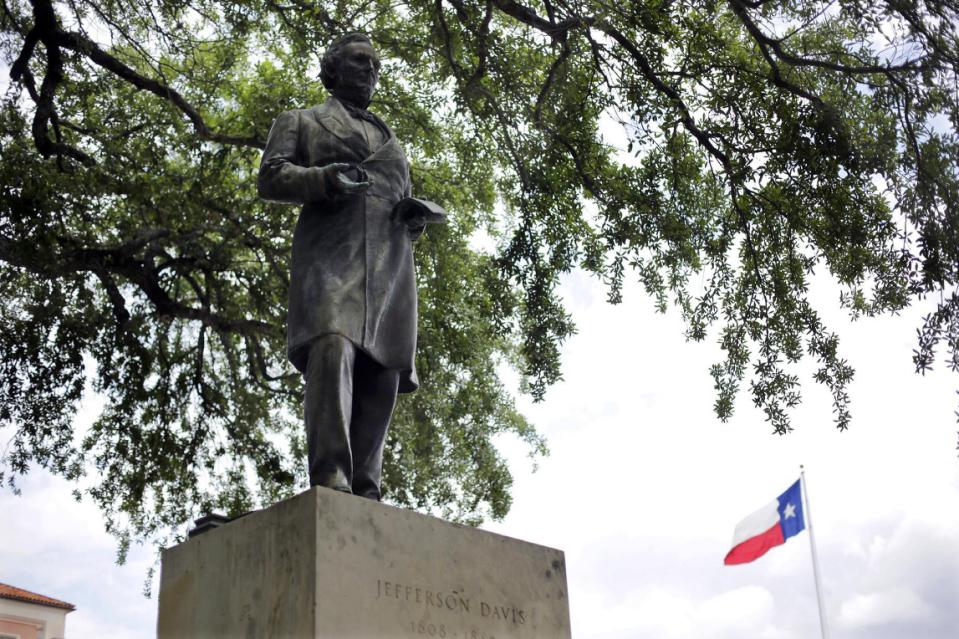
Texas students take aim at Jefferson Davis campus statue – Yahoo News
Apparently there are “more than 1,000 sites in the state that memorialize the Confederacy — from a Confederate cemetery in San Antonio and marker honoring Gen. Lawrence ‘Sul’ Ross at Sul Ross State University in Alpine to a building in Marshall that housed the Civil War State Government of Missouri in exile.” Unbelievable!!
Texas students take aim at Jefferson Davis campus statue – Yahoo News.

A statue of Jefferson Davis is seen on the University of Texas campus, Tuesday, May 5, 2015, in Austin, Texas. As University of Texas administrators consider a request to remove a statue that symbolizes the Confederacy, the number of memorials in Texas honoring the Confederate cause and its leaders continues to grow. (AP Photo/Eric Gay)
Review of Barry Eichengreen’s “Hall of Mirrors: The Great Depression, the Great Recession, and the Uses – and Misuses – of History” |History News Network
“What Was on the Minds of the Big Three at Potsdam?” |History News Network
History News Network | What Was on the Minds of the Big Three at Potsdam?
“What’s the Point of a Professor?” – NYTimes.com
Given the recent attacks on higher education, and the humanities in particular, Mark Bauerlein’s query (“What’s the Point of a Professor?”) is timely.
Reflecting on his own undergraduate education Bauerlein claims, “In our hunger for guidance, we were ordinary. The American Freshman Survey, which has followed students since 1966, proves the point. One prompt in the questionnaire asks entering freshmen about ‘objectives considered to be essential or very important.’ In 1967, 86 percent of respondents checked ‘developing a meaningful philosophy of life,’ more than double the number who said ‘being very well off financially.’ Naturally, students looked to professors for moral and worldly understanding.” This obviously no longer describes undergraduate attitudes. As Bauerlein notes, “finding meaning and making money have traded places. The first has plummeted to 45 percent; the second has soared to 82 percent.”
These changing attitudes have been at the root of the challenges to higher education and they threaten to transform it into a worker program. The stakes couldn’t be higher, but rather than address the larger issues that are driving the changes that he laments, Bauerlein lays the burden of turning the tide on professors. While I agree that we “can’t become a moral authority if you rarely challenge students in class and engage them beyond it,” this alone will not restore the prestige of professors or higher education.
Read the entire article here: