“Is Vladimir Putin an Ideologue, Idealist, or Opportunist?” | History News Network

The answer might surprise you. Walter G. Moss argues that Putin is more of an opportunist, but that he also “hold[s] some basic conservative beliefs and is willing to use various means to trumpet them.” Read his entire article here:

History News Network | Is Vladimir Putin an Ideologue, Idealist, or Opportunist?

"Putin laying wreaths at a monument to the defenders of Sevastopol in World War II, 9 May 2014 (www.kremlin.ru)"

“Putin laying wreaths at a monument to the defenders of Sevastopol in World War II, 9 May 2014 (www.kremlin.ru)”

“Same-sex marriage: Supreme Court Justices don’t know much about history” – LA Times

Michael Hiltzik, in the LA Times, rightly scolds some of the Supreme Court Justices for their ignorance of history. During the arguments about same-sex marriage at the Supreme Court last week, Chief Justice John Roberts declared, “Every definition that I looked up, prior to about a dozen years ago defined marriage as unity between a man and a woman as husband and wife.” As Hiltzik points out, “He must not have looked very far.” The historical record is very clear that marriage “[i]n definition and practice…has evolved and devolved to meet economic and political demands, shifting cultural norms and biological imperatives. The mandate of procreation to preserve the human race has always been part of the definition of marriage, certainly, but rarely the only goal or, in some cases, even the principal one.” Read the entire article here:

Same-sex marriage: Supreme Court Justices don’t know much about history – LA Times.

supreme-court-samesex-marriage 2015

Ronald Reagan Would Have Loved Rory Kennedy’s “Last Days in Vietnam” |History News Network

Last month PBS aired a documentary on the evacuation of Saigon as the North Vietnamese closed in. I just recently watched it and I was captivated by this part of the Vietnam era that I knew so little about. But knowing so little about this episode I wasn’t sure how accurate the story was. The reviews were mostly positive. The New York Times called it “concise and gripping.” Stephani Merry from The Washington Post described the documentary as being “like an intricate piece of woodwork. It’s painstakingly crafted, sturdy and incredible to look at.”
But Ron Briley, reviewing the documentary for the History News Network, took a more critical view of film. He claims that it as a heroic version of events, missing the broader context of American brutality. He ruefully declares that “the harsh reality of the Vietnam War was far more complex, and commemorating the conflict by depicting the war as a noble cause in which Americans were saving the Vietnamese people from communism does little to help the nation cope with what really happened to America and its ideas in the jungles of Southeast Asia. Last Days in Vietnam is an intriguing look at the fall of Saigon, but it is often quite misleading in its larger depiction of the Vietnam War and its meaning.”
I agree that the larger context is important, but I would still recommend watching the documentary. It raises important questions about how we engage with the world, especially in the places where we bear some level of responsibility for the chaos and violence. In Saigon the Americans were forced to leave behind many Vietnamese who had loyally served them. This is the same issue that we in Iraq and Afghanistan, in addition to many others. What obligation do we owe to those foreign nationals that have made great sacrifices and risked their own lives to help us?

History News Network | Ronald Reagan Would Have Loved Rory Kennedy’s “Last Days in Vietnam”.

Last Days in Vietnam

Here’s amazing color footage of Berlin from just after the Nazis were defeated – Yahoo Finance

This incredible footage of Berlin in the aftermath of WWII!

Here’s amazing color footage of Berlin from just after the Nazis were defeated – Yahoo Finance.
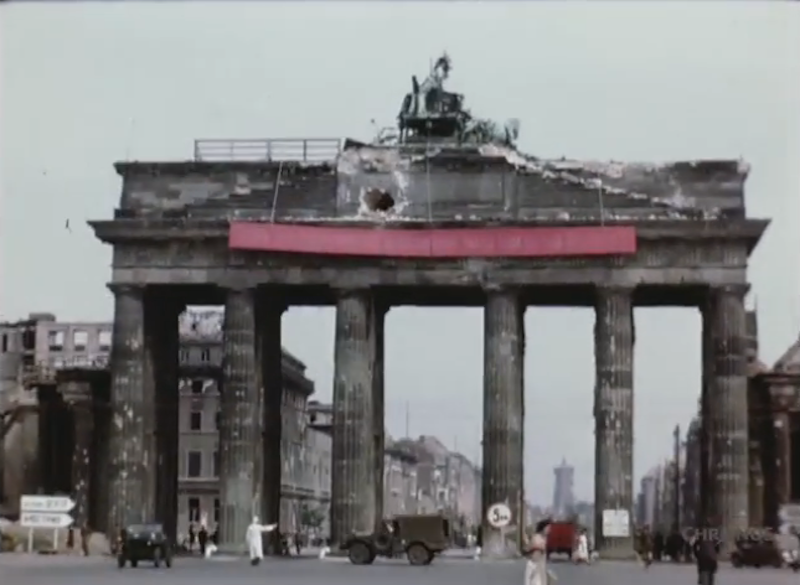
berlin in aftermath of WWII

“Remembering our Greatest Mission” | History News Network

William Lambers marks the anniversary of the U.S. air drop of food to the Netherlands (May 1945) with a plea to help the civilians trapped at the Yarmouk refugee camp near Damascus: “As we mark the anniversary of the great World War II mission that saved the Netherlands, we must keep that spirit alive. They are starving people today that are days way from death unless food can be brought to them. We, the international community, need to summon every ounce of strength and determination to help save them. That is our mission.” Read the entire article here:

History News Network | Remembering our Greatest Mission.

air drop to the Netherlands May 1945

The Consequences of Ignoring the Lessons of History: “Stand Your Ground Makes No Sense” – NYTimes.com

What has been the impact of the “Stand your Ground” laws since their enactment? This is the subject of an article in The New York Times today. After examining several new studies on the subject, Robert J. Spitzer concludes that “[n]ot only have these laws failed to increase public safety, they have also turned the clock back to the mythologized mayhem of the Wild West.” And he points out, “We’ve learned this lesson before, in our own violent past, when strict regulation of concealed gun carrying was the near-universal and successful response to gun violence. As early as 1686, New Jersey enacted a law against wearing weapons because they induced ‘great Fear and Quarrels.’ Massachusetts followed in 1750. In the late 1700s, North Carolina and Virginia passed similar laws. In the 1800s, as interpersonal violence and gun carrying spread, 37 states joined the list. Tennessee’s 1821 law fined ‘each and every person so degrading himself’ by carrying weapons in public. Alabama’s 1839 law was titled ‘An Act to Suppress the Evil Practice of Carrying Weapons Secretly.’ Why must we relearn a lesson we codified centuries ago? How dumb are we?” It’s unlikely that these laws will be repealed any time soon. Evidence means little to the NRA and its zealous followers.

Stand Your Ground Makes No Sense – NYTimes.com.

John-Patrick Thomas, The New York Times (May 4, 2015)

John-Patrick Thomas, The New York Times (May 4, 2015)

“Two Things You Don’t Know About Roe v. Wade that Will Surprise You” | History News Network

James Robenalt, in his new book January 1973, argues “that this controversial change in how the case was decided had a dramatic impact on American politics. The Roe decision activated the so-called Religious Right. But more importantly, because abortion is an issue about which many will not compromise—it is a life and death decision to some—the whole concept of “no compromise” as a political strategy entered our political bloodstream. Along with the other great events of January 1973—Truman’s death, end of the Vietnam War for the US, Watergate burglars’ trial, Nixon’s Second Inaugural, Roe and the death of Lyndon Johnson (on the same day as Roe)—the conditions set up for a government of deadlock.” To find out the two things about Roe that will surprise you, read his article:

History News Network | Two Things You Don’t Know About Roe v. Wade that Will Surprise You.

January 1973

“How Did Asians, Long Reviled, Become America’s Model Immigrants?” |History News Network

This is interesting:

History News Network | How Did Asians, Long Reviled, Become America’s Model Immigrants?.

The Good Immigrant