“What Does Marriage Equality Have to Do with Dred Scott?” – The New Yorker

Many of those who object to the Obergerfell ruling have compared it to the disgraceful Dred Scott (1857) decision that declared that even free blacks could not be citizens and that the Missouri Compromise was unconstitutional thus effectively nullifying the idea of slave free states. Amy Davidson debunks this flawed analogy in a discerning article at The New Yorker.  The analogy basically fails because “Dred Scott constrains liberty and Obergefell expands it,” but Davidson further breaks down the failures of this analogy by diving deeper into the Scott case. Thus Davidson’s exposé is also a reminder of the shameful racism that is part of our historical legacy.

Why are some using this analogy? Davidson concludes, “In part, Dred Scott is simply being used to give Obergefell a bad name—as pure invective, another way to call the decision rotten and the Supreme Court deluded. This is low enough; Dred Scott is a truly degraded decision, in a way that no other of the Court, conservative or liberal, has since matched. And, in part, the analogy reflects the notion, held by some contemporary conservatives, that they are now the ‘real’ victims of bigotry.”

Read the entire article here: What Does Marriage Equality Have to Do with Dred Scott? – The New Yorker.

 Eliza and Lizzie Scott, children of Dred Scott. Credit Image by Getty/MPI

Eliza and Lizzie Scott, children of Dred Scott.
Credit Image by Getty/MPI

Srebrenica: Twenty Years after the Genocide, Have we Learned Anything?

I doubt it. Many Americans don’t know anything about the Bosnian War (1991-1995) much less Srebrenica. And if they did they would likely be baffled by the confusing mix of ethnic and religious groups, and conclude, like we did during the conflict, that there is nothing we can do! In addition, our focus, in terms of foreign policy, has been taken over by the troubles in the Middle East. At the time of I don’t think we ever learned them, but it’s never too late to learn something. Therefore, it is worth remembering what happened in Srebrinica.

On this day twenty years ago the Bosnian Serb Gen. Ratko Mladić entered the U.N. declared “Safe Area” at Srebrenica, where thousands of Bosnian Muslim refugees had sought safety. No one thought that the Serbs would dare attack a U.N. “safe area” while the world was watching, but Mladić knew that the Dutch U.N. soldiers could do nothing. They were there to protect the Bosnian Muslims, yet their mandate only allowed them to use their weapons in their own defense. This situation was the result of the reluctance of Western nations to risk their own soldiers’ lives in defense of others.

After negotiations, Mladić was able to manipulate the U.N. into paying for the gas for buses that would, unbeknownst to the U.N., be used to take only the women out of Srebrinica. They had something else in mind for the men. Even before the Dutch soldiers had gone the Serbs separated the men from the women. However, they made sure that the Dutch would not see the killing, and therefore sent them on their way before the real killing began. In the end, they massacred approximately 8,000 Muslim men.

bosnia-srebrenica-warcrimes-genocide-commemoration-1

The point of the massacre, and those at other “safe areas,” was to ethnically cleanse (a term the Serbs coined themselves) the remaining Muslim enclaves in pursuit of their dream of a Greater Serbia that was free of all non-Serbs. Ironically, this massacre and the “cleansing” of the other safe areas opened the way for a peace agreement that was signed on December 14, 1995 in Dayton, Ohio. Continue reading

Confederate flag comes down at South Carolina legislature – Yahoo News

It should have never been there! But getting rid of this horrible symbol of hate is not enough. We need to work on getting rid of the real hate and the remaining prejudices that perpetuate inequality and discrimination.

Confederate flag comes down at South Carolina legislature – Yahoo News.

No more confederate flag

Texas officials: Schools should teach that slavery was ‘side issue’ to Civil War – The Washington Post

“Five million public school students in Texas will begin using new social studies textbooks this fall based on state academic standards that barely address racial segregation. The state’s guidelines for teaching American history also do not mention the Ku Klux Klan or Jim Crow laws. And when it comes to the Civil War, children are supposed to learn that the conflict was caused by ‘sectionalism, states’ rights and slavery’ — written deliberately in that order to telegraph slavery’s secondary role in driving the conflict, according to some members of the state board of education.” This is what happens when politically motivated Schools Boards determine what children will learn. You may recall the kerfuffle over the Texas state curriculum standards in 2010 and the textbooks in 2014 that led to this version of the Civil War appearing in Texas social studies textbooks. (see previous posts on this subject here and here)

The belief that the Civil War was about states’ rights not slavery might be comforting to some, but that feeling comes at the cost of truth, justice, progress, and everything we hold dear as a nation. How can students understand the present if they have been mislead about the past?

Texas officials: Schools should teach that slavery was ‘side issue’ to Civil War – The Washington Post.

civil-war-confederacy

Bob Peterson: What Scott Walker Will Do to Public Education

This is not surprising, but it is bad news for Wisconsin!

dianeravitch's avatarDiane Ravitch's blog

Bob Peterson describes what Scott Walker intends to do to public schools and higher education in Wisconsin. Since he plans to run for the Republican nomination for President, it is important to know his views on education.

He is a zealot for school choice and privatization. He doesn’t like public schools or universities. He thinks that taxpayers should foot the bill for religious education. He believes that the purpose of education is workforce training. He is contemptuous of liberal learning. He is proud of his disdain for free inquiry and the pursuit of knowledge.

Peterson writes:

“Buried within the budget are 135 non-budget policy items — a toxic cocktail of attacks on public education, democracy, environmental protections and labor rights.

“For Wisconsin’s schools, the budget is a blueprint for abandoning public education. In Milwaukee, in addition to insufficient funding, the budget includes a “takeover” plan that increases privatization and decreases…

View original post 195 more words

“The Persistence of Myth in Southern Politics and Life”|History News Network

Ron Briley explores the reasons and consequences of the mythic narratives that perpetuate the sense of southern victim hood. “The notion that the Civil War and Reconstruction were foisted upon a defenseless South by a tyrannical central government retains considerable influence in a Southern ideology of persecution…Whether it is lowering the Confederate battle flag, mandating individuals to purchase health insurance, acceptance of gay marriage, or discussions of gun control legislation, there is a siege mentality for many in the South that their way of way in endangered. The region continues to rank at the bottom of most economic indicators dealing with health care, education, and levels of poverty, yet the Confederate flag promotes a legacy of racism that prevents impoverished blacks and whites from establishing common ground.”
Read Briley’s insightful essay on southern politics:

History News Network | The Persistence of Myth in Southern Politics and Life.

kkk-initiation

“Two Cheers for the Middle Ages! by Eric Christiansen” | The New York Review of Books

In his review of three new books* on the Middle Ages, Eric Christiansen challenges the popular belief that the Middle Ages were dark. He claims that it is an unfair characterization of the Medieval period, “because it has been found again and again that our skills, laws, liberties, nations, and languages are the result of hard work in the millennium reputed dark, unlit by reason, and recessive from the sunshine of the classical civilizations, when perfectly formed philosophers sat debating in public colonnades, monk-free.” But, of course, not all was sunshine and roses!

Read Christiansen’s review here:

Two Cheers for the Middle Ages! by Eric Christiansen | The New York Review of Books.

Musée Condé, Chantilly, France/Bridgeman Images A country household in winter representing the month of February in the duke of Berry’s Book of Hours, by the Limbourg brothers, circa 1412–1416

Musée Condé, Chantilly, France/Bridgeman Images
A country household in winter representing the month of February in the duke of Berry’s Book of Hours, by the Limbourg brothers, circa 1412–1416

* The Middle Ages by Johannes Fried; 1381: The Year of the Peasants’ Revolt by Juliet Barker; and Dark Mirror: The Medieval Origins of Anti-Jewish Iconography by Sara Lipton

Thomas Piketty Gives Merkel a History Lesson

The economist Thomas Piketty, who gained fame last year as the author of Capital in the Twenty-First Century, reminds Merkel, “It was in the 1950s, he notes, that Germany benefited from a massive — and, in those days, surprisingly common — round of debt forgiveness that catapulted its rise into a peaceful economic power. Greece was one of the nations forgiving Germany’s debts. In other words, Piketty suggested, when it comes to how to handle Greece in 2015, the best argument against Germany might be … Germany, circa 1953.” Piketty is right, of course, but I doubt Angela Merkel will change her stance. She seems determined to punish Greece even if it makes things worse not just for Greeks, but for all of Europe.

Read Piketty’s history lesson here:  Thomas Piketty accuses Germany of forgetting history as it lectures Greece – The Washington Post.

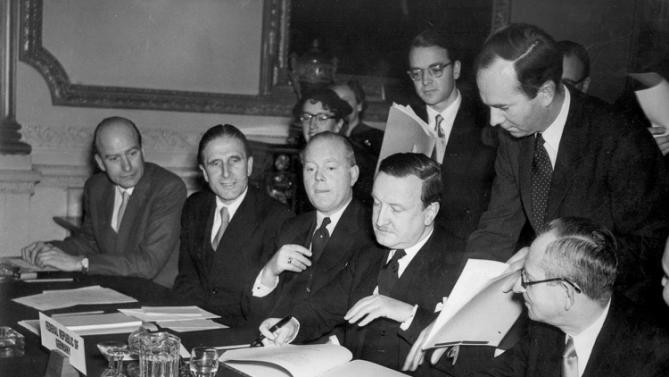
“FILE – In this Feb. 27, 1953 file photo, the German Debts Agreement is signed in London. Though Germany is resisting Greece’s pleas for some relief, it should know better than most what it can achieve. After the hell of World War II, the Federal Republic of Germany – more commonly known as West Germany – got massive help from its former foes, among them Greece. The agreement, in which Greece and about 20 other countries effectively wrote off a large chunk of Germany’s loans and restructured the rest, is a landmark case that shows how effective debt relief can be. It helped spark what became known as the German economic miracle. (AP Photo, file)”

“The Lesson of the Fall of the Roman Republic We Ignore at Our Peril” History News Network

Comparisons between Rome and the West (or the United States) are ubiquitous. Most are based on simplistic, superficial analogies used to warn of the demise of the West. These comparisons are almost always undertaken to serve ideological ends. A quick review of the youtube videos on this topic confirm this assertion. This type of speculation isn’t very surprising coming from non-experts bent on confirming their ideological predilections, but such superficial comparisons are not expected from experts. Historians cringe at the simplistic comparisons frequently found in popular culture. Unfortunately, the historian Richard Alston is not one of those historians (at least not in this article). Based on a simplistic reading of imperial Rome, Alston concludes, “In our modern attempts at state building, we must remember that for most people, the issue is not so much whether you like the rulers, but whether the regime will feed you and protect you. In the modern West, we assume loyalty to the state and thus fail to consider how states can secure the loyalty of their people. Rome’s revolutionaries reduced politics to its simplest form. They killed their enemies and rewarded their supporters; they fed the people and paid the soldiers. It is a recipe for success that we would do well to relearn.” What a sad, cynical, and ultimately incorrect assessment of the human condition. If things are really bad this kind of regime may be, and usually is, a welcome change, but I don’t think this kind of regime is one that human beings will ultimately settle for. I know I won’t!

History News Network | The Lesson of the Fall of the Roman Republic We Ignore at Our Peril.

rome

Social Darwinism: “When Libertarianism Became an Excuse for Plutocrats” Part II, History News Network

In part II of his series on libertarianism, Richard Striner reviews the role of Social Darwinism. Before delving into the history Striner reminds his audience that “Darwin himself —— a fervent humanitarian and opponent of slavery —— got a bum rap in this association, since he neither coined the term ‘survival of the fittest’ nor advocated a social system based upon ruthless competition. Both the term ‘survival of the fittest’ and the doctrine of dog-eat-dog competition were promulgated by the British philosopher Herbert Spencer.” It is unfortunate that Darwin’s name became associated with this movement, because it has led to so much confusion about Darwin and his theory of natural selection. The movement should be called “Social Lamarckianism” since it was Lamarck’s theory that was the basis for Spencer’s theory that became known as Social Darwinism. But Darwin’s name was much more useful than the long forgotten Jean-Baptiste Lamarck (1744-1829). [For a great book on the relationship between Darwin’s theory of natural selection and the subsequent rise of Neo-Lamarckianism see Peter J. Bowler’s The Eclipse of Darwinism.]
After reviewing this history my students still get this wrong on their exams. The belief that Darwin came up with both Social Darwinism and the term “survival of the fittest” persists no matter how many time I remind my students that it was Herbert Spencer (1820-1903), after all Darwin’s name is in the title!
Read part II of Stringer’s series here:

History News Network | When Libertarianism Became an Excuse for Plutocrats.

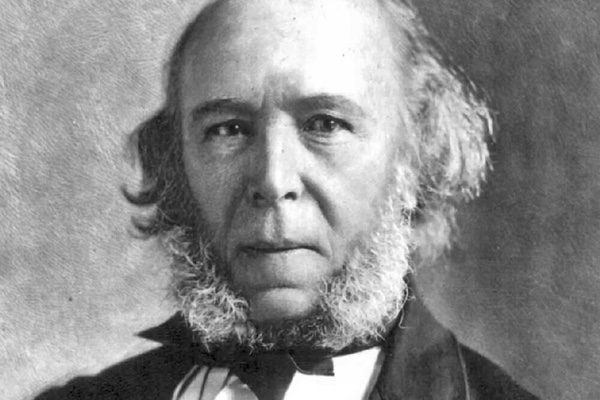
Herbert Spencer

Herbert Spencer, proponent of Social Darwinism who coined the phrase “survival of the fittest”