“The 100th Anniversary Funeral for ‘The Birth of a Nation'” | History News Network

Have you ever heard of the movie The Birth of a Nation? Me either! After reading Bruce Chadwick’s summary of the movie and watching snip-its from the 1915 film I now know why. It’s a blatantly racist film filled with stereotypes and outright falsehoods. (spoiler alert: the heroes of the movie are the KKK!!) But it was a hit at the time, becoming “one of the most financially successful films of all time.” The success of the movie says a lot about the mind-set of Americans in the early twentieth century. It’s also a testament of how far we have come even as we still have a long ways to go.

Chadwick thinks we should “bury” the movie, relegating it to the dust bin of history. While I think it is a vile movie, I think we can learn from it. It should cause us to reflect on our own willingness to accept stereotypes and myths that, while comforting to some, may be completely false. We are just as vulnerable to mythic narratives that cast ourselves as heroic and others as depraved as were our ancestors.

Today’s racism may not be as overt as it was in the twentieth century, but it is still there. Most of us aren’t racist (or don’t want to be racist), but we are vulnerable to the stereotypes that we are bombarded with in the media. The stereotypes are often subtle but nevertheless very real. Because it is so subtle we are often unaware it. These prejudices play out most visibly in our criminal justice system, where blacks are disproportionately arrested and convicted for crimes that are just as prevalent in white populations. Many of the cops, but not all, are probably being honest when they claim that they aren’t racist. Even well-meaning individuals act in ways that reflect the subtle prejudices that are the result of years of exposure to portrayal of blacks as criminals in the media and movies. A lot of research in psychology backs up this claim.

So, let’s celebrate our progress, but let’s also not forget that we have more work to do.

Read Bruce Chadwick’s history of this movie here:

History News Network | The 100th Anniversary Funeral for “The Birth of a Nation”.
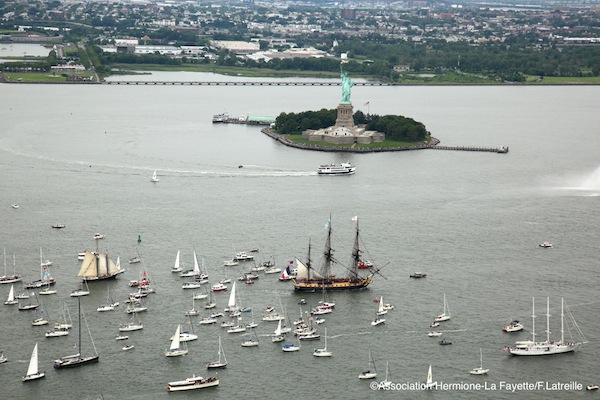
 

“Lafayette’s Second Voyage to America: Lafayette and l’Hermione” | Journal of the American Revolution

A replica of the tall ship L’Hermione leads a parade of ships to New York harbor. It was a fitting ceremony on the anniversary of American independence, and a reminder of the debt we owe to the French for our independence.

The original ship arrived in Boston on April 28, 1780 with the hero of the American Revolution, the Marquis de Lafayette. He brought news of France’s financial and military support for the Revolution. Lafayette first came to America in 1777 and fought bravely for the American cause, most famously at the Battle of Brandywine (September 11, 1777).

Read the story of the original ship and Lafayette’s voyage here:

Lafayette’s Second Voyage to America: Lafayette and l’Hermione | Journal of the American Revolution.

la fayette's ship in NY

Replica of the tall ship L’Hermione

John Leland’s Speech on the Fourth of July 1824: Continuing the Struggle for Religious Liberty

As one of the most significant religious dissenters in the fight against all religious establishments the Baptist preacher John Leland’s speech at Pittsfield, Massachusetts is particularly revealing. Almost two hundred years later his insights are just as relevant as they were in 1824. In the speech he attacked the remaining religious establishments in Massachusetts (a tax for the support of religion, Sunday laws, and other discriminations in law that privileged one religion or denomination over another). He, therefore, proposed the following amendment into the Massachusetts Declaration of Rights:

“The legislature have no right, and shall assume no power, to establish any religion – force any man to support any — give one religious sect any preference to another – proscribe any man for heresy – appoint any holy days for worship – compel any man to attend public worship, or cease from labor – give any legal reward for religious services, or require any religious test to qualify for office.”

In conclusion he reviewed Massachusetts sad history of religious oppression to support his claims against religious establishments:

“Almost two centuries past Roger Williams was ejected from Salem, and banished from Massachusetts, for contending for the same doctrine – that rulers, in their official capacity, had nothing to do with religion. The contrary opinion prevailed in the colony [Massachusetts]– that legislatures had a divine right to prescribe religion of the people; and, that magistrates had the same right to judge of doctrines and their tendencies. This claim occasioned the Baptists to be whipped, the Quakers to be hanged, and the witches to be gibbeted. Admit of the principle, that religious opinions are objects of civil government, or in any way under its control, and the broad stair is laid in the case that leads to the inquisition. Admit of the principle, and the rights of the people rest upon the good will of the legislature, and the benevolence of towns; whereas, they ought to rest upon a footing, out of the reach of the ill will of the legislature, and the malevolence of towns. Though the tree may be hewn down, yet, the just liberty of the people is not secure, while the stump is preserved with a band of iron and brass.
….
I close, by observing that here is an arm seventy years old, which, as long as it can rise to heaven in prayer, or wield a pen on earth, shall never be inactive, when the religious rights of men are in jeopardy.”

For more on Leland see my early post on him.

John Leland

John Leland, The Writings of the Late Elder John Leland: Including Some Events in His Life, edited by L.F. Greene (N.Y. 1845), pp. 506-7.

“The case for finally building a memorial to James Madison”

Michael Signer, author of Becoming Madison, makes a great case for a memorial to honor our fourth president James Madison. For me it’s an easy sell. I’ve spent the last six years studying Madison’s substantial contributions to the struggle for religious liberty. But Madison’s contributions to the government and character of the United States goes way beyond this important right. Here’s just part of his impressive resume:

– He served in the Virginia Convention (1776) that created Virginia’s first constitution, where he made a major contribution to the future of religious liberty in Virginia (see earlier post on this topic).

– He served in the Continental Congress from 1780 to 1783

– He served in the Virginia House of Delegates (1784 to 1786), where he successfully defeated Patrick Henry’s bill for a general assessment to support teachers of the Christian religion and pushed through the passage of Jefferson’s famous Statute for Establishing Religious Freedom.

– In the fight against Henry’s assessment bill, he wrote the Memorial & Remonstrance Against Religious Assessments (1785), one of the most impressive statements in defense of religious liberty.

– He was the primary mover and author of the Constitution, earning him the designation as the Father of the Constitution (see earlier post on this topic)

– He wrote 29 of the Federalist papers in defense of the Constitution (John Jay wrote 5, and Hamilton wrote the remaining 51)

– He was also the primary mover and author of the amendments that became the Bill of Rights, making him also the Father of the Bill of Rights

– He served in the House of Representatives from 1789 to 1797

– He served as Secretary of State in the Jefferson administration

– He served as President of the United States from 1809 to 1817

And those are only his main accomplishments! So why is there no memorial in his honor? In light of his accomplishments it’s hard to understand why he has been denied this honor, but the most obvious answer is that he was overshadowed by the prominent profiles of the war hero (Washington) and the author of the Declaration of Independence (Jefferson).  In contrast to the tall and manly Jefferson and Washington, Madison was slight and timid. But as Signer points out, this is actually one of his strengths. “Indeed, in contrast to contemporaries like Jefferson, Washington, Hamilton, Franklin and Adams, who were constantly seeking to polish their legacies in an epochal time, Madison seemed to try to disappear into the background. It is the cruelest of ironies that history rewards a truly selfless leader by, well, ignoring him.”

Madison was not perfect, but neither is anyone else. “But think of what this true story offers: for a time of unbearable shallowness, depth; for a time of false heroes, reality; for a country grappling to rediscover leadership, a statesman.” It’s time to give Madison the memorial he deserves.

The case for finally building a memorial to James Madison.

James_Madison

The Current “Crises” in Higher Education

In this post Dr. Kich exposes the flaws in the assumptions about higher ed as presented by James Baar. It also serves as a critique of some of these same assumptions that are often passed off as fact in the media.

martinkich's avatarACADEME BLOG

In an op-ed published by the Providence Journal in Rhode Island, James Baar identifies “Four Crises That Dog Higher Education”:

1. Inflation of product cost.

2. Deflation of product value.

3. Enablement of social and moral dissolution.

4. Lower-priced, knockoff and fraudulent competition.

Given the space constraints on most op-ed pieces, Baar addresses each of these topics fairly succinctly. So, I suspect that if he had more space, he might have been able to address somewhat articulately at least some of the concerns that I am about to express.

First, I don’t believe that anything can be dogged by a crisis. A crisis is the climax of an escalating situation; it is not a condition. And the word “dogged” suggests an extended condition. But perhaps some editorial assistant, rather than Baar himself, is responsible for the headline.

Second, I don’t think that it is either accurate or helpful to assert…

View original post 1,150 more words

“This Is Where Libertarianism Gets Its Ideas from” | History News Network

In the first of a three-part series, the historian Richard Striner traces the roots of libertarian ideology. He writes, “The cultural, intellectual, and political history of libertarianism spans at least two centuries. And several of the twists in the emergence of this ideology are surprising —— even strange.”

Based on Striner’s summary of the origins libertarianism, he’s right that some sources are “surprising,” but I don’t know about “strange.” Read the first part in this series here: History News Network | This Is Where Libertarianism Gets Its Ideas from.

no government