Some of you might find this interesting: History News Network | Did the Pentagon Learn from Vietnam?

Some of you might find this interesting: History News Network | Did the Pentagon Learn from Vietnam?
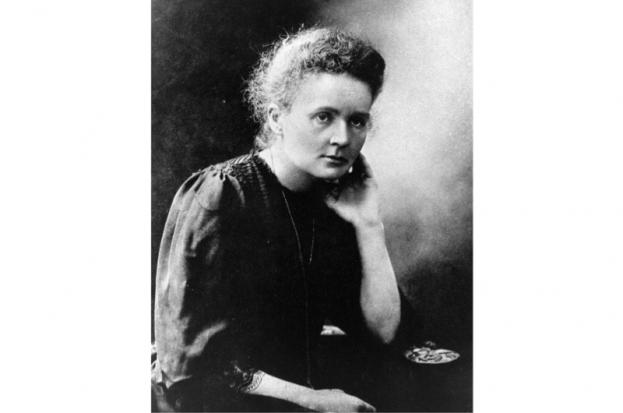
If you don’t know anything about Marie Curie, I would recommend reading this article in History Extra. She really was a pioneer in science!
Life of the Week: Marie Curie | History Extra.
Here’s a fun quiz on the American Revolution (although some of the questions seem obscure): How much do you know about the American Revolution? | OUPblog.
Good luck!

Yesterday was the first day of classes at ASU and I spent most of that day trying to explain to my students why studying history is important. Most of them are freshmen and are taking the course as a requirement, so I’m not sure how successful I was. But I’ll keep trying.
I know what you’re thinking. What does this have to do with “Drift and Disorder in World Affairs”?
Polk identifies other important factors that contribute to the drift and disorder of the world, but I find this one particularly compelling. We cannot change what kind of leaders we get if we don’t first change ourselves. We all need to take our responsibilities as citizens of the U.S. and the world more seriously.
Please read Polk’s thought-provoking piece: History News Network | Coping with the Sense of Drift and Disorder in World Affairs, Part 1.

Very interesting!
Expert with new theory on Nefertiti’s tomb invited to Egypt – Yahoo News.

FILE – In this Oct. 15, 2009 file photo, a 3,300-year-old bust of Queen Nefertiti is seen at the New Museum, in Berlin, Germany. Egypt’s Antiquities Ministry announced Wednesday, Aug. 19, 2015, that it is inviting an Egyptologist behind a theory that the tomb of Queen Nefertiti may be located behind King Tutankhamun’s 3,300-year-old tomb in the famed Valley of the Kings. British-educated expert Nicholas Reeves has been invited to Cairo in September to debate his theory with Egyptian colleagues. (AP Photo/Markus Schreiber, File)
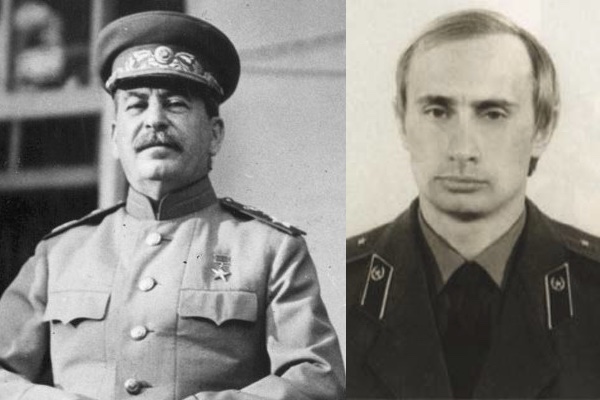
Walter G. Moss proposes that “[a]ny effective U.S. foreign policy must not just vilify leaders, whether Saddam Hussein or Putin, but recognize and try to understand why so many foreign citizens think differently than we do.” I half agree with him. We too often fail to take into account the views of other peoples in formulating our foreign policy. If our foreign policy is to be effective we must understand how others view the world and their place in it. However, I disagree with Moss’s contention that we should not “demonize” the leaders that they admire. Well, maybe we shouldn’t demonize them, but we should call them out for their outrageous behavior.
I would still recommend reading Moss’s article. He makes some good points concerning the history of our foreign policy. History News Network | We Need to Come to Terms with the Russian People’s Support Today of both Stalin and Putin.
What is the purpose of higher education? To create informed, critical thinkers who are engaged, thoughtful citizens? To create workers based on the needs of the market?
The latter reflects the thinking of the new neoliberalism, which now enjoys a broad popularity. The neoliberalist view of higher education is no longer just rhetoric. Colleges and universities have been transforming themselves for at least the last twenty years in alignment with this ideology. William Deresiewicz delves into the troubling consequences of this type of higher education on our society.
Deresiewicz defines neoliberalism as “an ideology that reduces all values to money values. The worth of a thing is the price of the thing. The worth of a person is the wealth of the person. Neoliberalism tells you that you are valuable exclusively in terms of your activity in the marketplace — in Wordsworth’s phrase, your [sic] getting and spending.”
Alternatively, he asserts, “we need to treat it [education] as a right. Instead of seeing it in terms of market purposes, we need to see it once again in terms of intellectual and moral purposes. That means resurrecting one of the great achievements of postwar American society: high-quality, low- or no-cost mass public higher education. An end to the artificial scarcity of educational resources. An end to the idea that students must compete for the privilege of going to a decent college, and that they then must pay for it.” I agree!
Please read Deresiewicz deliberative essay on this very important topic:
[Essay] | The Neoliberal Arts, by William Deresiewicz | Harper’s Magazine.
Here’s another worthwhile article on the subject of neoliberalism and education: “Organized Lightning: The liberal arts against neoliberalism.”

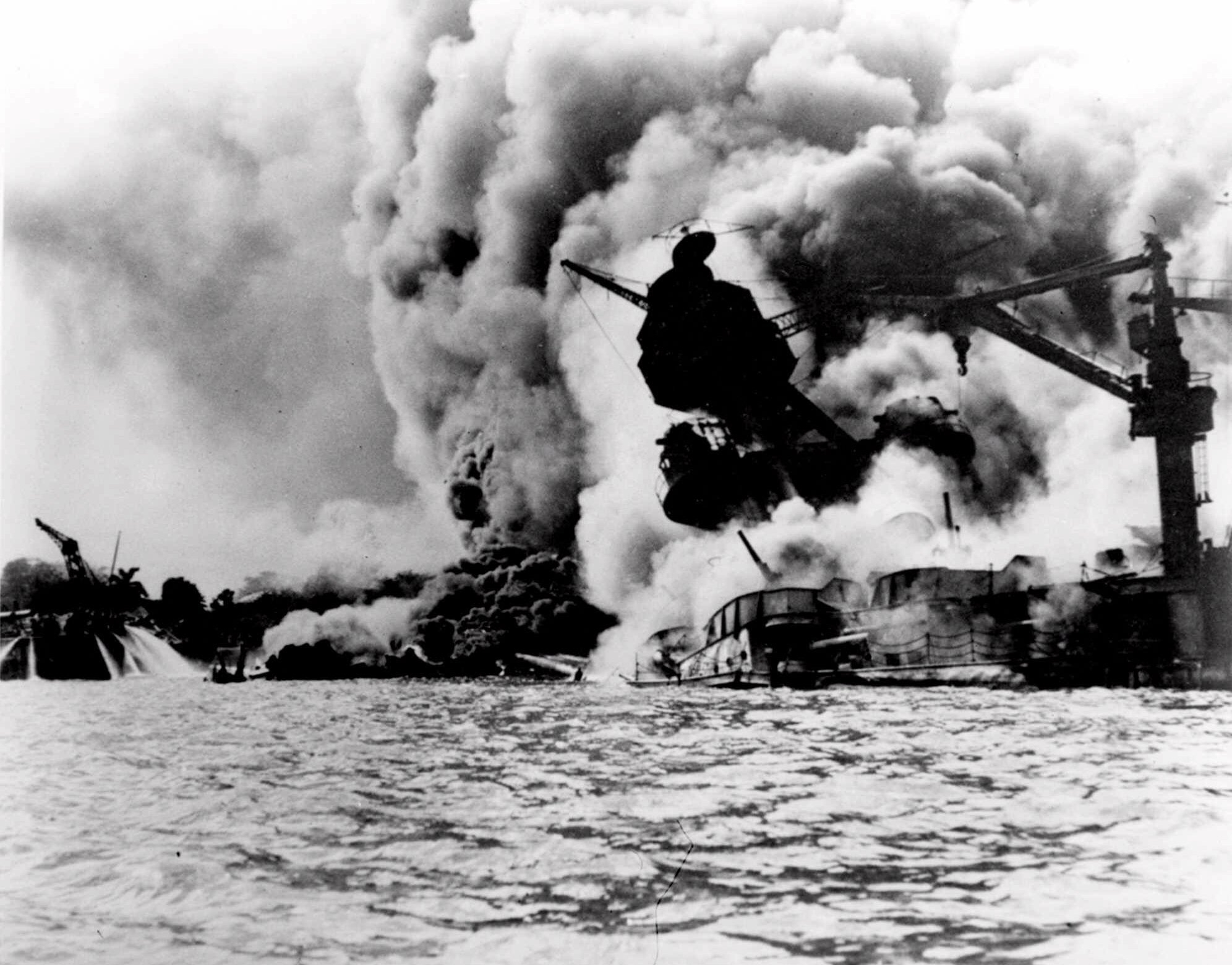
Brian Dunning respectfully examines the merits of the Pearl Harbor conspiracy theory that the American government knew about the attack and did nothing. In conclusion he states, “Even if this presumed conspiracy to allow the attack did exist, it failed to have any effect where the rubber meets the road. No orders from Washington altered the state of readiness at Pearl Harbor. Obviously the attack ultimately did play into the hands of anyone who wanted war with Japan; every tragedy somehow benefits somebody. That doesn’t make every tragedy a conspiracy.”
Read the entire article here: Attack on Pearl Harbor.
This video visually explores the numbers of casualties by nation. I’ve seen the numbers before, but this doesn’t have the same impact as seeing them presented visually in this video. It really brings home the vast differences in casualties by nation. Note the differences suffered by the U.S. in comparison to the Soviet Union.
While no one agrees on the exact number of deaths, the relative number of deaths shown in this video are comparable to credible estimates.
Thanks to HNN for the pointer: History News Network | This Animated Data Visualization Of World War II Fatalities Is Shocking.
In light of the earlier discussion on war crimes and apologies, here’s more on the consequences of Japan’s failure to apologize for (or recognize) its WWII war crimes: Japan’s way of remembering World War II still infuriates its neighbours.
“While Germany has managed to build holocaust education into its curriculum and is now at the centre of the European project, Abe and his predecessors have never acknowledged that relations with Korea and China would be greatly improved if there were a push for education and discussion about this terrible history. As things stand, no matter how the militaristic and nationalistic Abe handles the memory of the war in this anniversary year, Japan’s relations with its former adversaries are set to keep festering.”
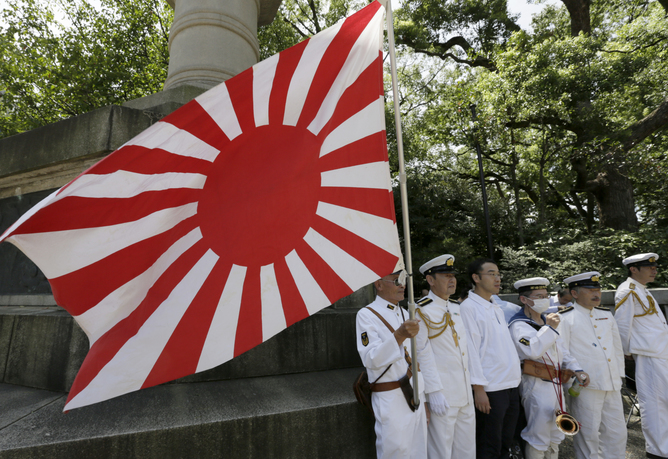
” Japanese people wearing imperial navy costumes raise a rising sun flag as they visit the controversial Yasukuni Shrine to mourn for victims of World War Two in front of a torii gate at the shrine, Japan, 15 August 2014, marking the 69th anniversary of the end of World War Two. More than 2.5 million Japanese soldiers who died in the service are enshrined at Yasukuni, including convicted war criminals from World War II.” EPA/KIMIMASA MAYAMA
 History Chick in AZ