“The strange, short career of Judeo-Christianity” | Aeon Opinions

It’s time to bury the charade of Judeo-Christianity. As Gene Zubovich points out, “The notion that the US is a nation bound together by civic principles enjoys a more distinguished history than the recently coined idea of the Judeo-Christian nation. It is also obvious that the US is more than a nation of many faiths. No wonder, then, that today Judeo-Christianity has few defenders apart from members of the Christian right, who use it to undermine the legitimacy of Muslims and the rapidly growing body of religiously unaffiliated Americans. The short career of Judeo-Christianity has already lasted too long.”

Read Zubovich’s brief overview of the history of this concept here: The strange, short career of Judeo-Christianity | Aeon Opinions

As Putin Zaps Lenin, Lavrov Hurriedly Rewrites History

“There is hardly any country history has been as utterly rewritten as Russia’s, from the tsars to communism…Indeed, like in the times of Russian tsars, emperors and general secretaries, the current Russian leadership’s real concern is great power status, which in the case of Russia, has always been achieved at the expense of its citizens’ prosperity.”

Source: As Putin Zaps Lenin, Lavrov Hurriedly Rewrites History

The ‘war on terror’ isn’t working – LA Times

Andrew Bacevich’s article at the Los Angeles Times is brief but smart. In contrast to the dominant voices calling for more bombing and even the use of torture, he proposes something different. His critique is historically informed and echoes what many scholars, including myself, have been advocating for a long time.

“What Americans refer to as terrorism is more accurately this: a violent outgrowth of chronic political dysfunction and economic underdevelopment affecting large parts of the Islamic world, exacerbated by deep-seated  sectarian divisions and the pernicious legacy of European colonialism and further complicated by the presence of Israel, all together finding expression in antipathy toward the West and especially the United States. For the “war on terror” to succeed, it will have to remedy the conditions giving rise to that antipathy in the first place.” Exactly!

Read the entire article here: The ‘war on terror’ isn’t working – LA Times

“Studying the 30 Years War Gives Me Hope about Our Religious Wars” | History News Network

Like the historian Wayne Te Brake I think the wars of religion that occurred in Europe during the sixteenth and seventeenth centuries can teach us something about the current conflicts in the Middle East. However, I have to disagree with his optimism concerning the current cease-fire in Syria.
Brake points to the well-known settlements to the European conflicts: “the Religious Peace of Augsburg (1555), the Edict of Nantes (1598), and the Peace of Westphalia (1648).”  While admitting that these were the result of a “grudging consent” rather than “the acceptance of explicit blueprints for a pluralistic future,” he sees in them hope for peace in the Middle East. This may be true in the long run, but the analogy between the current situation in Syria and the above peace settlements fails to take into account some important differences.
First, I think its’ important to note that the first two of the above peace settlements did not last. The breakdown of the Peace of Augsburg resulted in the Thirty Years War and the Edict of Nantes was revoked in 1685 by Louis XIV, unleashing a new rounds of violence. It was only after the idea of toleration was accepted as something desirable that we began to see permanent peaceful relations between the various religions in Europe. This is why Locke’s A Letter Concerning Toleration was so important. Locke was not the first, or the only person, to advocate in favor of toleration, but his influence in changing people’s attitudes about religious diversity that made him such an important figure in the West.
In the conflict zones of the Middle East today there are few, especially those in power, who are willing to accept even a grudging toleration. Without this there can be no lasting peace. The peace in Europe was enforced by powerful states, who despite not accepting toleration as a good were willing to enforce policies of toleration because it was in their interest to do so. The wars had taken such a toll in lives and treasure that a politique policy became necessary. This willingness, or even the ability, to follow a similar policy in Syria, the Islamic State, or Iraq is missing. And even if they get to the point of accepting a grudging toleration in the name of stability, it will not be permanent until there is a change in world view.

Read the entire article here: History News Network | Studying the 30 Years War Gives Me Hope about Our Religious Wars
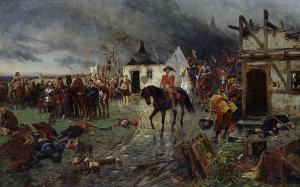
The Thirty Years War


The Thirty Years War

The Revenge of History: “The Theater of Violence” – The New York Times

We all say we want peace, but at the same time we unwittingly engage in behaviors that perpetuate violence. As philosopher Simon Critchley notes, “we are all players on history’s bloody stage.” Human nature is in large part to blame. However, biology is not destiny. The purpose of civilization is to tame our wilder side. Yet, we still have not been able to end the violence.

Critchley offers an important insight into this intractable problem: “We live in a world framed by violence, where justice seems to be endlessly divided between claim and counterclaim, right and left, freedom fighter and terrorist, believer and nonbeliever, and so on. Each side appears to believe unswervingly in the rightness of its position and the wrongness, or indeed ‘evil,’ of the opposition. Such belief legitimates violence and unleashes counterviolence in return. We seem to be trapped in deep historical cycles of violence where justice is usually simply understood as vengeance or revenge.”

This is not a new insight, but it one that is difficult to sell. If we were reflective enough, we would see this trap we’ve set for ourselves. This insight also requires a broad and deep knowledge of history.  It is much easier to offer simple solutions that satisfy our egos and our intuitions. The good vs. evil narrative is simple and it lets us off the hook for any wrongdoing. Savvy politicians know this and use it to their benefit.

Is there any hope then? Critchley offers art, and music in particular, as a solution. But I don’t think this is enough. It will take a much broader effort to convince enough people that we are in fact part of the problem. We also need leaders willing to take up the cause and inspire a new generation to see the world and our place in it differently.

Source: The Theater of Violence – The New York Times

Abusing History: “Dinesh D’Souza Claims in a New Film that the Democratic Party Was Pro-Slavery. Here’s the Sad Truth.” | History News Network


Dinesh D’Souza, true to form, comes out with another propaganda film. In order to discredit the current Democratic Party he using the Republican’s favor trope: claiming that the Democratic Party is the racist party because at one time it was the pro-slavery and racist party. Of course, they forget to mention that the parties basically traded positions on issues of race after LBJ’s signed civil rights legislation and the Republican party decided to expand their base by going after the disaffected southern Democrats in what is called their “southern strategy.” But this probably won’t matter to many conservatives who would love to believe that it’s the Democrats who are racist.

Read Michael Todd Landis’s review of the relevant history: History News Network | Dinesh D’Souza Claims in a New Film that the Democratic Party Was Pro-Slavery. Here’s the Sad Truth.

Ron Briley: I’ve Taught History for 40 Years. I’m Alarmed.” | History News Network

I share the same concerns as Ron Briley. He is rightly troubled by the side lining of history in favor of STEM (science, technology, engineering, and math) courses. He notes, “This view of higher education as simply providing the basis for job placement within a technological society may be understandable in light of the student loan debt burden, but it is shortsighted and fails to address the larger goals of a college education.”

A knowledge of history in all its complexities remains vital to the health of our democracy. History is more than names and dates. It helps us make sense of the world around us. It teaches us humility as we struggle to understand the complexities of human nature and the world. It shakes us from our simplistic worldview so that we can better address the problems of the world. It offers lessons and warnings if we are willing to learn from it. It forces us to see the world from different perspectives. And, of course, it offers us great stories. We should resist the transformation of education into a job training program. We are human beings not worker bots!

Read the entire article here: History News Network | I’ve Taught History for 40 Years. I’m Alarmed.

History News Network | The Medieval Christian King Inspired by the Muslim World

After a brief history of the world of the Christian King of Castile and Leon,  Alfonso, the historian Simon R. Doubleday invites us to follow his example. “Alfonso’s open-mindedness and outward gaze remind us of the need to engage deeply with the cultures of peoples and faiths that inspire fear. Today, the discourse of mainstream politics is distorted by a closure of the imagination that contrasts sharply with the thirteenth-century conviction that wisdom, intellectual accomplishment, and the pursuit of fascination should be prerequisites for true leadership, even (and especially) in the face of terror. ” This type of wisdom is sorely needed today!

Read Doubleday’s brief history of Alfonso here: History News Network | The Medieval Christian King Inspired by the Muslim World

“Should We Really Turn College Education over to the Free Market?” | History News Network

This idea that higher education should be driven by free market forces is gaining traction. And it has already had a detrimental impact on the quality of education as students and society at large value “job training” over a real education that prepares them to think critically and more broadly about the world.

The idea that institutions of higher education are and should be run like businesses is appealing . However, few Americans have really thought through the implications of this model of higher learning. As Paul J. Croce explains “education is more than a good-fitting pair of shoes; it can be a walk with towering and challenging ideas that can awaken to a mental map for understanding the world around us. Education can rouse us to support the world’s goodness and beauty, and also to tackle its problems, including those generated by the power of entrenched officeholders and the appeal of marketplace conventions.”


Read Croce entire argument here: History News Network | Should We Really Turn College Education over to the Free Market?

‘Rare’ Civil War Shipwreck Discovered Off North Carolina Coast – Yahoo

“Maritime archaeologists and researchers in North Carolina recently discovered one of the most significant shipwrecks found off the East Coast in recent years. During a routine sonar assessment of known wrecks off the seaside town of Oak Island in North Carolina on Feb. 27, researchers and archaeologists stumbled upon the well-preserved wreckage of a blockade runner steamer from the Civil War, according to Billy Ray Morris, North Carolina’s deputy state archaeologist-underwater and director of the North Carolina Department of Natural and Cultural Resources’ Underwater Archaeology branch. “This finding is incredibly exciting because it’s so intact,” Morris told ABC News.”

Very cool!

Source: ‘Rare’ Civil War Shipwreck Discovered Off North Carolina Coast – Yahoo