“‘We Couldn’t Believe Our Eyes’: A Lost World of Shipwrecks Is Found” – The New York Times

This is really exciting!

“Archaeologists have found more than 40 vessels in the Black Sea, some more than a millennium old, shedding light on early empires and trade routes.”

Source: ‘We Couldn’t Believe Our Eyes’: A Lost World of Shipwrecks Is Found – The New York Times

“Rare Pictish stone with dragon carving found on Orkney” – BBC News

A “Rare Pictish stone carved with a cross and what is believed to be a dragon-like beast has been discovered in an eroded cliff face on Orkney.”

Source: Rare Pictish stone with dragon carving found on Orkney – BBC News

Some Historical Perspective on the “Right to Bear Arms”

Great post from John Fea’s blog “The Way of Improvement Leaves Home”!

John Fea's avatarThe Way of Improvement Leads Home

battle_of_lexington_detail

The blog “Age of Revolutions” has published a very informative forum on the eighteenth-century meaning of the Second Amendment.  Check out essays by Bryan Banks, Robert Churchill, Andrew Fagal, and Eliga Gould.

Here is a taste of Gould’s wrap-up piece: “Bordering on the Frivolous?: The Right to Bear Arms Yesterday and Today.”

As I read the stimulating essays in this forum by Robert Churchill, Andrew Fagal, and Noah Shusterman, my thoughts kept turning to the late Antonin Scalia’s opinion in District of Columbia v. Heller (2008), the landmark case in which five of the Supreme Court’s nine justices affirmed an individual right to bear arms.  In particular, one phrase stood out: “bordering on the frivolous.”  For anyone who hasn’t read the opinion, this is how the famously combative justice dealt with the proposition “that only those arms in existence…

View original post 446 more words

“Disbelieve it or not, ancient history suggests that atheism is as natural to humans as religion” | University of Cambridge

“Despite being written out of large parts of history, atheists thrived in the polytheistic societies of the ancient world – raising considerable doubts about whether humans really are ‘wired’ for religion – a new study suggests.”

“Whitmarsh stresses that his study is not designed to prove, or disprove, the truth of atheism itself. On the book’s first page, however, he adds: ‘I do, however, have a strong conviction – that has hardened in the course of researching and writing this book – that cultural and religious pluralism, and free debate, are indispensable to the good life.’”

Source: Disbelieve it or not, ancient history suggests that atheism is as natural to humans as religion | University of Cambridge

“England’s Forgotten Muslim History” – The New York Times

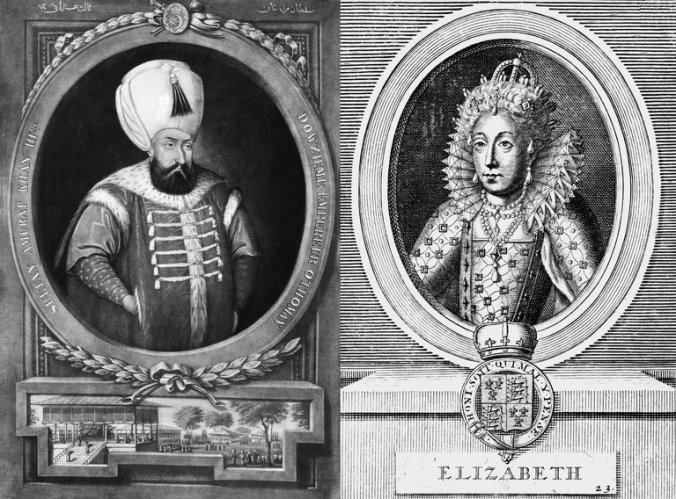
Isolated from Europe, Elizabeth I turned to the Islamic world.

This is only one story among many in the complex relationship between Europe and Islam. It is also a reminder of a time when it was the Islamic World was a beacon of toleration in contrast to intolerant Europe.

To read the full story go to: England’s Forgotten Muslim History – The New York Times

“Human Skeleton Found on Famed Antikythera Shipwreck” – Scientific American

“Two-thousand-year-old bones could yield first DNA from an ancient shipwreck victim.”

This is so exciting! It could tell us more about the shipwreck and potentially about the incredible Antikythera Mechanism.

Source: Human Skeleton Found on Famed Antikythera Shipwreck – Scientific American

“The Very Great Alexander von Humboldt” by Nathaniel Rich | The New York Review of Books

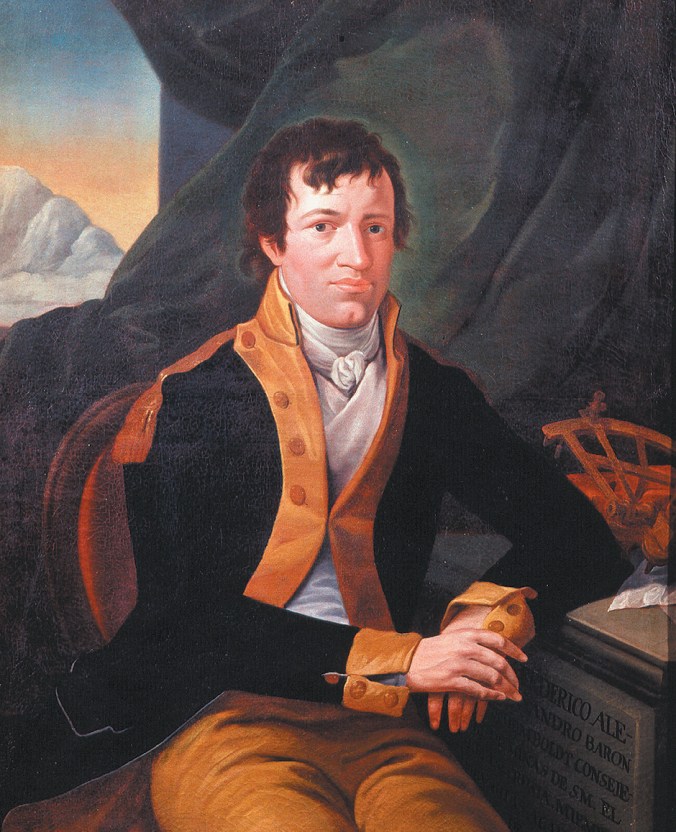
“The Prussian naturalist Alexander von Humboldt (1769–1859) is all around us. Yet he is invisible. “Alexander von Humboldt has been largely forgotten in the English-speaking world,” writes Andrea Wulf in her thrilling new biography. “It is almost as though his ideas have become so manifest that the man behind them has disappeared.” Wulf’s book is as much a history of those ideas as it is of the man. The man may be lost but his ideas have never been more alive.”

Nathaniel Rich reviews two books on nature. The first (The Invention of Nature: Alexander von Humboldt’s New World by Andrea Wulf) reminds us of Humboldt’s profound influence in science, culture, politics, and literature. His energy and curiosity took him across the New World including Venezuela, Cuba, Mexico, Colombia, and Peru. He met dignitaries such Thomas Jefferson, and as pointed out by Rich “exerted a profound influence on Goethe (with whom he had a deep friendship), Charles Lyell, William Wordsworth, Samuel Taylor Coleridge, Jules Verne, Carl Friedrich Gauss, Flaubert, Pushkin, Emerson, Poe, Whitman, Aldous Huxley, Ezra Pound, Erich Fried, Justus Liebig, James Lovelock, and Rachel Carson.” Even more significantly, Humboldt’s ideas had a significant impact on Charles Darwin, so much so that the “crowning paragraph of Origin of Species is a nearly verbatim plagiarism of a passage in Personal Narrative.”

Clearly impressed by the research and skill Wulf put into her new book, Rich conveys an enthusiasm in his review that disappears once he turns to Jedediah Purdy’s After Nature: A Politics for the Anthropocene.  For the full review go to The New York Review of Books.

“The real utopia: This ancient civilisation thrived without war” | New Scientist

“The Indus civilisation seems to have flourished for 700 years without armour, weapons, inequality or royalty. Here’s how to build a paradise on Earth.”

Source: The real utopia: This ancient civilisation thrived without war | New Scientist

The Great Plague of 1665: Case Closed? — TIME

History TodayThis post is in partnership with History Today. The article below was originally published at History Today. In August 1665, from his two-room lodgings in Southwark, the chemist John Allin wrote to a friend in Rye, Sussex that: I am through mercy yet well, in middest of death & that too approaching neerer &…

via The Great Plague of 1665: Case Closed? — TIME