“Don’t let ‘the market’ dominate the debate on university teaching” | Higher Education Network | The Guardian

“We applaud the government’s plan to bring in a Teaching Excellence Framework, but the language of business devalues it”

The author of this piece is referring to education in the UK, but it equally applies here:
“The traditional role of universities was, in many ways, to offer a counterbalance to the market, with an emphasis on social value rather than economics. The risk, however, is that with the introduction of the Tef, yet another regulatory regime will squeeze the intellectual dynamism, risk-taking, original thinking and vitality out of universities”

Source: Don’t let ‘the market’ dominate the debate on university teaching | Higher Education Network | The Guardian

The Destruction of Our Public Education System: “Splintering And Shattering Our Communities” Ed Berger

“There are forces at work that are so destructive they can shatter the hopes and dreams of our citizens and splinter our communities. Our communities serve the needs of citizens via good schools, good medical facilities, good policing, good and […]”

Ed Berger gives an impassioned plea to save our public education system from the corporate “reformers.” Please read his thoughtful piece:  Splintering And Shattering Our Communities

(Thanks Diane Ravitch for the pointer!)

education

Early American History could be a thing of the past

“Just Monday, the South Dakota Board of Education approved new guidelines that do not require high schools to teach early U.S. history beginning next year.”

Seriously? What are they thinking? (In truth, they probably weren’t thinking!)

Source: Early American History could be a thing of the past

History News Network | The Historical Ironies of the Right-Wing Movement Against Common Core

Andrew Hartman’s brief review of the history of education reform is very revealing in light of the current education “reform” movement. I think you’ll find it very interesting. He states that “[r]esistance to liberal curricular reform reveals the perplexities of a conservative movement that housed both religious conservatives and neoconservatives. Religious conservatives have long railed against the state as an agent of secularism. Yet since the 1980s they have formed alliances with neoconservatives who sought to reshape the national curriculum more to their liking from within the hallowed halls of government. This contradictory historical development underscores the ironies of the right-wing assault on Common Core, which, as we shall see, has roots in the neoconservative education reform movement.”
The Culture Wars A Battle for the Soul of America

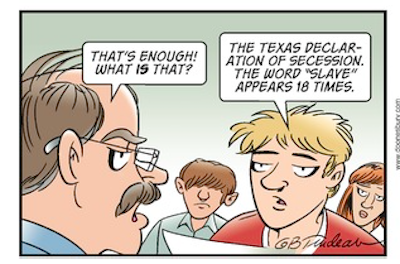
Poking Fun at the Texas Textbook Debacle: “Doonesbury as Documentary: Or, Comic Strip Imitates Life” | History News Network

This is great! You go Doonesbury!

History News Network | Doonesbury as Documentary: Or, Comic Strip Imitates Life.

doonberry Texas Textbook Civil War Controversy

“The Neoliberal Arts,” by William Deresiewicz | Harper’s Magazine

What is the purpose of higher education?  To create informed, critical thinkers who are engaged, thoughtful citizens? To create workers based on the needs of the market?

The latter reflects the thinking of the new neoliberalism, which now enjoys a broad popularity. The neoliberalist view of higher education is no longer just rhetoric. Colleges and universities have been transforming themselves for at least the last twenty years in alignment with this ideology. William Deresiewicz delves into the troubling consequences of this type of higher education on our society.

Deresiewicz defines neoliberalism as “an ideology that reduces all values to money values. The worth of a thing is the price of the thing. The worth of a person is the wealth of the person. Neoliberalism tells you that you are valuable exclusively in terms of your activity in the marketplace — in Wordsworth’s phrase, your [sic] getting and spending.”

Alternatively, he asserts, “we need to treat it [education] as a right. Instead of seeing it in terms of market purposes, we need to see it once again in terms of intellectual and moral purposes. That means resurrecting one of the great achievements of postwar American society: high-quality, low- or no-cost mass public higher education. An end to the artificial scarcity of educational resources. An end to the idea that students must compete for the privilege of going to a decent college, and that they then must pay for it.” I agree!

Please read Deresiewicz deliberative essay on this very important topic:

[Essay] | The Neoliberal Arts, by William Deresiewicz | Harper’s Magazine.

Here’s another worthwhile article on the subject of neoliberalism and education: Organized Lightning: The liberal arts against neoliberalism.”
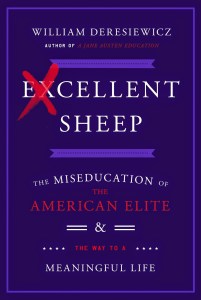
excellent+sheep+-+william+deresiewicz

“How Trigger Warnings Are Hurting Mental Health on Campus” – The Atlantic

I keep hearing about the coddling of America’s college students, but I’ve been teaching at a major university for almost 10 years and I haven’t seen it. People keep talking about “trigger warnings” and “microaggressions” but it’s not my students. This article in the Atlantic claims, “This new climate is slowly being institutionalized, and is affecting what can be said in the classroom, even as a basis for discussion.” I have not seen this either. There has always been some students who don’t like hearing things they don’t agree with, but this is not new.

Reading the article, it seems that they base their claims on a few extreme examples that are not indicative of the college experience across the board. They also misconstrue the purpose of Safe zones. I’m not an expert on these spaces, but from what I know from students, they are not meant to protect students from confronting ideas and beliefs they don’t like. They are places where students who experience discrimination can go to be themselves without fear of bullying, condemnation, or harassment. They still live in the real world where they are confronted by ideas and people they do not like. Nor are their examples of “coddling” an indication of what happens in the classroom, with a few exceptions as pointed out by the article. All professors that I know respect their students and do not intentionally go out of their way to offend their students, but they have not avoided teaching topics that may be uncomfortable for some students, even if the students feel offended as a result.

And I think it’s unfair to call these students coddled when they are under tremendous pressure to succeed (often defined solely in terms of financial success). They are also under a lot of pressure to achieve perfection in all aspects of their lives, which is in part responsible for the rise in student suicides.

Read the entire article here: How Trigger Warnings Are Hurting Mental Health on Campus – The Atlantic.

Coddling students

Jonas Persson Explores the History of School Choice: What He Finds Isn’t Pretty

After reviewing the history of vouchers, Jonas Persson at PR Watch concludes “‘choice’ was always predicated on parents choosing private—sometimes even segregated—schools. Vouchers were not proposed with equity in mind; they were cooked up out of an ideological disdain for public schools and teachers’ unions.”

Persson article is enlightening, if not sad. We all need to understand the real motives and purposes of the school choice movement if we want to save our public education system. Here’s an excerpt from Persson informative piece:

“As if hit by a collective wake-up call, voucher advocates suddenly realized that the pipe dream of a free market “utopia,” where public schools and democratic school boards were consigned to the dustheap of history, could actually be realized. All it took was some posturing and a great deal of cynicism.

‘In today’s world,’ the rightwing quarterly The Public Interest suggested in a 1988 article, ‘those who would expand choice programs face many legal and political obstacles. Linking choice programs and integration may be their best bet.’ The New Right had, as The Black Commentator eloquently explained in a 2004 article, found its missing link:

Former Reagan Education Secretary William Bennett understood what was missing from the voucher political chemistry: minorities. If visible elements of the Black and Latino community could be ensnared in what was then a lily-white scheme, then the Right’s dream of a universal vouchers system to subsidize general privatization of education, might become a practical political project. More urgently, Bennett and other rightwing strategists saw that vouchers had the potential to drive a wedge between Blacks and teachers unions, cracking the Democratic Party coalition. In 1988, Bennett urged the Catholic Church to “seek out the poor, the disadvantaged…and take them in, educate them, and then ask society for fair recompense for your efforts”–vouchers. The game was on.

In the late ’80s, conservative think tanks and advocacy groups across the nation launched massive whitewashing campaigns; they started churning out policy reports and books purporting to show how school vouchers would actually benefit minority students. Examples include: We Can Rescue Our Children: The Cure for Chicago’s Public School Crisis (Heartland Institute, 1988) and Liberating Schools: Education in the Inner City (Cato Institute, 1990).

By proposing schemes with vouchers weighted to boost racial diversity, or restricted to children from low-income families, the organizations pushing vouchers were able to kill two birds with one stone. They made them acceptable by obscuring the segregationist history, and, crucially, they could now cast themselves as the ‘new’ civil rights movement.”
"Participants hold up signs during an Americans For Prosperity "Tallahassee Days Rally" March 3, 2014 at the Capitol in Tallahassee, Fla. Participants hope to meet with their elected officials this week to discuss issues including tax cuts, pension reform, school choice and accountability for education spending. The 2014 Florida legislative session starts Tuesday. (AP Photo/Phil Sears)"

(AP Photo/Phil Sears)

Comments on the Rising Cost of Higher Ed: “Check, Please! An Itemized Tuition Bill for College”

As a response to the high cost of tuition Erik C. Banks proposes offering “parents a transparent itemized tuition bill that shows them exactly where their money goes and how much of it is spent on things having nothing to do with education.” I think it’s a great idea! We need some way of making it very clear where money is being spent in our institutions of higher education. Despite popular perceptions that excessive tuition costs are the result of the bloated salaries of professors (there may be some examples of excessive salaries, but they are the exception, not the rule. Trust me!), the main culprits are the combination of decreased state funding and higher administrative costs.

But if we’re going to have a productive debate about the costs of higher education, we also need to make sure that we address the motivations that are driving both of these trends. Banks points out one of the driving factors behind the administrative bloat: “college presidents and administrators embarking on massive spending programs to hype their ratings and impress students and parents with extras which do not directly add to education.” (see also an early post for more on this problem )

The other problem of decreased funding for public education is the result of irresponsible tax cuts and ideological movements to privatize education (see posts about Scott Walker’s campaign in Wisconsin and the struggles at the University of North Carolina).

Please read Banks informed discussion on this very important topic! I would also recommend reading the “2015 Ohio Education Report” that Banks provides at the bottom of his post. It breaks down the increased costs of higher education in Ohio (the trends are similar across the nation) and the decreasing state funding. It also gives a compelling defense of the value of higher education.

Check, Please! An Itemized Tuition Bill for College.

education higher costs

More Evidence That Civil War Was Not About States’ Rights (As if the words of the Confederate leaders wasn’t enough!)

In the wake of the fight over the Confederate flag and the new that Texas school children will not learn that the Civil War was fought over slavery, two articles this week at the History News Network present us with more evidence that the South did not fight for states’ rights. Roy Finkenbine invokes “the little-known U.S. Supreme Court case of Ableman v. Booth” to argue that “[o]nly in the wake of Appomattox did former Confederates assert that the conflict had been waged over constitutional principles.”And Stephen R. Leccese argues that “[t]he states’ rights argument falls apart when one has an understanding of antebellum Southern history. Before the Civil War, the South was in no way a bastion of states’ rights.”
I agree with Leccese that “[t]his country’s educational system must do better and present an accurate view of history. When that happens, we can have a public that acts with an informed mind on issues of national (and international, as the world views race relations in this country very poorly) importance.”

“The Supreme Court Case that Proves that the Antebellum South Wasn’t Really Concerned with States Rights.” | HNN

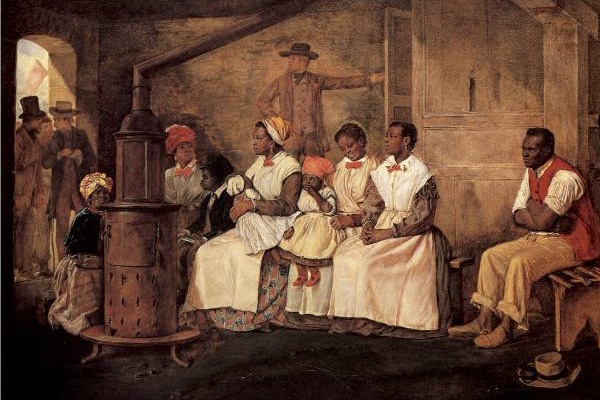
"Slaves Waiting for Sale: Richmond, Virginia - Wikipedia"

“Slaves Waiting for Sale: Richmond, Virginia – Wikipedia”