“Paris: The War ISIS Wants by Scott Atran and Nafees Hamid” | NYR Daily | The New York Review of Books

“Following the Paris attacks, France, the United States, and our allies may opt for all-out war. But even if ISIS is destroyed, its message could still captivate many in coming generations.”

If we want to defeat ISIS we must understand them first. The desire for revenge in the aftermath of the attacks in Paris is understandable. However, this emotionally satisfying response will lead us right into the trap set by ISIS, and will most likely make things worse.

The article by Atran and Hamid go a long way in helping us understand ISIS and the motives to those who join the movement: Paris: The War ISIS Wants by Scott Atran and Nafees Hamid | NYR Daily | The New York Review of Books

Propaganda and De-humanization: “The Brain with David Eagleman” PBS

The study of history is the study of human nature. However, it’s not the only way to understand human behavior. Science can also illuminate the mysteries of human behavior. Scientists may approach the problem in a different way, but they are also trying to understand human beings. So, I was thrilled when David Eagleman turned to the subject of ethnic/religious conflict in the third program in a series on the brain.  And he used the War in Bosnia (something I’ve spent years studying) to illustrate the problem.

What have scientists found? That when people are confronted with people in our out group (however defined) our brains react as if they were objects, not human beings. The ability to empathize with those in their out group had been lost. How does this de-humanization happen? Usually, through propaganda.

I’ve spent years studying religious/ethnic conflict to come to the same conclusion. He also proposed the same solution: educate students to detect propaganda. In other words, we need to educate students to be good B.S. detectors and independent thinkers. This is one of the reasons why the humanities are so important, particularly philosophy and history.

Here’s the link to the website for the PBS program:  The Brain with David Eagleman

“The Frightening Return of Religious Wars” | History News Network

“This horrible discord, which has lasted for so many centuries, is a very striking lesson that we should pardon each other’s errors; discord is the great ill of mankind; and tolerance is the only remedy for it.” (Voltaire speaking on the long history of intolerance within the Christian world, Philosophical Dictionary)

As someone who has spent years studying religious and ethnic conflict, I have  watched the current ascendance of violence and intolerance with much sadness. Every week I have a new story from around the globe (Syria, Israel, India, Bangladesh, Pakistan, even Europe along with many other examples) to share with my students. By now they’re probably tired of the depressing news, but these stories are relevant to the twentieth-century horrors that we are reviewing in class. Will we ever learn?

The idea that toleration was a virtue was a hard-won lesson of the wars of religion that engulfed Europe in the aftermath of the Protestant Reformation. Unfortunately, it is not a lesson that has taken hold completely even in the West. Despite the many factors that have contributed to the rise of violence, it is the spirit of intolerance that is fueling the violence and hatred. This is why Mustafa Akyol has called for  “A Letter Concerning Muslim Toleration” (in honor of John Locke’s famous Letter Concerning Toleration. Unfortunately, it is a value that takes years (as the Western example shows) to cultivate.

Read the entire article here: History News Network | The Frightening Return of Religious Wars

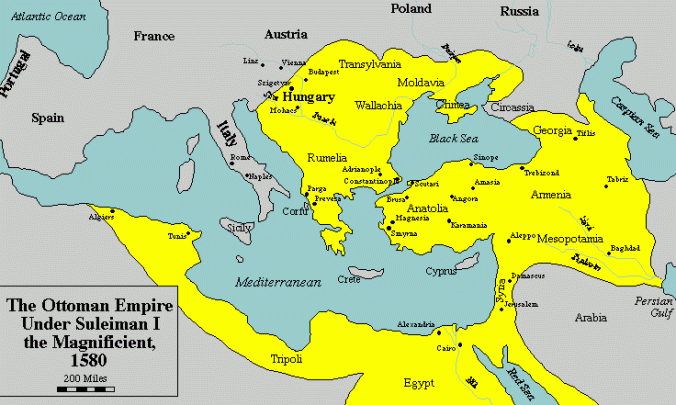
“Ottomans saved Hungarian PM Orban’s Ancestors; now he says Islam never part of Europe” | History News Network

“Hungarian Prime Minister Viktor Orban not only continued to defend his anti-immigrant bigotry but went on to say that Islam has never been part of Europe. Mr. Orban not only is increasing the misery of largely Muslim refugees, but now he has erased 1300 years of European culture and politics, committing a sort of cliocide or mass killing of history.” Juan Cole explains why Orban is wrong: History News Network | Ottomans saved Hungarian PM Orban’s Ancestors; now he says Islam never part of Europe

“Netanyahu Denounced for Saying Palestinian Inspired Holocaust” – The New York Times

As the violence escalates between Israelis and Palestinians, Netanyahu reaches a new low. Rather than aiming to deescalate the situation, he continues to use rhetoric that is inflammatory, offensive, and dishonest. But this time he may have went too far. Even Israelis are denouncing him: “Israeli historians and opposition politicians joined Palestinians in denouncing the Israeli prime minister for saying the grand mufti of Jerusalem gave Hitler the idea of annihilating Jews.”

Read the entire article here: Netanyahu Denounced for Saying Palestinian Inspired Holocaust – The New York Times

“Get Used to It Europe: Homogenous States Are a Thing of the Past” | History News Network

Lawrence Davidson prompts European nations to accept the fact that homogeneous states are no longer realistic (if they ever were!). Therefore, “from every angle, ethical as well as historical, the way to approach the present refugee crisis is to allow, in a controlled but adequately responsive way, the inflow of those now running from the ravages of invasion and civil war. In so doing we should accept the demise of the homogeneous state. Whether it is Germany, France, Hungary, Israel or Burma, the concept is historically untenable and neither raises nor even maintains our civilizational standards. Rather it grinds them down into the dust of an inhumane xenophobia.”
I agree with Davidson that ideal vision of the nation-state of the past is a fantasy and that all European nations (I would add the U.S. as well) need to step up and help these refugees. However, it’s not enough just to accept the idea that nation-states must be multi-cultural. France, for example, has been a diverse society for some time now, but that hasn’t solved the problem of creating a harmonious society. The first difficulty will be to redefine what it means to be a member of a nation. Any definition that limits inclusion to those who have the right heritage (French ancestry, for example) or religion must be abandoned in favor a more inclusive definition (all citizens are members of the nation). This will not be easy, but diversity is a reality and it can be a benefit.
What’s the alternative? Any attempt to maintain uniformity within a nation can only come at great cost.  What Jefferson claimed in reference to religious uniformity is equally applicable when it comes to attempts to maintain uniformity more broadly: “is uniformity of opinion desirable? No more than of face and stature Introduce the bed of Procrustes then, and as there is danger that the large men may beat the small, make us all of a size, by lopping the former and stretching the latter. Difference of opinion is advantageous in religion. The several sects perform the office of a Censor morum [moral censor] over each other. Is uniformity attainable? Millions of innocent men, women, and children, since the introduction of Christianity, have been burnt, tortured, fined, imprisoned; yet we have not advanced one inch towards uniformity.”

History News Network | Get Used to It Europe: Homogenous States Are a Thing of the Past

“Fear” by Marilynne Robinson | The New York Review of Books

In FDR’s inaugural address in 1932, he famously said: “the only we thing we have to fear is fear itself.” In his speech he was referring to a fear that was “paralyz[ing].” But this famous quote equally applies to a different kind of fear. A fear that mobilizes.

The last several years have seen a rise in nationalism, xenophobia, and intolerance, which are fueling the rise in religious and ethnic violence. We cannot attribute this rise in hatred to one cause, but underlying many of these events are some common factors, whether past or present.

As human beings we are prone to tribalism. It is in our DNA, but we must remember that biology is not destiny. We can live peacefully side by side with those who are different, as we have frequently have done. However, this peace can too easily be shattered by changes in circumstance that cause feelings of insecurity  and uncertainty (such as economic downturns, changes in climate that lead to drought, real and imagined resentments, etc.). The resulting anxiety leads to the inevitable search for scapegoats (usually a foreign or disadvantaged group). Such conditions are ripe for the cunning demagogue. By exploiting the fears and prejudices of one group, he (or she) can mobilize this group into projects that serve the political/ideological/economic purposes of the demagogue. This pattern is repeating itself across the globe.

It appears that we are set to repeat the horrors of the twentieth century. Maybe not on the scale of WWII with large national armies (although that is possible as well), but more likely it will take the form of a guerrilla-style fighting that is brutal and barbaric. But no matter what form it takes many more innocent people will suffer unless we figure out some way to live with those who are different from us. Demanding a brutal conformity is not a viable option, unless we want to live in a totalitarian society that has no qualms about using fear, coercion, and violence to achieve such conformity. Attempts to create uniformity (which inevitably fail) come at too great a cost, as Jefferson recognized: “Is uniformity attainable? Millions of innocent men, women, and children, since the introduction of Christianity, have been burnt, tortured, fined, imprisoned; yet we have not advanced one inch towards uniformity.” Jefferson was speaking of religious conformity, but the same sentiment applies to all efforts at conformity, whether national, religious, or political.

This brings me to the article by Marilynne Robinson. Even though Robinson was writing in the context of domestic events and our gun culture, her analysis leads to conclusions that are similar to mine above. In fact, she begins by referring back to the Wars of Religion in France, in which the Catholic majority tried to exterminate the Protestant minority (Huguenots).

“The terrible massacres of Protestants in France in the sixteenth century, whether official or popular in their origins, reflect the fear that is engendered by the thought that someone really might destroy one’s soul, plunge one into eternal fire by corrupting true belief even inadvertently. If someone had asked a citizen of Lyon, on his way to help exterminate the Calvinists, to explain what he and his friends were doing, he would no doubt have said that he was taking back his city, taking back his culture, taking back his country, fighting for the soul of France.” (although they saw it more in terms of defending the “true” religion.)

Based on these insights she came to the same basic underlying factor that unites the Wars of Religion with the fanatic gun rights advocates in the US (she’s not saying they are the same, only that they are motivated by a similar attitude towards another group): “At the core of all this is fear, real or pretended. What if these dissenters in our midst really are a threat to all we hold dear? Better to deal with the problem before their evil schemes are irreversible, before our country has lost its soul and the United Nations has invaded Texas. We might step back and say that there are hundreds of millions of people who love this nation’s soul, who in fact are its soul, and patriotism should begin by acknowledging this fact. But there is not much fear to be enjoyed from this view of things. Why stockpile ammunition if the people over the horizon are no threat? If they would in fact grieve with your sorrows and help you through your troubles?”

Source: Fear by Marilynne Robinson | The New York Review of Books

“India and Israel Start to See Enemies Within” – Bloomberg View

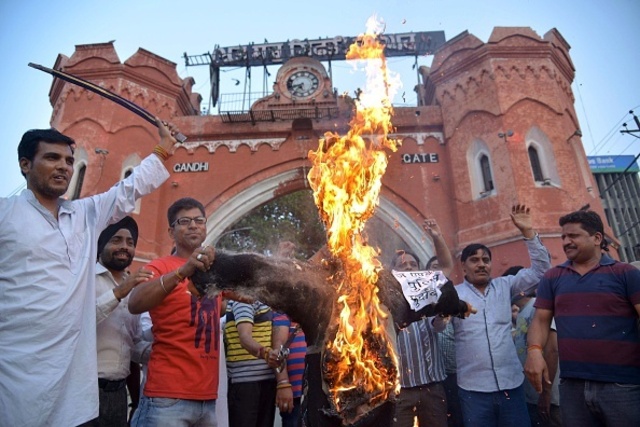
Nationalism has been on the rise lately. I’ve written previously about the new nationalism in Russia and Japan, but the rise of nationalism in India and Israel may even be more concerning. Pankaj Mishra describes the current situation in these two countries: “There are eerie similarities between the Hindu thugs who assault Muslim males marrying Hindu women and followers of the far-right Israeli group Lehava (Flame), who try to break up weddings between Muslims and Jews…The new ruling classes seem obsessed with moral and patriotic education, reverence for national symbols and icons (mostly right-wing), and the uniqueness of national culture and history.” These leaders were brought to power by tapping into the resentment and discontent of their respective populations. This “politics of resentment,” as Mishra calls it, is powerful, and astute politicians know how to exploit it. As human beings we seem to have an affinity for nationalism. It gives us an identity, a purpose, a community, a compelling narrative, and a scapegoat for our woes. Unfortunately, it more often than not devolves into violence and oppression. How many times do we have to go down this road? Will we ever learn?

“It would be nice to hope that India and Israel’s emboldened hotheads are different, and will lead their countries to stability, prosperity and peace through their special mix of right-wing economics and the politics of ressentiment. It is already clear, however, that they find more thrilling the prospect of perpetual warfare with their perceived enemies, especially the ones within.” I’m afraid that Mishra is right.

Read Mishra’s important reporting on the situation in India and Israel: India and Israel Start to See Enemies Within – Bloomberg View.

"Playing with fire? Photographer: NARINDER NANU/AFP/Getty Images"

“Playing with fire? Photographer: NARINDER NANU/AFP/Getty Images”

“This is One Reason the World Is on Fire” | History News Network

I don’t think “the world is on fire,” but Lawrence Davidson’s essay does hold some relevance to the violence that we see in some parts of the world. He argues that “there are millions of people, Muslims, Jews and Christians and others who not only still idealize a religiously imagined past, but want, in one way or another, to import that past into the present – and not only their present but everyone else’s as well.” This desire for some kind of mythical, ideal past is not new. These kind of golden age myths can be found throughout history, indicating a human affinity for them. They are particularly appealing in times of trouble, and Davidson is right to call them “downright dangerous.”
The problem is that while appealing, these mythical pasts never existed. They were created by scrubbing the particular period of interest of all its blemishes while embellishing the good. All attempts to recreate a mythical past have ended in human tragedy. Just as Procrustes was made to fit his bed by chopping off his legs, humanity is made to fit in an unattainable utopian box by destroying all that does not fit the ideal.
While Davidson focuses solely on the religious versions that are particularly prevalent at the moment, but this kind of golden age thinking can be found in other types of ideologies such as nationalism. We must all resist the siren song of these kinds of golden age narratives no matter how enticing they are.

History News Network | This is One Reason the World Is on Fire.

ISIS

“Russia must not be allowed to rewrite Srebrenica’s history” | Natalie Nougayrede | The Guardian

We all want to belong. We all want to think that we are good. We all want to be proud of our heritage, community, and history. We all want to have purpose and meaning in our lives. These are all genuine human desires that are by themselves positive sentiments, but they ultimately leave us vulnerable to manipulation by ambitious political leaders. Because nationalism fulfills all of these desires it has been the ideal political weapon for leaders like Slobodan Milosević, who unleashed the forces of Serbian nationalism as a way to rise to power. But more than fulfilling Milosević’s political ambitions it also released the forces of hatred that tore apart the former Yugoslavia of which the massacre of Srebrenica was a part of. Nationalism rests on an “us versus them” narrative that is more myth than actual history. All past nationals sins must be swept under the rug as a way to make the nation worthy of glory. If it just engendered pride in one’s past, nationalism would not be such a destructive force. Unfortunately, the end result is usually arrogance and hatred.

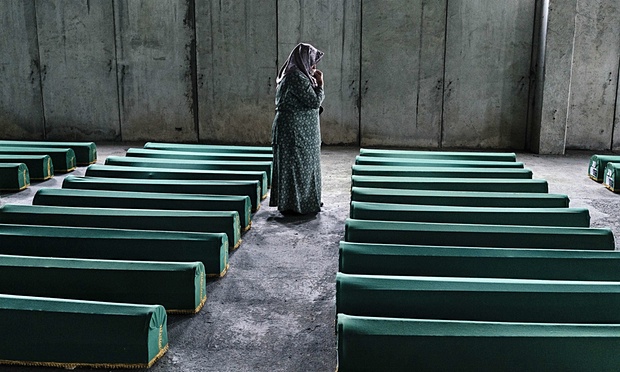
Natalie Nougayrede’s article at The Guardian reminds us that Putin is playing with the same fire for his own political purposes. This is not to say that Putin is planning to commit genocide or ethnic cleansing, but that his use of nationalism will, and already has, bring great suffering to many. Putin’s veto of the UN resolution is only a small part of his overall power play, but as Nougrayrede reminds us, it is still significant if we value peace and justice. “Some will argue that Russia’s latest veto should be seen as just another snub to the west. But the rewriting of the history of the Bosnian war and the unravelling of the mechanisms that the west tried to put in place to prevent more violence are something that Europeans would do well not to minimise. If only because of those unarmed 8,000 men and boys who were killed just because of who they were: Bosnian and Muslim.”

Russia must not be allowed to rewrite Srebrenica’s history | Natalie Nougayrede | Comment is free | The Guardian.

Srebrenica mourning