Counter-Terrorism Beyond Platitudes | commentary

“Donald Trump and Ted Cruz have embraced a shallow, platitudinous approach to counter-terrorism and anti-insurgency warfare.”

Max Boot effectively explains the flawed analogy (resulting from a lack of historical perspective) behind the simplistic approach to counter-terrorism espoused by Trump, Cruz, and many Americans. Their understanding of war is based on the crushing defeats inflicted on the Axis powers during WWII.

But as Boot points out, “The situation with the War on Terror today is very different. We are fighting insurgencies, not nation-states, even if some of the insurgents (the Taliban before 9/11, ISIS today) have taken on many of the attributes of nation-states. This is an unconventional conflict in which our enemies seldom wear uniforms or mass in the open. They prefer to hide among a civilian population and to strike with stealth and surprise, usually against civilian, not military, targets. As I argued in my book Invisible Armies, this is an ancient form of warfare that requires a different response from conventional conflicts. Using maximal force against terrorists and guerrillas can backfire, more often than not, by killing innocent civilians and thereby driving their friends and relatives into the insurgent camp.”

Read the entire article here: Counter-Terrorism Beyond Platitudes | commentary
“Are Russians Really Long-Suffering” | History News Network

Christopher A. Lawrence contests the claim that Russians have had a particularly difficult history. I was shocked when I read his claim. How could this be?
As a graduate student one of my areas of specialization was Russian history (Imperial Russia and the Soviet Union). Therefore, I had to read a lot about the history of the Russian people in preparation for my comprehensive exams. One of the things that struck me was the constant stream of misfortunes endured by Russians. They never seemed to catch a break.
I thought maybe I mis-remembered  their history when I saw this article by a supposedly credible historian. But upon reading the essay I realized that it wasn’t my memory that was the problem, it was Lawrence’s argument. His argument focuses on their many political revolutions, the last of which he highlights as “fundamentally peaceful.” Now where does he discuss the actual suffering or explain why it wasn’t actually suffering. In fact his argument works by actually ignoring the real suffering of the Russian people (wars, famines, political oppression, purges, etc.). He only mentioned one, World War I, which he points out was short-lived and entailed fewer deaths than other nations. He forgets to mention that they left only to fight a civil war that killed millions, followed by famine, political purges, terror, and crushing poverty.  And that was all before the Second World War!
It’s easy to make an argument that the Russians  are not long-suffering, if you ignore the actual suffering!

Source: History News Network | Are Russians Really Long-Suffering

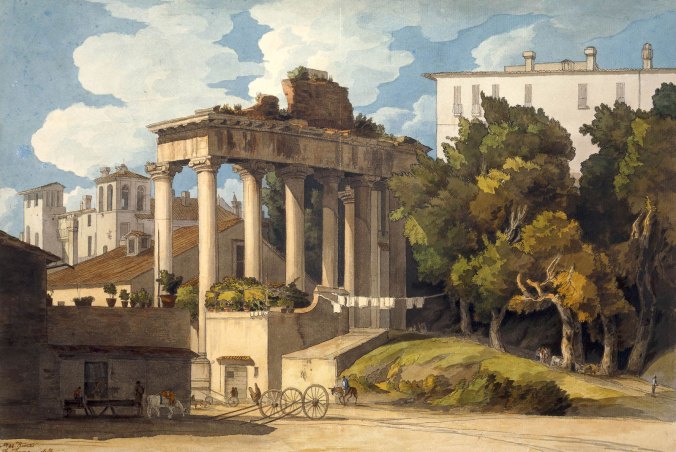
“Rome: Behind the Ruins by Jenny Uglow” | NYR Daily | The New York Review of Books

“After many years in the shadows, Francis Towne’s haunting paintings of Rome are back in the light, beautifully displayed—they may appear a mere sideshow in comparison to the blockbuster exhibitions of great names, but they offer a luminous vision of a civilization lost in time, a tribute to the genius of a quiet man.”

See the other paintings and read the article here: Rome: Behind the Ruins by Jenny Uglow | NYR Daily | The New York Review of Books

Book Review: “The Amazing Career of a Pioneer Capitalist by Martha Howell” | The New York Review of Books

Martha Howell’s review of The Richest Man Who Ever Lived: The Life and Times of Jacob Fugger provides an excellent overview of early capitalism in Europe. If you are interested in the history of capitalism you’ll find this review enjoyable.

Bringing the past to bear on the present, Howell points out a notable fact about capitalism:

“If Fugger was not the “first capitalist,” the story of his life perfectly exemplifies sixteenth-century capitalism and suggests a fundamental truth about many more forms of capitalism, one that was so monstrously embodied by the Dutch East India Company: wealth is won and preserved with the support of a state that is, in turn, dependent on the riches accumulated by the few who excel in commerce. In some periods, at some moments of technological history, the riches are typically extracted from ever more efficient production, invariably aided by ruthless exploitation of human labor and natural resources. In others the wealth comes principally from control of supplies, manipulation of demand, and management of distribution networks. But always the merchants grow rich because state power protects them or looks away when the time is right—and does so because in a world where commerce reigns, neither the state nor a powerful merchant class can exist without the other. We have Steinmetz’s book to thank not just for telling Fugger’s story so well but also for showing us how the partnership between state and commerce worked in the earliest days of European capitalism.”

Read the review here: The Amazing Career of a Pioneer Capitalist by Martha Howell | The New York Review of Books

“Israel: The Broken Silence by David Shulman” | The New York Review of Books

We can learn from history if we are willing to. We remember the Holocaust because of the important lessons it provides. “Never again” is the mantra. Unfortunately, we keep making the same mistakes.

If any peoples should have learned the lessons of exclusion and hate it should have been the Jews. Of course, many Jews have. Unfortunately, the leaders of the Israeli state have learned nothing from the past. This period does provides amble evidence of the dangers of nationalism and racism, especially when they become the guiding principles of authoritarian regimes.

Yet they are making the same mistakes with similar  (but not identical) consequences. This time they (the Israeli government and their right-wing supporters) are the victimizers. They may justify their behavior in the name of self-defense, but what they have actually done is locked themselves into a cycle of never-ending violence and revenge.

David Shulman explains the unfortunate situation in Israel today.

An excerpt: “But Israeli McCarthyism has an additional, distinctive element that deepens the madness. It is directly linked to Israel’s colonial project in the occupied Palestinian territories. Anyone who opposes the occupation in word or deed is now at risk. For the right, patriotism is synonymous with occupation and all that comes with it, above all the dispossession and expulsion of Palestinians and the theft of their lands. One can hear overtly racist rationalizations of this aim any day on the public radio talk shows. Put simply, the occupation system as a whole is ruled by the logic of stark division between the privileged Israeli occupiers and the Palestinian occupied, who are totally disenfranchised and stripped of all basic human rights.”

Source: Israel: The Broken Silence by David Shulman | The New York Review of Books

“The strange, short career of Judeo-Christianity” | Aeon Opinions

It’s time to bury the charade of Judeo-Christianity. As Gene Zubovich points out, “The notion that the US is a nation bound together by civic principles enjoys a more distinguished history than the recently coined idea of the Judeo-Christian nation. It is also obvious that the US is more than a nation of many faiths. No wonder, then, that today Judeo-Christianity has few defenders apart from members of the Christian right, who use it to undermine the legitimacy of Muslims and the rapidly growing body of religiously unaffiliated Americans. The short career of Judeo-Christianity has already lasted too long.”

Read Zubovich’s brief overview of the history of this concept here: The strange, short career of Judeo-Christianity | Aeon Opinions

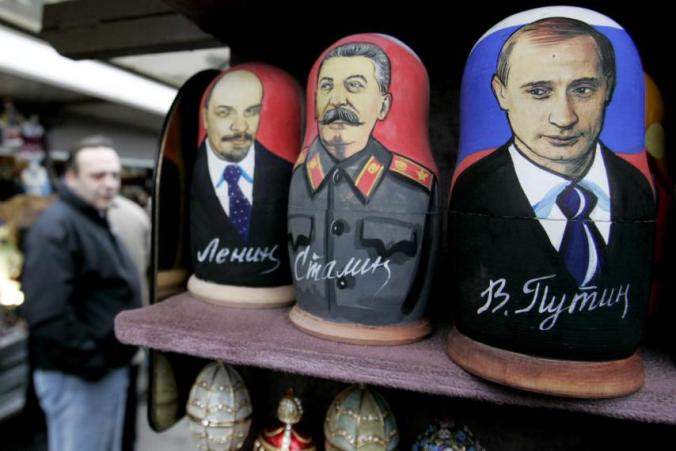
As Putin Zaps Lenin, Lavrov Hurriedly Rewrites History

“There is hardly any country history has been as utterly rewritten as Russia’s, from the tsars to communism…Indeed, like in the times of Russian tsars, emperors and general secretaries, the current Russian leadership’s real concern is great power status, which in the case of Russia, has always been achieved at the expense of its citizens’ prosperity.”

Source: As Putin Zaps Lenin, Lavrov Hurriedly Rewrites History

The ‘war on terror’ isn’t working – LA Times

Andrew Bacevich’s article at the Los Angeles Times is brief but smart. In contrast to the dominant voices calling for more bombing and even the use of torture, he proposes something different. His critique is historically informed and echoes what many scholars, including myself, have been advocating for a long time.

“What Americans refer to as terrorism is more accurately this: a violent outgrowth of chronic political dysfunction and economic underdevelopment affecting large parts of the Islamic world, exacerbated by deep-seated  sectarian divisions and the pernicious legacy of European colonialism and further complicated by the presence of Israel, all together finding expression in antipathy toward the West and especially the United States. For the “war on terror” to succeed, it will have to remedy the conditions giving rise to that antipathy in the first place.” Exactly!

Read the entire article here: The ‘war on terror’ isn’t working – LA Times

“Studying the 30 Years War Gives Me Hope about Our Religious Wars” | History News Network

Like the historian Wayne Te Brake I think the wars of religion that occurred in Europe during the sixteenth and seventeenth centuries can teach us something about the current conflicts in the Middle East. However, I have to disagree with his optimism concerning the current cease-fire in Syria.
Brake points to the well-known settlements to the European conflicts: “the Religious Peace of Augsburg (1555), the Edict of Nantes (1598), and the Peace of Westphalia (1648).”  While admitting that these were the result of a “grudging consent” rather than “the acceptance of explicit blueprints for a pluralistic future,” he sees in them hope for peace in the Middle East. This may be true in the long run, but the analogy between the current situation in Syria and the above peace settlements fails to take into account some important differences.
First, I think its’ important to note that the first two of the above peace settlements did not last. The breakdown of the Peace of Augsburg resulted in the Thirty Years War and the Edict of Nantes was revoked in 1685 by Louis XIV, unleashing a new rounds of violence. It was only after the idea of toleration was accepted as something desirable that we began to see permanent peaceful relations between the various religions in Europe. This is why Locke’s A Letter Concerning Toleration was so important. Locke was not the first, or the only person, to advocate in favor of toleration, but his influence in changing people’s attitudes about religious diversity that made him such an important figure in the West.
In the conflict zones of the Middle East today there are few, especially those in power, who are willing to accept even a grudging toleration. Without this there can be no lasting peace. The peace in Europe was enforced by powerful states, who despite not accepting toleration as a good were willing to enforce policies of toleration because it was in their interest to do so. The wars had taken such a toll in lives and treasure that a politique policy became necessary. This willingness, or even the ability, to follow a similar policy in Syria, the Islamic State, or Iraq is missing. And even if they get to the point of accepting a grudging toleration in the name of stability, it will not be permanent until there is a change in world view.

Read the entire article here: History News Network | Studying the 30 Years War Gives Me Hope about Our Religious Wars

The Thirty Years War

The Thirty Years War

The Revenge of History: “The Theater of Violence” – The New York Times

We all say we want peace, but at the same time we unwittingly engage in behaviors that perpetuate violence. As philosopher Simon Critchley notes, “we are all players on history’s bloody stage.” Human nature is in large part to blame. However, biology is not destiny. The purpose of civilization is to tame our wilder side. Yet, we still have not been able to end the violence.

Critchley offers an important insight into this intractable problem: “We live in a world framed by violence, where justice seems to be endlessly divided between claim and counterclaim, right and left, freedom fighter and terrorist, believer and nonbeliever, and so on. Each side appears to believe unswervingly in the rightness of its position and the wrongness, or indeed ‘evil,’ of the opposition. Such belief legitimates violence and unleashes counterviolence in return. We seem to be trapped in deep historical cycles of violence where justice is usually simply understood as vengeance or revenge.”

This is not a new insight, but it one that is difficult to sell. If we were reflective enough, we would see this trap we’ve set for ourselves. This insight also requires a broad and deep knowledge of history.  It is much easier to offer simple solutions that satisfy our egos and our intuitions. The good vs. evil narrative is simple and it lets us off the hook for any wrongdoing. Savvy politicians know this and use it to their benefit.

Is there any hope then? Critchley offers art, and music in particular, as a solution. But I don’t think this is enough. It will take a much broader effort to convince enough people that we are in fact part of the problem. We also need leaders willing to take up the cause and inspire a new generation to see the world and our place in it differently.

Source: The Theater of Violence – The New York Times