Politics
“What Does Marriage Equality Have to Do with Dred Scott?” – The New Yorker
Many of those who object to the Obergerfell ruling have compared it to the disgraceful Dred Scott (1857) decision that declared that even free blacks could not be citizens and that the Missouri Compromise was unconstitutional thus effectively nullifying the idea of slave free states. Amy Davidson debunks this flawed analogy in a discerning article at The New Yorker. The analogy basically fails because “Dred Scott constrains liberty and Obergefell expands it,” but Davidson further breaks down the failures of this analogy by diving deeper into the Scott case. Thus Davidson’s exposé is also a reminder of the shameful racism that is part of our historical legacy.
Why are some using this analogy? Davidson concludes, “In part, Dred Scott is simply being used to give Obergefell a bad name—as pure invective, another way to call the decision rotten and the Supreme Court deluded. This is low enough; Dred Scott is a truly degraded decision, in a way that no other of the Court, conservative or liberal, has since matched. And, in part, the analogy reflects the notion, held by some contemporary conservatives, that they are now the ‘real’ victims of bigotry.”
Read the entire article here: What Does Marriage Equality Have to Do with Dred Scott? – The New Yorker.
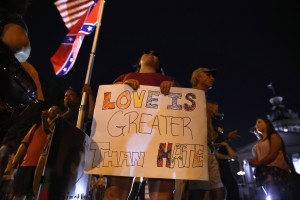
Confederate flag comes down at South Carolina legislature – Yahoo News
It should have never been there! But getting rid of this horrible symbol of hate is not enough. We need to work on getting rid of the real hate and the remaining prejudices that perpetuate inequality and discrimination.
Confederate flag comes down at South Carolina legislature – Yahoo News.
Texas officials: Schools should teach that slavery was ‘side issue’ to Civil War – The Washington Post
“Five million public school students in Texas will begin using new social studies textbooks this fall based on state academic standards that barely address racial segregation. The state’s guidelines for teaching American history also do not mention the Ku Klux Klan or Jim Crow laws. And when it comes to the Civil War, children are supposed to learn that the conflict was caused by ‘sectionalism, states’ rights and slavery’ — written deliberately in that order to telegraph slavery’s secondary role in driving the conflict, according to some members of the state board of education.” This is what happens when politically motivated Schools Boards determine what children will learn. You may recall the kerfuffle over the Texas state curriculum standards in 2010 and the textbooks in 2014 that led to this version of the Civil War appearing in Texas social studies textbooks. (see previous posts on this subject here and here)
The belief that the Civil War was about states’ rights not slavery might be comforting to some, but that feeling comes at the cost of truth, justice, progress, and everything we hold dear as a nation. How can students understand the present if they have been mislead about the past?
“The Persistence of Myth in Southern Politics and Life”|History News Network
History News Network | The Persistence of Myth in Southern Politics and Life.
Thomas Piketty Gives Merkel a History Lesson
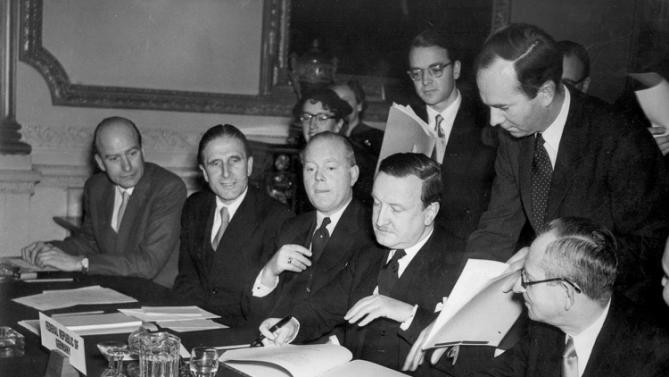
The economist Thomas Piketty, who gained fame last year as the author of Capital in the Twenty-First Century, reminds Merkel, “It was in the 1950s, he notes, that Germany benefited from a massive — and, in those days, surprisingly common — round of debt forgiveness that catapulted its rise into a peaceful economic power. Greece was one of the nations forgiving Germany’s debts. In other words, Piketty suggested, when it comes to how to handle Greece in 2015, the best argument against Germany might be … Germany, circa 1953.” Piketty is right, of course, but I doubt Angela Merkel will change her stance. She seems determined to punish Greece even if it makes things worse not just for Greeks, but for all of Europe.
Read Piketty’s history lesson here: Thomas Piketty accuses Germany of forgetting history as it lectures Greece – The Washington Post.

“FILE – In this Feb. 27, 1953 file photo, the German Debts Agreement is signed in London. Though Germany is resisting Greeces pleas for some relief, it should know better than most what it can achieve. After the hell of World War II, the Federal Republic of Germany – more commonly known as West Germany – got massive help from its former foes, among them Greece. The agreement, in which Greece and about 20 other countries effectively wrote off a large chunk of Germanys loans and restructured the rest, is a landmark case that shows how effective debt relief can be. It helped spark what became known as the German economic miracle. (AP Photo, file)”
“The case for finally building a memorial to James Madison”
Michael Signer, author of Becoming Madison, makes a great case for a memorial to honor our fourth president James Madison. For me it’s an easy sell. I’ve spent the last six years studying Madison’s substantial contributions to the struggle for religious liberty. But Madison’s contributions to the government and character of the United States goes way beyond this important right. Here’s just part of his impressive resume:
– He served in the Virginia Convention (1776) that created Virginia’s first constitution, where he made a major contribution to the future of religious liberty in Virginia (see earlier post on this topic).
– He served in the Continental Congress from 1780 to 1783
– He served in the Virginia House of Delegates (1784 to 1786), where he successfully defeated Patrick Henry’s bill for a general assessment to support teachers of the Christian religion and pushed through the passage of Jefferson’s famous Statute for Establishing Religious Freedom.
– In the fight against Henry’s assessment bill, he wrote the Memorial & Remonstrance Against Religious Assessments (1785), one of the most impressive statements in defense of religious liberty.
– He was the primary mover and author of the Constitution, earning him the designation as the Father of the Constitution (see earlier post on this topic)
– He wrote 29 of the Federalist papers in defense of the Constitution (John Jay wrote 5, and Hamilton wrote the remaining 51)
– He was also the primary mover and author of the amendments that became the Bill of Rights, making him also the Father of the Bill of Rights
– He served in the House of Representatives from 1789 to 1797
– He served as Secretary of State in the Jefferson administration
– He served as President of the United States from 1809 to 1817
And those are only his main accomplishments! So why is there no memorial in his honor? In light of his accomplishments it’s hard to understand why he has been denied this honor, but the most obvious answer is that he was overshadowed by the prominent profiles of the war hero (Washington) and the author of the Declaration of Independence (Jefferson). In contrast to the tall and manly Jefferson and Washington, Madison was slight and timid. But as Signer points out, this is actually one of his strengths. “Indeed, in contrast to contemporaries like Jefferson, Washington, Hamilton, Franklin and Adams, who were constantly seeking to polish their legacies in an epochal time, Madison seemed to try to disappear into the background. It is the cruelest of ironies that history rewards a truly selfless leader by, well, ignoring him.”
Madison was not perfect, but neither is anyone else. “But think of what this true story offers: for a time of unbearable shallowness, depth; for a time of false heroes, reality; for a country grappling to rediscover leadership, a statesman.” It’s time to give Madison the memorial he deserves.
The Current “Crises” in Higher Education
In this post Dr. Kich exposes the flaws in the assumptions about higher ed as presented by James Baar. It also serves as a critique of some of these same assumptions that are often passed off as fact in the media.
In an op-ed published by the Providence Journal in Rhode Island, James Baar identifies “Four Crises That Dog Higher Education”:
1. Inflation of product cost.
2. Deflation of product value.
3. Enablement of social and moral dissolution.
4. Lower-priced, knockoff and fraudulent competition.
Given the space constraints on most op-ed pieces, Baar addresses each of these topics fairly succinctly. So, I suspect that if he had more space, he might have been able to address somewhat articulately at least some of the concerns that I am about to express.
First, I don’t believe that anything can be dogged by a crisis. A crisis is the climax of an escalating situation; it is not a condition. And the word “dogged” suggests an extended condition. But perhaps some editorial assistant, rather than Baar himself, is responsible for the headline.
Second, I don’t think that it is either accurate or helpful to assert…
View original post 1,150 more words
“Dylann Roof Was No Lone Madman” | History News Network
“The Long Campaign by White Supremacists to ‘Take Our Country Back’” |History News Network
History News Network | The Long Campaign by White Supremacists to “Take Our Country Back”.