“‘Defending the Faith’ in the Middle East” – NYTimes.com

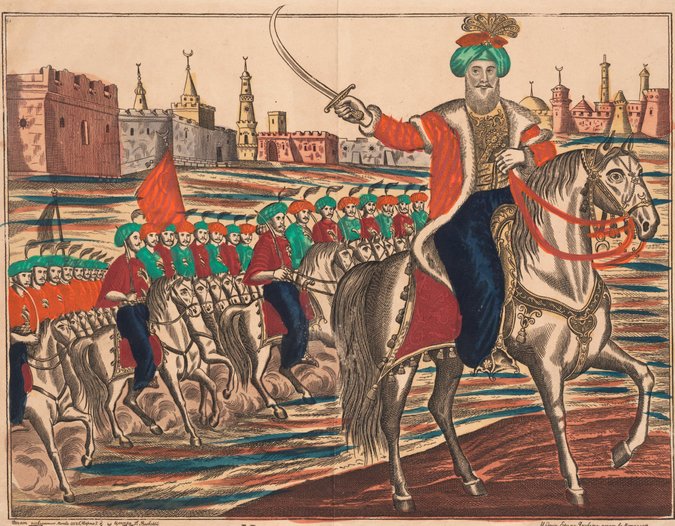
In a New York Times article David Motadel examines the role of religious protectorates past and present to help shed light on current events in the Middle East.  Several powers during the eighteenth and nineteenth centuries declared themselves protectorates of coreligionists in other states. For example, Russia declared itself the protector of Orthodox Christians within Ottoman territories and then used this as leverage to intervene in Ottoman affairs. As Motadel points out this type of “politics of religion…subverted states, fueled divisions within them — and often ended in violence.”

Currently in the Middle East it is Iran and Saudi Arabia who are engaging in the politics of religion. Motadel argues that “Iran’s attempts to become the global defender of Shiite Muslims and Saudi Arabia’s efforts to lead the Sunnis have become central in their battle for mastery of the Middle East, transforming the region’s international system from an order of states to an order of faiths.” And just as in the past this political maneuvering is destabilizing the region and fueling the violence. Obviously the causes of instability in the region are many, but I think Motadel has indicated an important contributor to the current unrest.  Read the entire article here:

‘Defending the Faith’ in the Middle East – NYTimes.com.

"An anonymous painting of Turkish Emperor Mahmud II leading his troops. Credit Fine Art Images/Heritage Images/Getty Images "

“An anonymous painting of Turkish Emperor Mahmud II leading his troops. Credit Fine Art Images/Heritage Images/Getty Images “

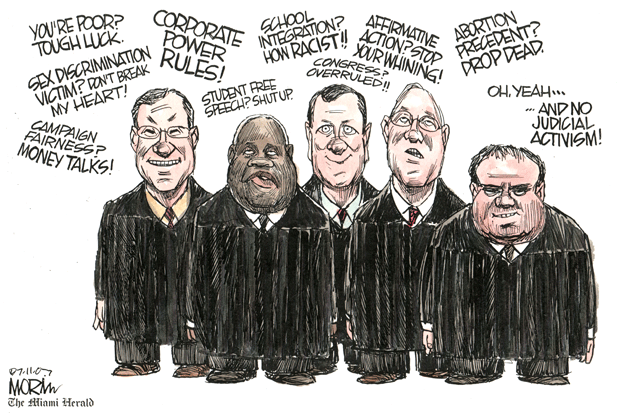
Are the Supreme Court Justices Roberts, Scalia, Alito, and Thomas Qualified to be Justices?

Alan J. Singer says “no.” In an interview at Education News, Singer told Michael F. Shaughnessy that these four should never have been elected Supreme Court Justices  “because Justices swear an oath to defend the United States Constitution as the first law of the land…In decision after decision they placed ideology and personal values above the Constitution and the law. They decided corporations have the same rights as people and then defended the rights of the world’s wealthiest companies over the rights of ordinary people, are still considering undermining a national health insurance plan, and denounce crime and violence while ensuring the maximum distribution of deadly weapons. However they eventually decide on the same-sex marriage issue, I do not trust them.” Neither do I! Read the entire interview here:

Alan J. Singer: Comments about the Supreme Court Justices Comments | Education News.

Alito, Thomas, Roberts, Kennedy, and Scalia

Alito, Thomas, Roberts, Kennedy, and Scalia

History Wars: “Fight over AP U.S. History framework lands in N.J.” | The Auditor | NJ.com

Republican state Sen. Joe Kyrillos proposed a resolution (SR128) that would encourage the College Board to alter the AP U.S. history framework, because “the framework the College Board adopted in 2012 ‘reflects a seemingly biased view of American history, overemphasizing the negative aspects of our nation’s history while omitting and minimizing many of the positive aspects,'” and that “the new test’s framework ‘does not adequately discuss America’s Founding Fathers, the principles of the Declaration of independents the religious influences on our nation’s history.'” Even though this non-binding resolution is unlikely to pass, the efforts to teach our students a distorted patriotic version of history is troubling. We should be educating and challenging our students, not indoctrinating them. Progress requires an educated and thoughtful citizenry. And it is only by confronting the past honestly that we can actually live up to our ideals.

Fight over AP U.S. History framework lands in N.J. | The Auditor | NJ.com.

apush

“The American Military Uncontained” | History News Network

The retired lieutenant colonel (USAF) William J. Astore examines the current role of the U.S. military from the perspective of the 1990s, after we emerged victorious from the Cold War. Rather than gearing down for peacetime Astore shows that the military retained it Cold War size and attitude. But crucially, according to Astore, it also became uncontained as the sole superpower. He argues that after the fall of the Soviet Union the attitude that emerged was one of “go[ing] for broke.” After laying out the consequences of this situation, he warns, “No military should ever be trusted and no military should ever be left uncontained.  Our nation’s founders knew this lesson.  Five-star general Dwight D. Eisenhower took pains in his farewell address in 1961 to remind us of it again.  How did we as a people come to forget it?  WTF, America?”
I agree with much of what Astore says, but I see the transition to the present situation a little differently. He makes no differentiation between the humanitarian efforts (or non-efforts to be more accurate) in places like Bosnia, Somalia, and Rwanda in the 1990s, and the so-called “national security” interests in places like Iraq, Afghanistan, Iraq, Pakistan, and Yemen in the twenty-first century.
“Yet even as civilian leaders hankered to flex America’s military muscle in unpromising places like Bosnia and Somalia in the 1990s, and Afghanistan, Iraq, Libya, Pakistan, and Yemen in this century, the military itself has remained remarkably mired in Cold War thinking.”
I think it is a mistake to see this trend beginning in the 1990s. We did NOT “go all in” for the 1990s humanitarian situations. In fact, trying to persuade the Bush (papa) administration and then the Clinton administration to do anything in these situations was like pulling teeth. We only intervened belatedly in the Bosnian War with very little cost or effort after thousands of Bosnian Muslims (Bosniaks) were slaughtered. We did successfully intervene in Kosovo, but mostly out of guilt for what we didn’t do in Bosnia. We shamefully did nothing in Rwanda. And we pulled out of Somalia, where we were engaged in humanitarian aid, after the first sign of trouble (Black Hawk Down), which played right into the hands of the Somalian warlords. So, I think it is misleading to include Madeleine Albright’s plea to send in troops to the former Yugoslavia as evidence of the “all in” attitude in regards to the military. In all these cases, those in power did everything they could to make sure we didn’t use the military. Why? Because these were humanitarian causes and the “Vietnam Syndrome” was still alive and well. These were the cases we should have intervened, but didn’t. So much for “never again”!
The hawks that Astore refers to care little for humanitarian interventions and were happy to intervene in what they saw as “national security” situations (e.g. The Gulf War). But I think it was something else that turned the tide toward the intervention everywhere attitude: 9/11. Presently the fear of terrorism ensures that this attitude will continue to prevail.
However, I agree with his conclusion “Take an uncontained, mutating military, sprinkle it with unconditional love and plenty of dough, and you have a recipe for disaster.” Read the entire article here:

History News Network | The American Military Uncontained.

rice.cheney.bush.rumsfeld

Texas students take aim at Jefferson Davis campus statue – Yahoo News

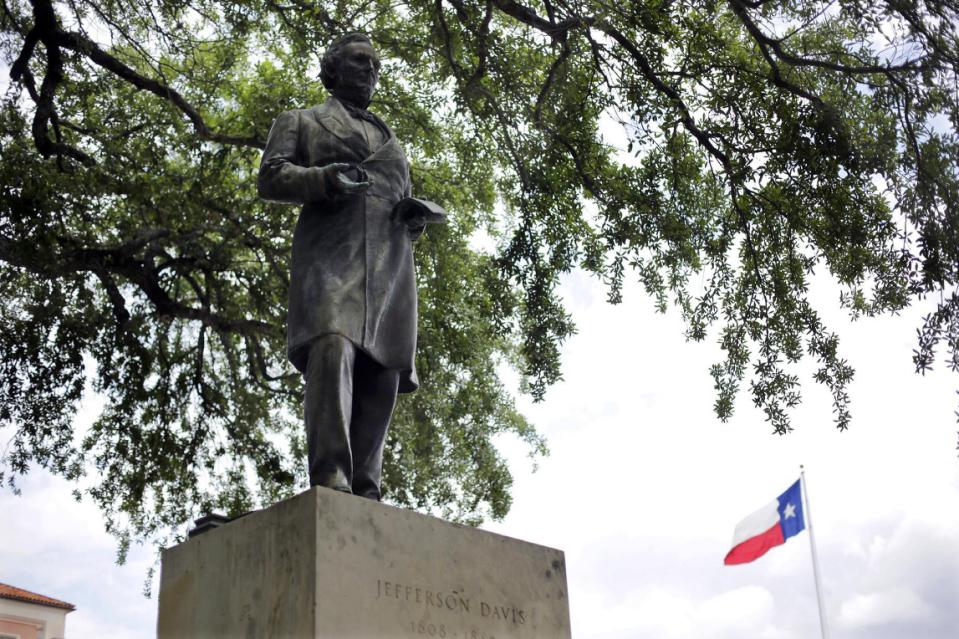
Apparently there are “more than 1,000 sites in the state that memorialize the Confederacy — from a Confederate cemetery in San Antonio and marker honoring Gen. Lawrence ‘Sul’ Ross at Sul Ross State University in Alpine to a building in Marshall that housed the Civil War State Government of Missouri in exile.” Unbelievable!!

Texas students take aim at Jefferson Davis campus statue – Yahoo News.

A statue of Jefferson Davis is seen on the University of Texas campus, Tuesday, May 5, 2015, in Austin, Texas. As University of Texas administrators consider a request to remove a statue that symbolizes the Confederacy, the number of memorials in Texas honoring the Confederate cause and its leaders continues to grow. (AP Photo/Eric Gay)

A statue of Jefferson Davis is seen on the University of Texas campus, Tuesday, May 5, 2015, in Austin, Texas. As University of Texas administrators consider a request to remove a statue that symbolizes the Confederacy, the number of memorials in Texas honoring the Confederate cause and its leaders continues to grow. (AP Photo/Eric Gay)

The Consequences of Ignoring the Lessons of History: “Stand Your Ground Makes No Sense” – NYTimes.com

What has been the impact of the “Stand your Ground” laws since their enactment? This is the subject of an article in The New York Times today. After examining several new studies on the subject, Robert J. Spitzer concludes that “[n]ot only have these laws failed to increase public safety, they have also turned the clock back to the mythologized mayhem of the Wild West.” And he points out, “We’ve learned this lesson before, in our own violent past, when strict regulation of concealed gun carrying was the near-universal and successful response to gun violence. As early as 1686, New Jersey enacted a law against wearing weapons because they induced ‘great Fear and Quarrels.’ Massachusetts followed in 1750. In the late 1700s, North Carolina and Virginia passed similar laws. In the 1800s, as interpersonal violence and gun carrying spread, 37 states joined the list. Tennessee’s 1821 law fined ‘each and every person so degrading himself’ by carrying weapons in public. Alabama’s 1839 law was titled ‘An Act to Suppress the Evil Practice of Carrying Weapons Secretly.’ Why must we relearn a lesson we codified centuries ago? How dumb are we?” It’s unlikely that these laws will be repealed any time soon. Evidence means little to the NRA and its zealous followers.

Stand Your Ground Makes No Sense – NYTimes.com.

John-Patrick Thomas, The New York Times (May 4, 2015)

John-Patrick Thomas, The New York Times (May 4, 2015)

“Two Things You Don’t Know About Roe v. Wade that Will Surprise You” | History News Network

James Robenalt, in his new book January 1973, argues “that this controversial change in how the case was decided had a dramatic impact on American politics. The Roe decision activated the so-called Religious Right. But more importantly, because abortion is an issue about which many will not compromise—it is a life and death decision to some—the whole concept of “no compromise” as a political strategy entered our political bloodstream. Along with the other great events of January 1973—Truman’s death, end of the Vietnam War for the US, Watergate burglars’ trial, Nixon’s Second Inaugural, Roe and the death of Lyndon Johnson (on the same day as Roe)—the conditions set up for a government of deadlock.” To find out the two things about Roe that will surprise you, read his article:

History News Network | Two Things You Don’t Know About Roe v. Wade that Will Surprise You.

January 1973

The Cost of Turkey’s Genocide Denial – NYTimes.com

The historian Ronald Grigor Suny offered a potent lesson, not just for Turkey, but for all peoples in The New York Times this past week. Assaulting historical truth in the service of political ends is nothing new. However, a recent rise in nationalism in places like Russia and Japan has brought this issue to the forefront as a potential destabilizing force. Suny persuasively explains why this is a concern and why Turkey should admit to the genocide. “It is well known that each nation feels its own pain and has difficulty feeling that of others. Yet reconciliation of Armenians, Kurds and Turks — who are fated to live next to each other — will require both an acceptance of their shared history and mutual suffering and a hard look backward in order to move forward. Acknowledging who set the fire and directed it against the most vulnerable population must be part of the healing.” Read the entire article here:

The Cost of Turkey’s Genocide Denial – NYTimes.com.

armenian_genocide protest

Privatizing History | Patrick Stephenson

“An academic view of history that at least tries to be objective is a bit like a public good. We don’t all pay for it. But we all benefit from it. Because a basic grasp of history is, in my view, the foundation of critical thinking and democratic governance. But if history is a public good, we’re witnessing its privatization. The past has become a commodity that can be manufactured, packaged and sold to audiences eager to hear a good story that justifies their policies and their prejudices.” Wise words from Patrick Stephenson. Will we listen?

Read his article here:

Privatizing History | Patrick Stephenson.

history

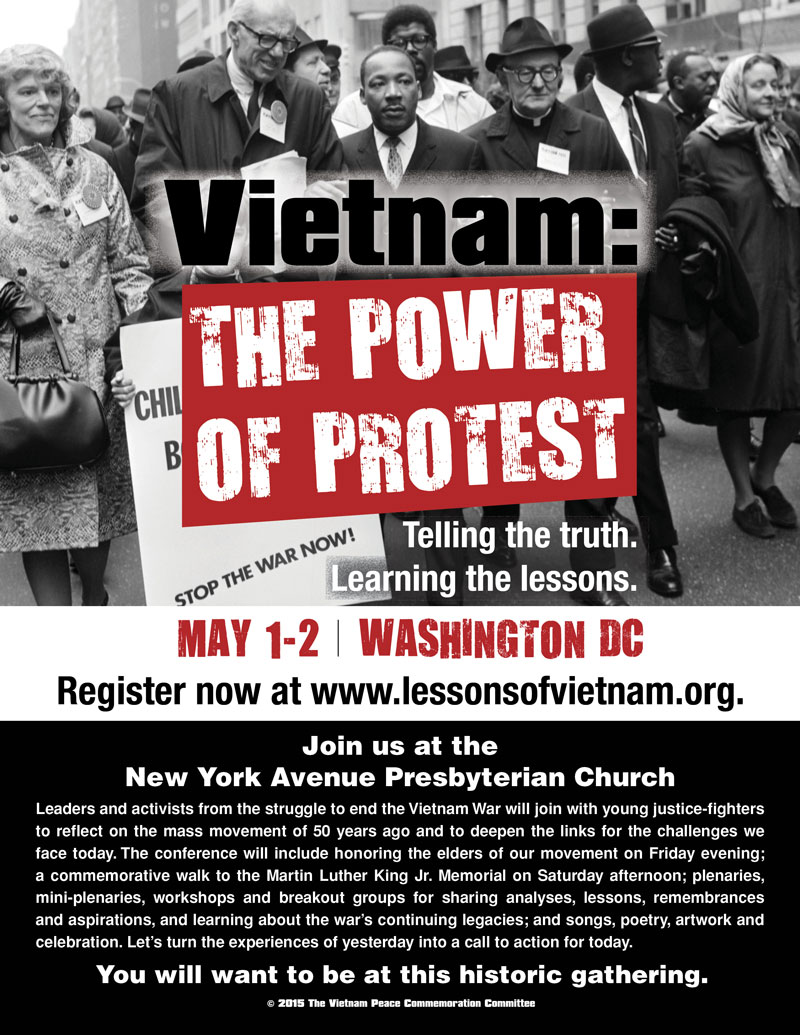
“Activists are combating the U.S. Army’s multimillion dollar commemoration of the War in Vietnam”| History News Network

Some of you may be interested in this:

History News Network | Activists are combating the U.S. Army’s multimillion dollar commemoration of the War in Vietnam.

Vietnam the power of protest