The historian Gregory J. W. Urwin debunks some of the self-serving Second Amendment narrative perpetuated by the NRA. Urwin’s essay is insufficient, but I applaud his effort. We need more historians pushing back against the seriously flawed and deadly NRA interpretation of the Second Amendment. The stakes are too high for them to remain on the sidelines.
I’m Irish-American and a historian, and I’m embarrassed to admit that I was unaware of this controversy over Irish-American immigrants.
The controversy began after the historian Richard J. Jensen published the article “No Irish Need Apply: A Myth of Victimization” in 2002. In it, Jensen argued that the Irish victimization narrative in America was based on a myth about “No Irish Need Apply” signs. He claimed that “there is no evidence for any printed NINA signs in America, or for their display at places of employment other than private homes.”
At the time some historians pushed back against Jensen’s claims, but no serious challenge was mounted against his claims. Although the historian Kerby Miller tried to mount an attack, he realized that it was “an unwinnable fight when he went to New Zealand to present some work and he was bombarded with questions on why he didn’t believe Jensen.” (The Daily Beast)
It took a 14-year-old student, Rebecca Fried, to debunk Jensen’s claim about the nonexistence of the NINA signs. She diligently searched through many newspaper databases and found plenty of evidence that these signs in-fact existed. (I want to add that there is plenty other evidence for the persecution of Irish Americans in the nineteenth and twentieth centuries. Maybe there was some exaggeration of the persecution the Irish faced but it was most definitely real.)
I question Jensen’s motives for his thesis. As historians we strive to be objective, but sometimes our bias get the better of us. This is why the study of history is a collective endeavor. We are all responsible for keeping other historians in check. In this case a curious student did what a fellow historian should have done. Great job Rebecca!
No one could have predicted that! Archaeologists found Catholic relics in the coffin of one of the most important leaders of the Jamestown settlement: Captain Gabriel Archer. The history of Jamestown was already interesting but it just got a whole lot more interesting.
Many of those who object to the Obergerfell ruling have compared it to the disgraceful Dred Scott (1857) decision that declared that even free blacks could not be citizens and that the Missouri Compromise was unconstitutional thus effectively nullifying the idea of slave free states. Amy Davidson debunks this flawed analogy in a discerning article at The New Yorker. The analogy basically fails because “Dred Scott constrains liberty and Obergefell expands it,” but Davidson further breaks down the failures of this analogy by diving deeper into the Scott case. Thus Davidson’s exposé is also a reminder of the shameful racism that is part of our historical legacy.
Why are some using this analogy? Davidson concludes, “In part, Dred Scott is simply being used to give Obergefell a bad name—as pure invective, another way to call the decision rotten and the Supreme Court deluded. This is low enough; Dred Scott is a truly degraded decision, in a way that no other of the Court, conservative or liberal, has since matched. And, in part, the analogy reflects the notion, held by some contemporary conservatives, that they are now the ‘real’ victims of bigotry.”
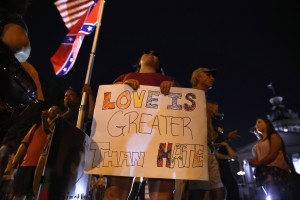
It should have never been there! But getting rid of this horrible symbol of hate is not enough. We need to work on getting rid of the real hate and the remaining prejudices that perpetuate inequality and discrimination.
Have you ever heard of the movie The Birth of a Nation? Me either! After reading Bruce Chadwick’s summary of the movie and watching snip-its from the 1915 film I now know why. It’s a blatantly racist film filled with stereotypes and outright falsehoods. (spoiler alert: the heroes of the movie are the KKK!!) But it was a hit at the time, becoming “one of the most financially successful films of all time.” The success of the movie says a lot about the mind-set of Americans in the early twentieth century. It’s also a testament of how far we have come even as we still have a long ways to go.
Chadwick thinks we should “bury” the movie, relegating it to the dust bin of history. While I think it is a vile movie, I think we can learn from it. It should cause us to reflect on our own willingness to accept stereotypes and myths that, while comforting to some, may be completely false. We are just as vulnerable to mythic narratives that cast ourselves as heroic and others as depraved as were our ancestors.
Today’s racism may not be as overt as it was in the twentieth century, but it is still there. Most of us aren’t racist (or don’t want to be racist), but we are vulnerable to the stereotypes that we are bombarded with in the media. The stereotypes are often subtle but nevertheless very real. Because it is so subtle we are often unaware it. These prejudices play out most visibly in our criminal justice system, where blacks are disproportionately arrested and convicted for crimes that are just as prevalent in white populations. Many of the cops, but not all, are probably being honest when they claim that they aren’t racist. Even well-meaning individuals act in ways that reflect the subtle prejudices that are the result of years of exposure to portrayal of blacks as criminals in the media and movies. A lot of research in psychology backs up this claim.
So, let’s celebrate our progress, but let’s also not forget that we have more work to do.
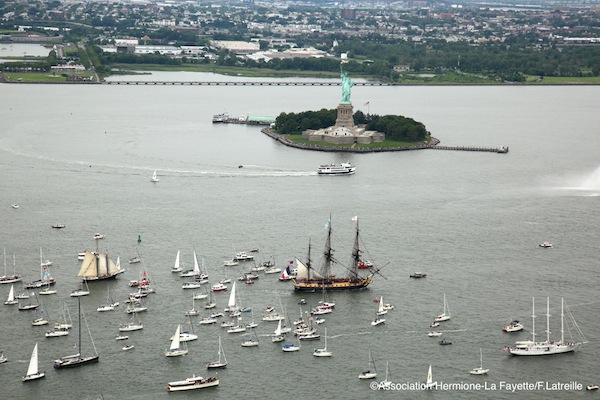
A replica of the tall ship L’Hermione leads a parade of ships to New York harbor. It was a fitting ceremony on the anniversary of American independence, and a reminder of the debt we owe to the French for our independence.
The original ship arrived in Boston on April 28, 1780 with the hero of the American Revolution, the Marquis de Lafayette. He brought news of France’s financial and military support for the Revolution. Lafayette first came to America in 1777 and fought bravely for the American cause, most famously at the Battle of Brandywine (September 11, 1777).
Read the story of the original ship and Lafayette’s voyage here:
I shouldn’t be surprised, but this is shocking! Here’s one example of a comment on the plight of African-American slaves that Margaret Biser heard giving tours: “Yeah, well, Egyptians enslaved the Israelites, so I guess what goes around comes around!” I think Biser correctly identified the source of the ignorance, indifference, and animosity toward the slaves: “The minimization of the unjustness and horror of slavery does more than simply keep the bad feelings of guilt, jealousy, or anger away: It liberates the denier from social responsibility to slaves’ descendants.”
Read all the other crazy questions and comments Biser heard:
It is common knowledge that American’s have a short historical memory, but some of that forgetting is politically expedient as well. This is certainly the case when it comes the history of guns in the South. Therefore, it is significant that Robert McWhirter reminds us of this important history: “We associate the American south with guns and consider it the most anti-gun control part of the nation. In reality it was always the most gun controlled. From before the American Revolution until the well after the Civil War slaves couldn’t touch a gun without the master’s permission. Laws prohibited even free blacks from having a gun, a situation that persisted throughout the Jim Crow south well into the twentieth century. This was strict gun control.”





 History Chick in AZ