“A New Look at Japan’s Wartime Atrocities and a U.S. Cover-Up” – The New York Times

“After the war, the United States covered up Japan’s biological warfare research on humans, allowing the perpetrators to escape punishment and to prosper.” Why? It “enabled the United States to gather information that was of great use for its own biological warfare program, early in the Cold War.” I don’t think that any potential benefit from these horrific experiments can justify covering up these crimes. And in the long run, it is against our own interests by undermining our moral standing in the world.  How we conduct ourselves around the world does have implications for our national security.

Read the entire article here: A New Look at Japan’s Wartime Atrocities and a U.S. Cover-Up – The New York Times

An exhibit at the Unit 731 museum depicts a frostbite experiment on prisoners.Credit Gilles Sabrie for The New York Times

“Japan May Cut Unesco Funds Following Nanjing Massacre Listing” – Japan Real Time – WSJ

“Japan said it may cut its financial contribution to an agency of the United Nations after the organization added documents on the Nanjing Massacre to its International Memory of the World Register last week.” The nationalist government in Japan proclaims that it wants to restore honor to the Japanese people, but its actions (denial of WWII war crimes, etc.) have served only to bring dishonor to the Japanese people. The honorable thing to do would be to own up to their past crimes and work to ensure that their nation never goes down that path again.

Source: Japan May Cut Unesco Funds Following Nanjing Massacre Listing – Japan Real Time – WSJ

Chinese honor guard members march at the Nanjing Massacre Memorial Hall in Jiangsu in December 2014. Associated Press

“Japanese historian upends the familiar narrative of WW 2 by taking a bottom up approach, focusing on fascism from the grassroots” | History News Network

We’re used to viewing the rise of Japanese fascism/imperialism in the 1930s from the perspective of the leaders who took Japan down this path.  But this is a limited perspective. If we really want to understand why Japan turned towards fascism, we need to understand the role that ordinary Japanese played as well. This much needed perspective is found in Yoshimi Yoshiaki’s Grassroots Fascism, which has recently been translated into English.

grassroots fascism Japan

“Long Journey Home: A Moment of Japan-Korea Remembrance and Reconciliation” | The Asia-Pacific Journal

Finally some good news in Japanese-Korean relations!

“The most important participants in this journey are not the living, but the dead: the bones of 115 Koreans brought to Japan as labourers during the Asia-Pacific War will be carried along the route, with ceremonies of remembrance along the way, to their final resting place in Korea. The itinerary they will trace in September follows, in reverse, the route they travelled in trucks and boats and trains when they were taken to remote mines and construction sites in wartime Japan, unaware that they would never see their homes or families again. More than seventy years on, they are at last going home.”

Source: Long Journey Home: A Moment of Japan-Korea Remembrance and Reconciliation | The Asia-Pacific Journal

China joins Russian and Japan in the History Wars: “World War II: From the Chinese Perspective” | History News Network

Source: History News Network | World War II: From the Chinese Perspective

Another Conspiracy Theory Bites the Dust: “Attack on Pearl Harbor”

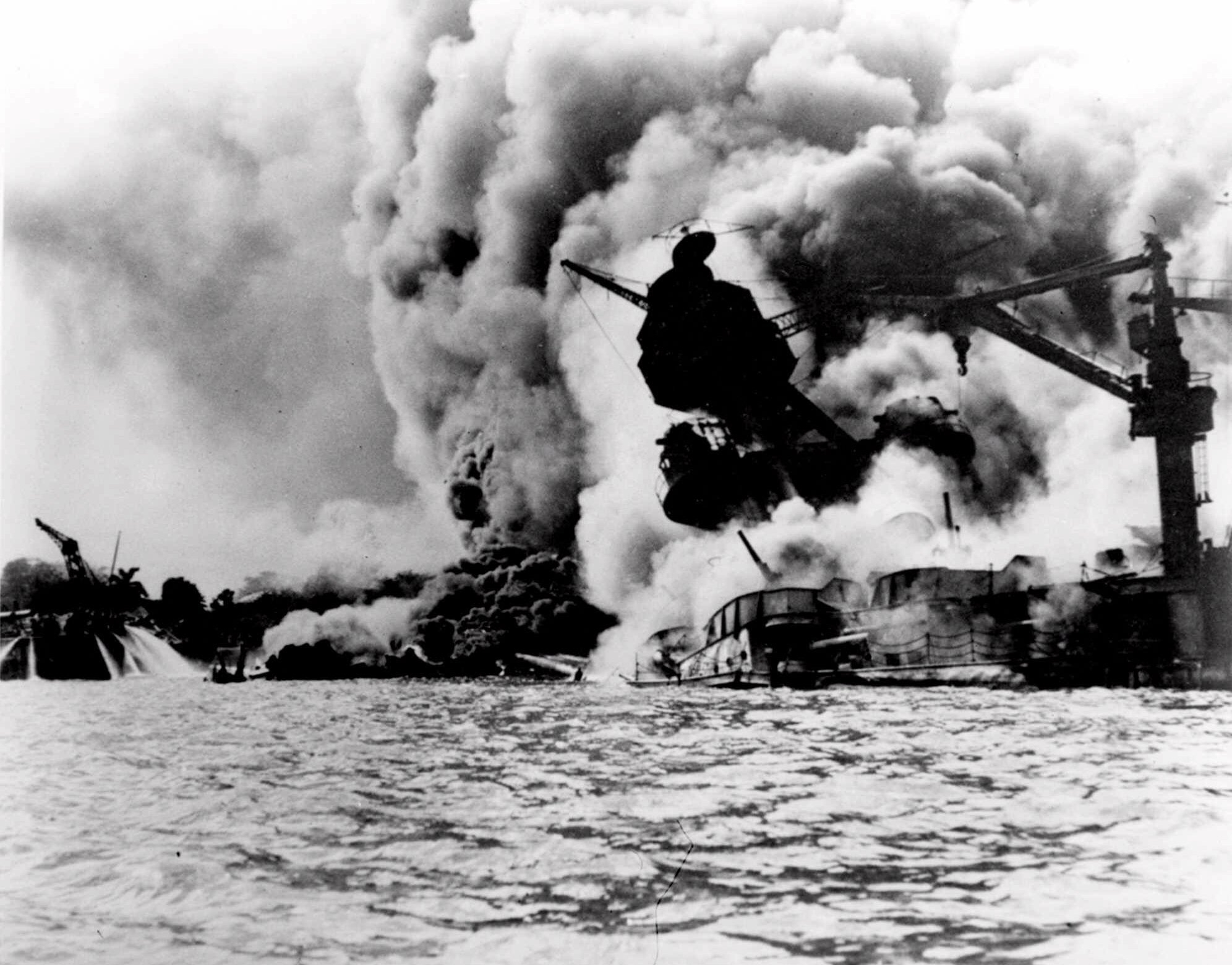
Brian Dunning respectfully examines the merits of the Pearl Harbor conspiracy theory that the American government knew about the attack and did nothing. In conclusion he states, “Even if this presumed conspiracy to allow the attack did exist, it failed to have any effect where the rubber meets the road. No orders from Washington altered the state of readiness at Pearl Harbor. Obviously the attack ultimately did play into the hands of anyone who wanted war with Japan; every tragedy somehow benefits somebody. That doesn’t make every tragedy a conspiracy.”

Read the entire article here:  Attack on Pearl Harbor.

Pearl_Harbor

Visualizing World War II Casualties (Military and Civilian): A Must Watch Video

This video visually explores the numbers of casualties by nation. I’ve seen the numbers before, but this doesn’t have the same impact as seeing them presented visually in this video. It really brings home the vast differences in casualties by nation. Note the differences suffered by the U.S. in comparison to the Soviet Union.

While no one agrees on the exact number of deaths, the relative number of deaths shown in this video are comparable to credible estimates.

Thanks to HNN for the pointer: History News Network | This Animated Data Visualization Of World War II Fatalities Is Shocking.

Abusing History: “Japan’s way of remembering World War II still infuriates its neighbours” The Conversation

In light of the earlier discussion on war crimes and apologies, here’s more on the consequences of Japan’s failure to apologize for (or recognize) its WWII war crimes: Japan’s way of remembering World War II still infuriates its neighbours.

“While Germany has managed to build holocaust education into its curriculum and is now at the centre of the European project, Abe and his predecessors have never acknowledged that relations with Korea and China would be greatly improved if there were a push for education and discussion about this terrible history. As things stand, no matter how the militaristic and nationalistic Abe handles the memory of the war in this anniversary year, Japan’s relations with its former adversaries are set to keep festering.”

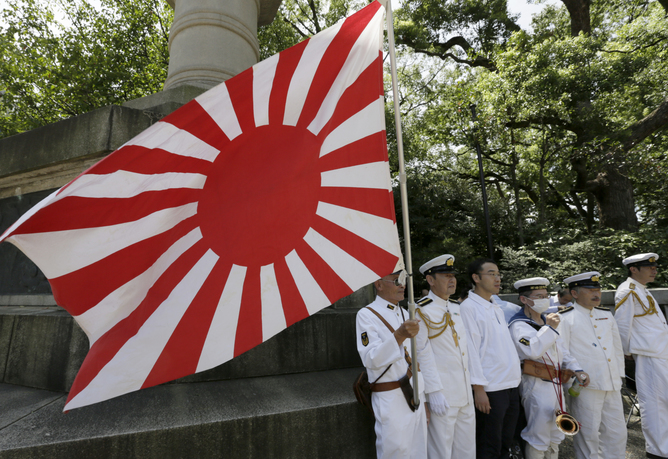
epa04354254 Japanese people wearing imperial navy costumes raise a rising sun flag as they visit the controversial Yasukuni Shrine to mourn for victims of World War Two in front of a torii gate at the shrine, Japan, 15 August 2014, marking the 69th anniversary of the end of World War Two. More than 2.5 million Japanese soldiers who died in the service are enshrined at Yasukuni, including convicted war criminals from World War II. EPA/KIMIMASA MAYAMA

” Japanese people wearing imperial navy costumes raise a rising sun flag as they visit the controversial Yasukuni Shrine to mourn for victims of World War Two in front of a torii gate at the shrine, Japan, 15 August 2014, marking the 69th anniversary of the end of World War Two. More than 2.5 million Japanese soldiers who died in the service are enshrined at Yasukuni, including convicted war criminals from World War II.” EPA/KIMIMASA MAYAMA

“Only One Occupied Country in Europe Rose to the Defense of Jews During World War II” | History News Network

This is a little known story about Denmark’s brave role in saving Jews. The story is quite remarkable and inspirational. If only more people had shown the same moral fortitude that the Danes did, many more Jews could have been saved.

There were many brave individuals who risked their own lives to save Jews in all European nations, but as Yoav J. Tenembaum points out  “there was a singular nation that, as a collective endeavor, saved most of its Jews: Denmark.” However, credit should also be given to the Italians, who protected their Jews despite the fact they were allies with the Nazis. It was only after they were occupied by the Germans that Italian Jews were sent to the camps. They also protected non-Italian Jews in the areas of the Balkans that were under their control.

It’s unfortunate that these acts of heroism are little known. I think we could learn a lot from these acts of bravery.

Read the story here: History News Network | Only One Occupied Country in Europe Rose to the Defense of Jews During World War II..

Jewish refugees rescued by Denmark

Christian Appy: “Our ‘Merciful’ Ending to the ‘Good War'” |History News Network

Seventy years ago today, the U.S. dropped an atomic bomb on Nagasaki. Just three days earlier Hiroshima had suffered the same fate. The debate over the necessity of dropping these bombs on continues to be highly contentious and divisive. Despite the fact that there has been a growing body of evidence that challenges the standard narrative (see below) of these events, this comforting narrative shows no sign of abating in public memory. Since I’ve already addressed this topic in a previous post, I’d like to address a related, but very important issue brought up by Christian Appy.

He challenges to consider these questions:

“Will an American president ever offer a formal apology? Will our country ever regret the dropping of ‘Little Boy’ and ‘Fat Man,’ those two bombs that burned hotter than the sun? Will it absorb the way they instantly vaporized thousands of victims, incinerated tens of thousands more, and created unimaginably powerful shockwaves and firestorms that ravaged everything for miles beyond ground zero? Will it finally come to grips with the ‘black rain’ that spread radiation and killed even more people — slowly and painfully — leading in the end to a death toll for the two cities conservatively estimated at more than 250,000?”

Appy concedes, and I agree, that any kind of apology is unlikely in the foreseeable future given current politics. But the issue is too important not to discuss.

Even if there was some agreement on the morality of the bombings, there is another hurdle to overcome before we can ever get to an apology. There is a widespread belief that apologies are for the weak. This is unfortunate. In reality, apologies show a strength of character that is hard to find among leaders today. An exception is Pope Francis, who has improved the standing of the Catholic Church by apologizing for the “past sins” of the church. (e.g. Bolivia)

In 1995, the Japanese Prime Minister apologized for their war crimes, as he should have. But the current Prime Minister, Shinzo Abe, has done much to undermine the good will that was achieved by these apologies, to the detriment of Japan’s relationships with South Korea and China.

Apologies go a long way towards healing relationships between victim(s) and the wrongdoer. It is not only the right thing to do; it goes a long way towards creating amicable relationships. Therefore, it would be in our interest to apologize. An apology would also go a long way in improving our image in the world.

Read Appy’s informative and thoughtful essay on this topic here: History News Network | Our ‘Merciful’ Ending to the ‘Good War’.

Standard narrative: The U.S. dropped an atomic bomb on Hiroshima and Nagasaki to end the war quickly and save American lives. Part of this narrative is the claim that the Japanese were warned and that the cities were military targets.

Nagasaki bomb