Source: History News Network | Oh, No, It’s Happening Again!
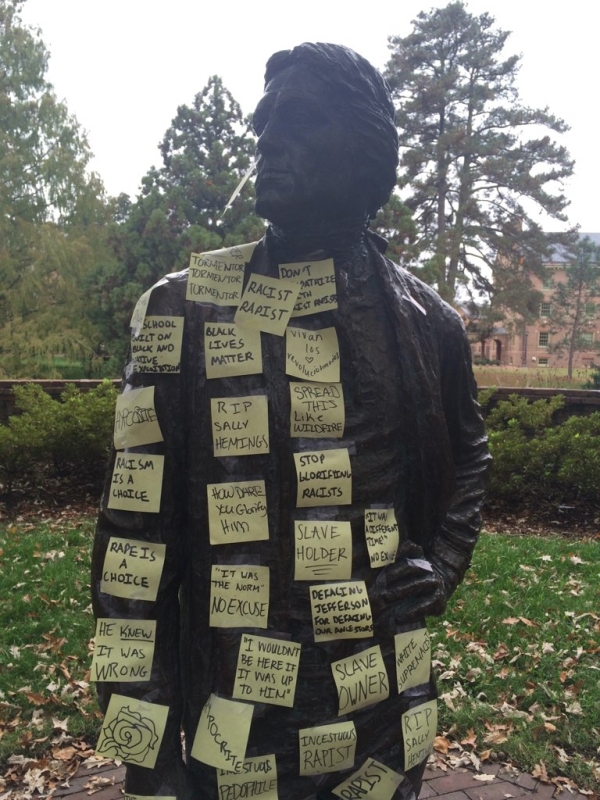
“Thomas Jefferson is next target of students who question honors for figures who were racists” | Inside Higher Ed
“At University of Missouri and William & Mary, some place notes on statues honoring the author of Declaration of Independence, calling him a rapist and a racist.”
This is unfortunate. There is no comparison between Jefferson and the leaders of the Confederacy, who fought to preserve the institution of slavery.
To some, the fact that Jefferson was a slave holder is enough to condemn him. But we must look at the broader context of the world in which Jefferson lived. Yes, Jefferson was born into a world of privilege, largely built on the backs of slaves. But in this he had no choice. The institution of slavery was rarely questioned at this time. Jefferson will be part of a generation that will begin to challenge the assumptions and traditions of his native Virginia.
As a product of the Enlightenment, Jefferson embraced values that were antithetical to slavery (equality and freedom). It is clear from his writings that he was aware of the contradictions between his values and his ownership of slaves. It is a blot on his character, but we must remember that Jefferson’s social standing and income rested on this wretched institution. While not completely exculpatory, we must give Jefferson credit for being one of the first among his peers to question the practice. In his day, Jefferson was a radical, even if he was not as radical as we would have liked him to be. In the 18th century it was radical to question the institution of slavery.
In Jefferson’s original draft of the Declaration of Independence, he included a clause that accused King George III of “wag[ing] a cruel war against human nature itself, violating it’s most sacred rights of life and liberty in the persons of a distant people who never offended him, captivating and carrying them into slavery in another hemisphere, or to incure miserable death in their transportation thither….he has prostituted his negative for suppressing every legislative attempt to prohibit or to restrain this execrable commerce…” [full draft] Obviously, this did not sit well with his fellow Southerners (as well as some Northerners) and it was therefore deleted from the final draft.
Jefferson also wrote against the institution of slavery in his Notes on the State of Virginia (1782): “There must doubtless be an unhappy influence on the manners of our people produced by the existence of slavery among us. The whole commerce between master and slave is a perpetual exercise of the most boisterous passions, the most unremitting despotism on the one part, and degrading submissions on the other.”
Was Jefferson a racist? Yes, guilty as charged, but so was everyone else at the time. And even here, Jefferson was ahead of his time. While he saw them as inferior, he wondered if this was due to “the difference of condition, of education, of conversation, of the sphere in which they move.” (Notes on the State of Virginia) This is in sharp contrast to many of his fellow Americans who saw their inferiority as an intrinsic feature of their race.
There is another important difference between Jefferson and the Confederates. Jefferson articulated the very values that ultimately undermined the slavery. The language of the Declaration of Independence (“all men are created equal”) provided the language and values to with which to attack slavery, and later all other forms of injustice.
The pursuit of liberty and equality was Jefferson’s raison d’ etre, even if he was unable to fully live up to those values. We should honor Jefferson for his noble contributions, as embodied most poignantly in the Declaration of Independence and the Statute for Establishing Religious Freedom. It is these values that we should think of when we see a statue of Jefferson.
“I trust that the whole course of my life has proved me a sincere friend to religious as well as civil liberty” (Jefferson, Letter to the Society of the Methodist Episcopal Church, 1809)

“The Refugees & the New War by Michael Ignatieff “| The New York Review of Books
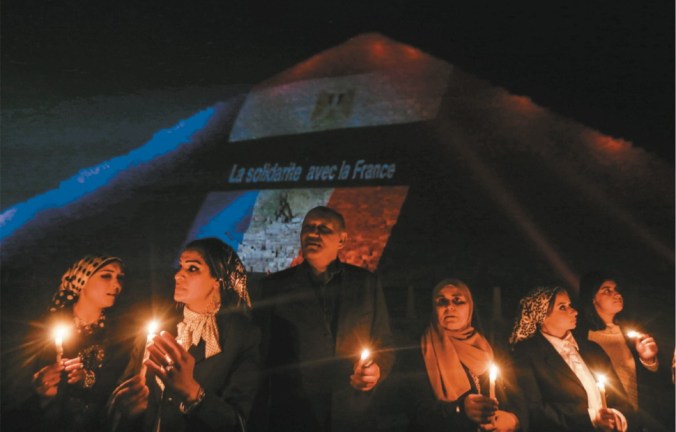
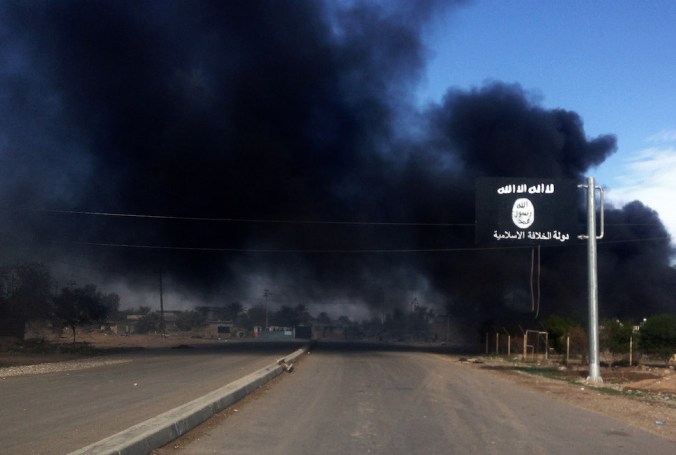
Another credible voice making the case against giving ISIS what it wants: “Strategists will tell you that it is a mistake to fight the battle your enemies want you to fight. You should impose your strategy on them, not let them impose theirs on you. These lessons apply to the struggle with the leaders of ISIS. We have applied pressure upon them in Syria; they have replied with atrocious attacks in Ankara, Beirut, and now Paris. They are trying to provoke an apocalyptic confrontation with the Crusader infidels. We should deny them this opportunity.”
Source: The Refugees & the New War by Michael Ignatieff | The New York Review of Books
“Paris: The War ISIS Wants by Scott Atran and Nafees Hamid” | NYR Daily | The New York Review of Books
“Following the Paris attacks, France, the United States, and our allies may opt for all-out war. But even if ISIS is destroyed, its message could still captivate many in coming generations.”
If we want to defeat ISIS we must understand them first. The desire for revenge in the aftermath of the attacks in Paris is understandable. However, this emotionally satisfying response will lead us right into the trap set by ISIS, and will most likely make things worse.
The article by Atran and Hamid go a long way in helping us understand ISIS and the motives to those who join the movement: Paris: The War ISIS Wants by Scott Atran and Nafees Hamid | NYR Daily | The New York Review of Books
“The New Monument Men Outsmart ISIS”
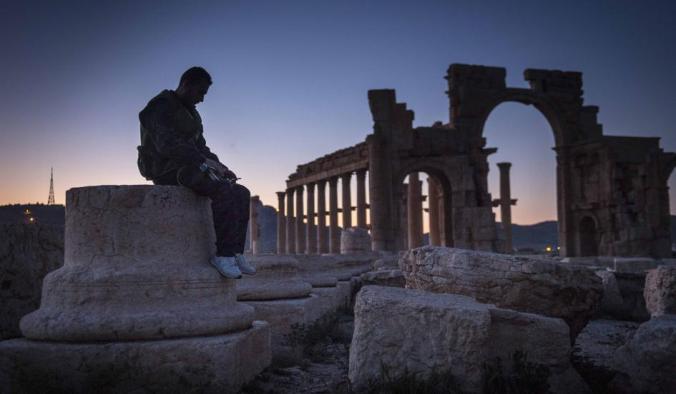
A bit of a bright spot on the monuments front: “A team of scientists employ technology to document archaeological sites before ISIS destroys them.”
“Despite an attempt to eradicate the cultural heritage of the Middle East, ISIS has inspired new ways for it to spread. By stimulating IDA’s plans for creative collaborations taking place on a global scale, ISIS has opened up a dialogue between those it most desperately wanted to silence.”
TV Weekly Now | NGC Premieres Two-night Movie Event “Saints & Strangers,” a Story that goes beyond the Historical Account of Thanksgiving
“Goes beyond the historical account of Thanksgiving & the founding of Plymouth Plantation, revealing the trials and tribulations of the settlers at Plymouth: 102 men, women & children who sailed on a chartered ship for a place they had never seen.”
I don’t get the National Geographic Channel but this looks good. For those of you who do, it premieres Nov. 22.
Textbook Wars, cont.: “South Korea’s Textbook Whitewash” – The New York Times
Sadly, the South Korean government will now mandate the use of their specially created textbook. “Issued by the government, the new books will rewrite history to bolster the president’s conservative cause.”
Beyond the implications for the education of South Korea’s students, this move has geopolitical implications. As Se-Woong Koo points out: “In geopolitical terms, the Park administration is undermining efforts to confront Japan over its crimes in the wartime era, especially the issue of comfort women. If South Korea can promote its own incomplete history among children, why should Japan not be able to do the same and obscure its dark past?”
This is an unfortunate trend seen across the globe!
Source: South Korea’s Textbook Whitewash – The New York Times
“Kissinger, the Bombardier” | History News Network
Grandin concludes: “Here, then, is a perfect expression of American militarism’s unbroken circle. Kissinger invokes today’s endless, open-ended wars to justify his diplomacy by air power in Cambodia and elsewhere nearly half a century ago. But what he did then created the conditions for today’s endless wars, both those started by Bush’s neocons and those waged by Obama’s war-fighting liberals like Samantha Power. So it goes in Washington.”
Read the entire piece here: History News Network | Kissinger, the Bombardier
Propaganda and De-humanization: “The Brain with David Eagleman” PBS
The study of history is the study of human nature. However, it’s not the only way to understand human behavior. Science can also illuminate the mysteries of human behavior. Scientists may approach the problem in a different way, but they are also trying to understand human beings. So, I was thrilled when David Eagleman turned to the subject of ethnic/religious conflict in the third program in a series on the brain. And he used the War in Bosnia (something I’ve spent years studying) to illustrate the problem.
What have scientists found? That when people are confronted with people in our out group (however defined) our brains react as if they were objects, not human beings. The ability to empathize with those in their out group had been lost. How does this de-humanization happen? Usually, through propaganda.
I’ve spent years studying religious/ethnic conflict to come to the same conclusion. He also proposed the same solution: educate students to detect propaganda. In other words, we need to educate students to be good B.S. detectors and independent thinkers. This is one of the reasons why the humanities are so important, particularly philosophy and history.
Here’s the link to the website for the PBS program: The Brain with David Eagleman
“Thermal Scans Of Egypt’s Great Pyramid Reveal ‘Impressive’ Anomaly” | Huffington Post
“We have several hypotheses but no conclusion for the moment.” Maybe it’s Ben Carson’s grain!! he he!
Source: Thermal Scans Of Egypt’s Great Pyramid Reveal ‘Impressive’ Anomaly