How exciting! They found a late 18th- or early 19th-century shipwreck in the Atlantic.
Accidental Find: Scientists Stumble on Centuries-Old Shipwreck – Yahoo News.

How exciting! They found a late 18th- or early 19th-century shipwreck in the Atlantic.
Accidental Find: Scientists Stumble on Centuries-Old Shipwreck – Yahoo News.
History News Network | This is One Reason the World Is on Fire.

In Richard Striner’s final post on the history of Libertarianism, he examines the influence of Ayn Rand and Friedrich Hayek. Then he briefly examines the rise of the current movement in the U.S. from Barry Goldwater to the present. In conclusion, he questions the viability of the rigid libertarian worldview that is based on an extreme form of individualism: “We prize our own liberty, true, and we will obviously struggle to defend it —— fiercely if we must —— when it is threatened. But to elevate government above all other possible threats to our liberty is hard to do when push comes to shove. When a natural disaster devastates the region in which we are living and reduces our homes to a shambles —— what then? If vicious thugs invade our homes, what instincts take over as we rush to respond to the invasion? Do we immediately think of warning all the agents of government to watch their step and avoid messing with us? Or do we call 911 and hope the agents of government arrive just as quickly as they can?”

Leif Parsons, The New York Times
We all want to belong. We all want to think that we are good. We all want to be proud of our heritage, community, and history. We all want to have purpose and meaning in our lives. These are all genuine human desires that are by themselves positive sentiments, but they ultimately leave us vulnerable to manipulation by ambitious political leaders. Because nationalism fulfills all of these desires it has been the ideal political weapon for leaders like Slobodan Milosević, who unleashed the forces of Serbian nationalism as a way to rise to power. But more than fulfilling Milosević’s political ambitions it also released the forces of hatred that tore apart the former Yugoslavia of which the massacre of Srebrenica was a part of. Nationalism rests on an “us versus them” narrative that is more myth than actual history. All past nationals sins must be swept under the rug as a way to make the nation worthy of glory. If it just engendered pride in one’s past, nationalism would not be such a destructive force. Unfortunately, the end result is usually arrogance and hatred.
Natalie Nougayrede’s article at The Guardian reminds us that Putin is playing with the same fire for his own political purposes. This is not to say that Putin is planning to commit genocide or ethnic cleansing, but that his use of nationalism will, and already has, bring great suffering to many. Putin’s veto of the UN resolution is only a small part of his overall power play, but as Nougrayrede reminds us, it is still significant if we value peace and justice. “Some will argue that Russia’s latest veto should be seen as just another snub to the west. But the rewriting of the history of the Bosnian war and the unravelling of the mechanisms that the west tried to put in place to prevent more violence are something that Europeans would do well not to minimise. If only because of those unarmed 8,000 men and boys who were killed just because of who they were: Bosnian and Muslim.”


On this day in 1789, the French revolutionaries in search of arms stormed the Bastille, the former prison that stood as a symbol of tyranny, and in the process killed the governor of the Bastille, Bernard-Rene Jourdan de Launey. The Bastille was then dismantled brick by brick. It remains a symbol of the Revolution!

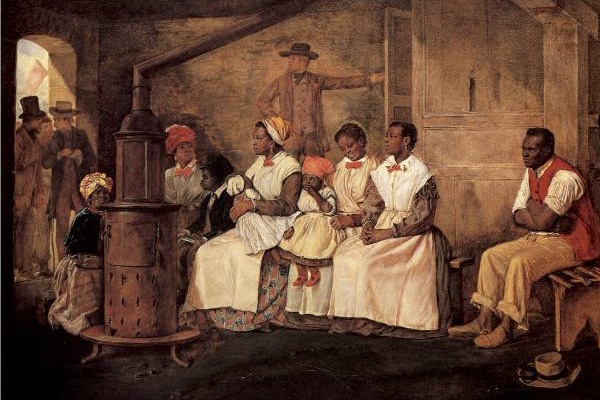
“Slaves Waiting for Sale: Richmond, Virginia – Wikipedia”
Update on the attack on public education in Wisconsin. So sad!
Peter Greene dissects a statement by the Heartland Institute, a rightwing think tank, cheering for the “dismantling” of public education in Wisconsin. The cheering from the free marketeers was prompted by new legislation to expand vouchers and charters. That legislation awaits Governor Scott Walker’s signature, of which there is no doubt.
The privateers view public education with scorn, as a public monopoly rather than a public responsibility. They forget, or never knew, that the development if public education was long considered a major milestone in our democracy, a promise that all the children would have the right to a free public education. Given our diversity, the public schools would be common schools, serving the entire community and creating an educated citizenry.
Greene writes:
“The Wisconsin Legislature passed a budget this week that dumps more funding into the already-robust voucherific choicetastic system in Wisconsin. All the budget needs is a signature…
View original post 203 more words
Many of those who object to the Obergerfell ruling have compared it to the disgraceful Dred Scott (1857) decision that declared that even free blacks could not be citizens and that the Missouri Compromise was unconstitutional thus effectively nullifying the idea of slave free states. Amy Davidson debunks this flawed analogy in a discerning article at The New Yorker. The analogy basically fails because “Dred Scott constrains liberty and Obergefell expands it,” but Davidson further breaks down the failures of this analogy by diving deeper into the Scott case. Thus Davidson’s exposé is also a reminder of the shameful racism that is part of our historical legacy.
Why are some using this analogy? Davidson concludes, “In part, Dred Scott is simply being used to give Obergefell a bad name—as pure invective, another way to call the decision rotten and the Supreme Court deluded. This is low enough; Dred Scott is a truly degraded decision, in a way that no other of the Court, conservative or liberal, has since matched. And, in part, the analogy reflects the notion, held by some contemporary conservatives, that they are now the ‘real’ victims of bigotry.”
Read the entire article here: What Does Marriage Equality Have to Do with Dred Scott? – The New Yorker.

Eliza and Lizzie Scott, children of Dred Scott.
Credit Image by Getty/MPI

 History Chick in AZ