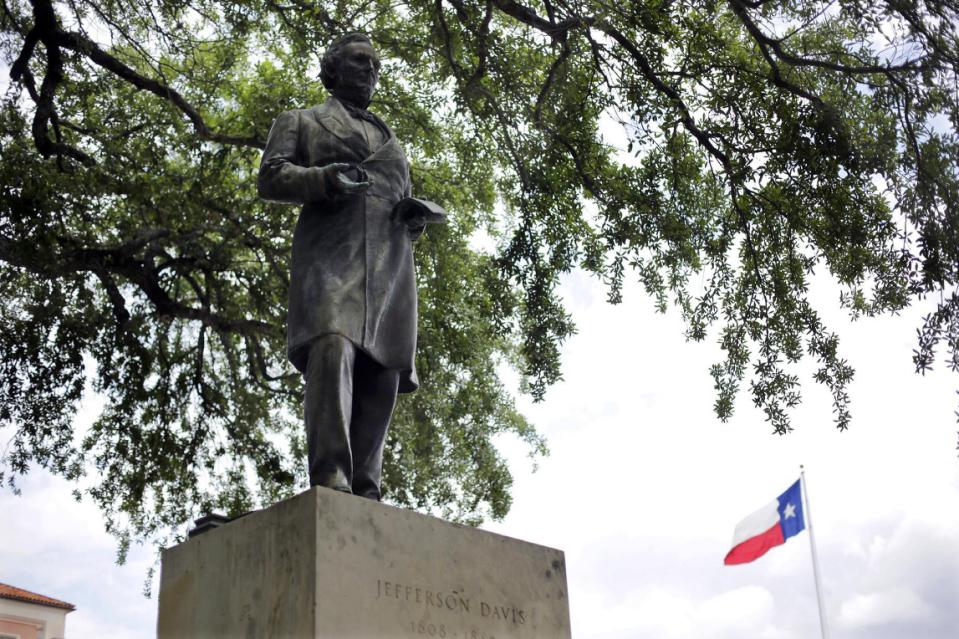
Texas students take aim at Jefferson Davis campus statue – Yahoo News

Apparently there are “more than 1,000 sites in the state that memorialize the Confederacy — from a Confederate cemetery in San Antonio and marker honoring Gen. Lawrence ‘Sul’ Ross at Sul Ross State University in Alpine to a building in Marshall that housed the Civil War State Government of Missouri in exile.” Unbelievable!!

Texas students take aim at Jefferson Davis campus statue – Yahoo News.

A statue of Jefferson Davis is seen on the University of Texas campus, Tuesday, May 5, 2015, in Austin, Texas. As University of Texas administrators consider a request to remove a statue that symbolizes the Confederacy, the number of memorials in Texas honoring the Confederate cause and its leaders continues to grow. (AP Photo/Eric Gay)

A statue of Jefferson Davis is seen on the University of Texas campus, Tuesday, May 5, 2015, in Austin, Texas. As University of Texas administrators consider a request to remove a statue that symbolizes the Confederacy, the number of memorials in Texas honoring the Confederate cause and its leaders continues to grow. (AP Photo/Eric Gay)

Review of Barry Eichengreen’s “Hall of Mirrors: The Great Depression, the Great Recession, and the Uses – and Misuses – of History” |History News Network

Robert Brent Toplin reviews Barry Eichengreen’s Hall of Mirrors and concludes, “He makes that valuable contribution by addressing the subject uniquely, asking what we have learned and failed to learn from the record of the Great Depression. His investigation offers many useful hints about ways policymakers can avoid repeating the mistakes of the past.” Read the entire review here:

History News Network | Review of Barry Eichengreen’s “Hall of Mirrors: The Great Depression, the Great Recession, and the Uses – and Misuses – of History”.

Hall of Mirrors Great Depression

“What Was on the Minds of the Big Three at Potsdam?” |History News Network

Michael S. Neiberg argues that it was the failures of the Paris Peace Conference (1919) rather than the issues around what became the Cold War. Read the summary of his argument here:

History News Network | What Was on the Minds of the Big Three at Potsdam?

Potsdam

“What’s the Point of a Professor?” – NYTimes.com

Given the recent attacks on higher education, and the humanities in particular, Mark Bauerlein’s query (“What’s the Point of a Professor?”) is timely.

Reflecting on his own undergraduate education Bauerlein claims, “In our hunger for guidance, we were ordinary. The American Freshman Survey, which has followed students since 1966, proves the point. One prompt in the questionnaire asks entering freshmen about ‘objectives considered to be essential or very important.’ In 1967, 86 percent of respondents checked ‘developing a meaningful philosophy of life,’ more than double the number who said ‘being very well off financially.’ Naturally, students looked to professors for moral and worldly understanding.” This obviously no longer describes undergraduate attitudes. As Bauerlein notes, “finding meaning and making money have traded places. The first has plummeted to 45 percent; the second has soared to 82 percent.”

These changing attitudes have been at the root of the challenges to higher education and they threaten to transform it into a worker program. The stakes couldn’t be higher, but rather than address the larger issues that are driving the changes that he laments, Bauerlein lays the burden of turning the tide on professors. While I agree that we “can’t become a moral authority if you rarely challenge students in class and engage them beyond it,” this alone will not restore the prestige of professors or higher education.

Read the entire article here:

What’s the Point of a Professor? – NYTimes.com.

professor

“Israel needs to acknowledge the reasons for the rise of anti-Semitism in Europe”| History News Network

In his astute assessment of the current state of anti-Semitism, Alon Ben-Meir quotes H. L. Mencken: “Moral certainty is always a sign of cultural inferiority… All human progress, even in morals, has been the work of men who have doubted the current moral values, not of men who have whooped them up and tried to enforce them.” I think this gets to the heart of the problem. All sides (all who are involved in fanning the flames of hatred, whether toward the Jews or Palestinians) have been guilty of adamantly adhering to their own moral superiority without ever considering that they may be wrong or partly wrong.
With this in mind, Ben-Meir wisely advises Israelis not to “dismiss anti-Semitism simply as an incurable disease when in reality it is practicing ‘anti-Semitism’ against a large segment of its own population. The responsibility of diminishing anti-Semitism falls squarely on the shoulders of the Israeli political leaders and the public. Israel must embrace the moral values on which it was founded; its future, if not its very survival, may well depend on it.”
Please read the entire article at:

History News Network | Israel needs to acknowledge the reasons for the rise of anti-Semitism in Europe.

anti-semitism europe

“Is Vladimir Putin an Ideologue, Idealist, or Opportunist?” | History News Network

The answer might surprise you. Walter G. Moss argues that Putin is more of an opportunist, but that he also “hold[s] some basic conservative beliefs and is willing to use various means to trumpet them.” Read his entire article here:

History News Network | Is Vladimir Putin an Ideologue, Idealist, or Opportunist?

"Putin laying wreaths at a monument to the defenders of Sevastopol in World War II, 9 May 2014 (www.kremlin.ru)"

“Putin laying wreaths at a monument to the defenders of Sevastopol in World War II, 9 May 2014 (www.kremlin.ru)”

“Same-sex marriage: Supreme Court Justices don’t know much about history” – LA Times

Michael Hiltzik, in the LA Times, rightly scolds some of the Supreme Court Justices for their ignorance of history. During the arguments about same-sex marriage at the Supreme Court last week, Chief Justice John Roberts declared, “Every definition that I looked up, prior to about a dozen years ago defined marriage as unity between a man and a woman as husband and wife.” As Hiltzik points out, “He must not have looked very far.” The historical record is very clear that marriage “[i]n definition and practice…has evolved and devolved to meet economic and political demands, shifting cultural norms and biological imperatives. The mandate of procreation to preserve the human race has always been part of the definition of marriage, certainly, but rarely the only goal or, in some cases, even the principal one.” Read the entire article here:

Same-sex marriage: Supreme Court Justices don’t know much about history – LA Times.

supreme-court-samesex-marriage 2015

Ronald Reagan Would Have Loved Rory Kennedy’s “Last Days in Vietnam” |History News Network

Last month PBS aired a documentary on the evacuation of Saigon as the North Vietnamese closed in. I just recently watched it and I was captivated by this part of the Vietnam era that I knew so little about. But knowing so little about this episode I wasn’t sure how accurate the story was. The reviews were mostly positive. The New York Times called it “concise and gripping.” Stephani Merry from The Washington Post described the documentary as being “like an intricate piece of woodwork. It’s painstakingly crafted, sturdy and incredible to look at.”
But Ron Briley, reviewing the documentary for the History News Network, took a more critical view of film. He claims that it as a heroic version of events, missing the broader context of American brutality. He ruefully declares that “the harsh reality of the Vietnam War was far more complex, and commemorating the conflict by depicting the war as a noble cause in which Americans were saving the Vietnamese people from communism does little to help the nation cope with what really happened to America and its ideas in the jungles of Southeast Asia. Last Days in Vietnam is an intriguing look at the fall of Saigon, but it is often quite misleading in its larger depiction of the Vietnam War and its meaning.”
I agree that the larger context is important, but I would still recommend watching the documentary. It raises important questions about how we engage with the world, especially in the places where we bear some level of responsibility for the chaos and violence. In Saigon the Americans were forced to leave behind many Vietnamese who had loyally served them. This is the same issue that we in Iraq and Afghanistan, in addition to many others. What obligation do we owe to those foreign nationals that have made great sacrifices and risked their own lives to help us?

History News Network | Ronald Reagan Would Have Loved Rory Kennedy’s “Last Days in Vietnam”.

Last Days in Vietnam