“A history professor explains why Americans are so prone to conspiracy theories” – Business Insider

In an interview with Alysia Santo, Robert Goldberg explains why Americans are prone to conspiratorial thinking.

Here’s an excerpt: “And add another piece to this: the Internet. You go into this echo chamber, all saying that this is true, that this is possible. And what I argue is that people go onto the web, not for information, but for confirmation. If they’re already suspicious, they’re going to find their suspicions validated, and what the psychologists say is the more and more you are presented with the truth of your opinion, the stronger you hold onto those opinions and the more extreme you get.”

Read the entire interview here: A history professor explains why Americans are so prone to conspiracy theories – Business Insider

“Why Clear Thinking About the Big Events of Our Time Becomes More Difficult Around this Time of Year” | History News Network

Robert Goldberg explains why we need to take conspiracy theories seriously and challenge their problematic claims. “In a conspiratorial frame of mind, we open ourselves to the rants of liars and demagogues. Perhaps, it is now time, in this season, to end denial and quit dismissing conspiracy theories as merely harmless or foolish or the work of the uninformed. Confrontation and refutation offer more valuable strategies for defeating the real enemy within.” I agree!

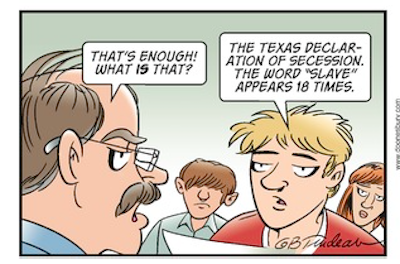
Poking Fun at the Texas Textbook Debacle: “Doonesbury as Documentary: Or, Comic Strip Imitates Life” | History News Network

This is great! You go Doonesbury!

History News Network | Doonesbury as Documentary: Or, Comic Strip Imitates Life.

doonberry Texas Textbook Civil War Controversy

Abusing History: “Japan’s way of remembering World War II still infuriates its neighbours” The Conversation

In light of the earlier discussion on war crimes and apologies, here’s more on the consequences of Japan’s failure to apologize for (or recognize) its WWII war crimes: Japan’s way of remembering World War II still infuriates its neighbours.

“While Germany has managed to build holocaust education into its curriculum and is now at the centre of the European project, Abe and his predecessors have never acknowledged that relations with Korea and China would be greatly improved if there were a push for education and discussion about this terrible history. As things stand, no matter how the militaristic and nationalistic Abe handles the memory of the war in this anniversary year, Japan’s relations with its former adversaries are set to keep festering.”

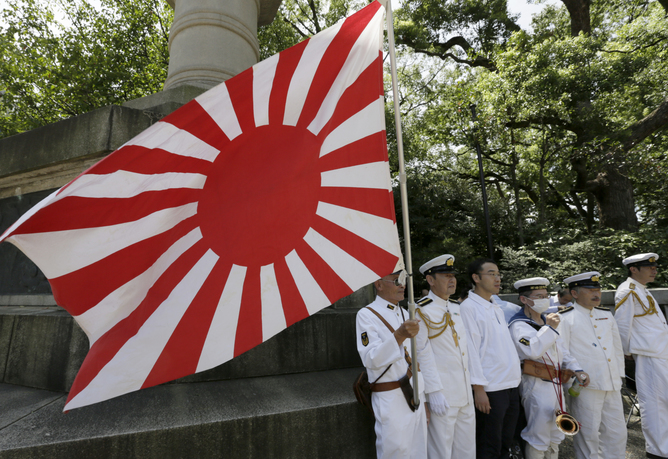
epa04354254 Japanese people wearing imperial navy costumes raise a rising sun flag as they visit the controversial Yasukuni Shrine to mourn for victims of World War Two in front of a torii gate at the shrine, Japan, 15 August 2014, marking the 69th anniversary of the end of World War Two. More than 2.5 million Japanese soldiers who died in the service are enshrined at Yasukuni, including convicted war criminals from World War II. EPA/KIMIMASA MAYAMA

” Japanese people wearing imperial navy costumes raise a rising sun flag as they visit the controversial Yasukuni Shrine to mourn for victims of World War Two in front of a torii gate at the shrine, Japan, 15 August 2014, marking the 69th anniversary of the end of World War Two. More than 2.5 million Japanese soldiers who died in the service are enshrined at Yasukuni, including convicted war criminals from World War II.” EPA/KIMIMASA MAYAMA

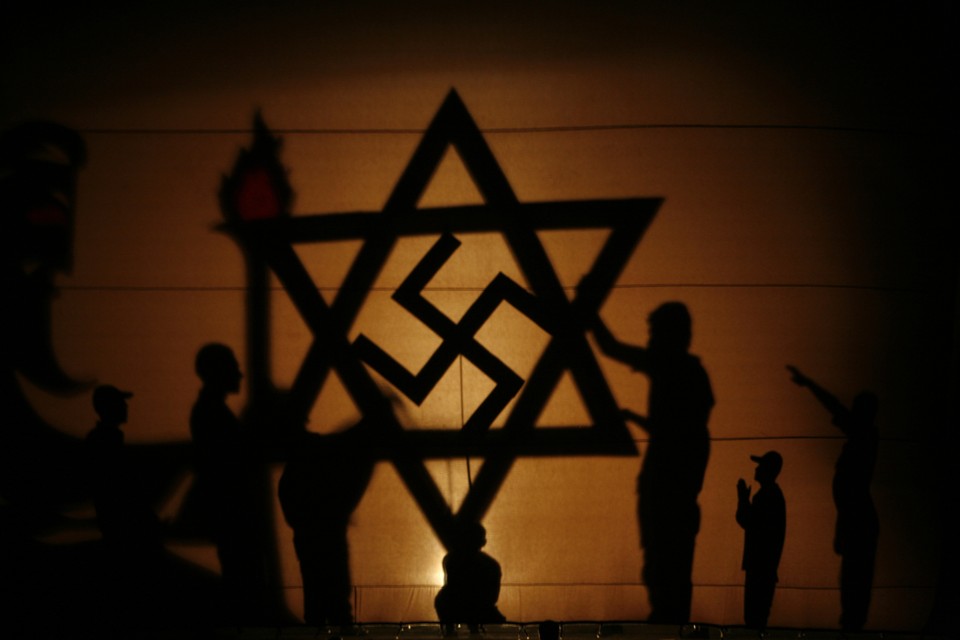
“Mike Huckabee Is Wrong: Iran Isn’t Nazi Germany” – The Atlantic

In case it wasn’t obvious, here’s a thorough take down of the Nazi Germany/Iran analogy: Mike Huckabee Is Wrong: Iran Isn’t Nazi Germany – The Atlantic.

Irans revolutionary guards

“Why historians are fighting about ‘No Irish Need Apply’ signs — and why it matters” – Vox

I’m Irish-American and a historian, and I’m embarrassed to admit that I was unaware of this controversy over Irish-American immigrants.

The controversy began after the historian Richard J. Jensen published the article “No Irish Need Apply: A Myth of Victimization” in 2002. In it, Jensen argued that  the Irish victimization narrative in America was based on a myth about “No Irish Need Apply” signs. He claimed that “there is no evidence for any printed NINA signs in America, or for their display at places of employment other than private homes.”

At the time some historians pushed back against Jensen’s claims, but no serious challenge was mounted against his claims. Although the historian Kerby Miller tried to mount an attack, he realized that it was “an unwinnable fight when he went to New Zealand to present some work and he was bombarded with questions on why he didn’t believe Jensen.” (The Daily Beast)

It took a 14-year-old student, Rebecca Fried, to debunk Jensen’s claim about the nonexistence of the NINA signs. She diligently searched through many newspaper databases and found plenty of evidence that these signs in-fact existed. (I want to add that there is plenty other evidence for the persecution of Irish Americans in the nineteenth and twentieth centuries. Maybe there was some exaggeration of the persecution the Irish faced but it was most definitely real.)

I question Jensen’s motives for his thesis. As historians we strive to be objective, but sometimes our bias get the better of us. This is why the study of history is a collective endeavor. We are all responsible for keeping other historians in check. In this case a curious student did what a fellow historian should have done. Great job Rebecca!

Read the interesting story here:  Why historians are fighting about “No Irish Need Apply” signs — and why it matters – Vox.

No help wanted Irish

“This is One Reason the World Is on Fire” | History News Network

I don’t think “the world is on fire,” but Lawrence Davidson’s essay does hold some relevance to the violence that we see in some parts of the world. He argues that “there are millions of people, Muslims, Jews and Christians and others who not only still idealize a religiously imagined past, but want, in one way or another, to import that past into the present – and not only their present but everyone else’s as well.” This desire for some kind of mythical, ideal past is not new. These kind of golden age myths can be found throughout history, indicating a human affinity for them. They are particularly appealing in times of trouble, and Davidson is right to call them “downright dangerous.”
The problem is that while appealing, these mythical pasts never existed. They were created by scrubbing the particular period of interest of all its blemishes while embellishing the good. All attempts to recreate a mythical past have ended in human tragedy. Just as Procrustes was made to fit his bed by chopping off his legs, humanity is made to fit in an unattainable utopian box by destroying all that does not fit the ideal.
While Davidson focuses solely on the religious versions that are particularly prevalent at the moment, but this kind of golden age thinking can be found in other types of ideologies such as nationalism. We must all resist the siren song of these kinds of golden age narratives no matter how enticing they are.

History News Network | This is One Reason the World Is on Fire.

ISIS

“Why Are So Many Distraught to Learn that Slavery Was the Cause of the Civil War?” |History News Network

I think that most of us would agree with Dale Schlundt’s answer to this question: “Because who in the middle of the twentieth century wanted to admit great grandpa fought for something other than an honorable and admirable ideology.” The motive is understandable. However, the deception comes at a cost. We cannot understand the present if we do not understand the past, and by denying the crime we dishonor the thousands who suffered and died as a result of the despicable institution of slavery. If we want to live up to our own values and learn from the past we must confront the history of the Civil War honestly.
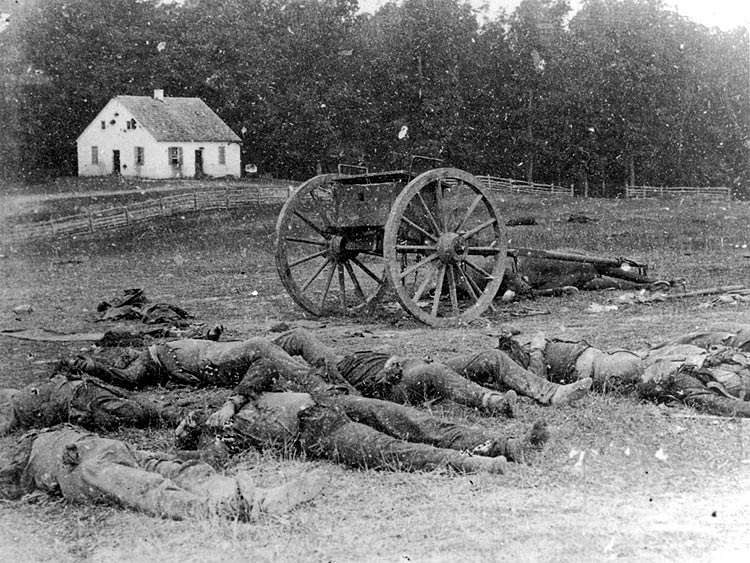
Civil-War

More Evidence That Civil War Was Not About States’ Rights (As if the words of the Confederate leaders wasn’t enough!)

In the wake of the fight over the Confederate flag and the new that Texas school children will not learn that the Civil War was fought over slavery, two articles this week at the History News Network present us with more evidence that the South did not fight for states’ rights. Roy Finkenbine invokes “the little-known U.S. Supreme Court case of Ableman v. Booth” to argue that “[o]nly in the wake of Appomattox did former Confederates assert that the conflict had been waged over constitutional principles.”And Stephen R. Leccese argues that “[t]he states’ rights argument falls apart when one has an understanding of antebellum Southern history. Before the Civil War, the South was in no way a bastion of states’ rights.”
I agree with Leccese that “[t]his country’s educational system must do better and present an accurate view of history. When that happens, we can have a public that acts with an informed mind on issues of national (and international, as the world views race relations in this country very poorly) importance.”

“The Supreme Court Case that Proves that the Antebellum South Wasn’t Really Concerned with States Rights.” | HNN

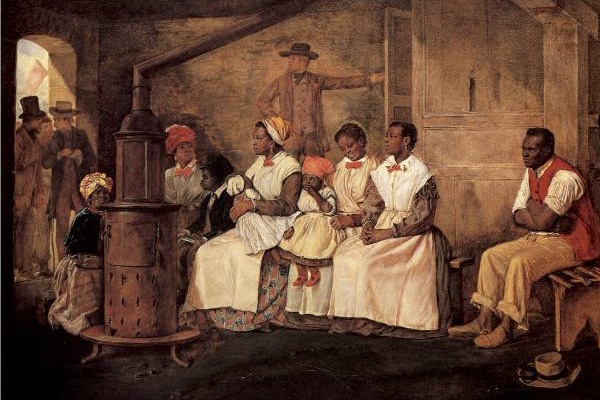
"Slaves Waiting for Sale: Richmond, Virginia - Wikipedia"

“Slaves Waiting for Sale: Richmond, Virginia – Wikipedia”