“A New Look at Japan’s Wartime Atrocities and a U.S. Cover-Up” – The New York Times

“After the war, the United States covered up Japan’s biological warfare research on humans, allowing the perpetrators to escape punishment and to prosper.” Why? It “enabled the United States to gather information that was of great use for its own biological warfare program, early in the Cold War.” I don’t think that any potential benefit from these horrific experiments can justify covering up these crimes. And in the long run, it is against our own interests by undermining our moral standing in the world.  How we conduct ourselves around the world does have implications for our national security.

Read the entire article here: A New Look at Japan’s Wartime Atrocities and a U.S. Cover-Up – The New York Times

An exhibit at the Unit 731 museum depicts a frostbite experiment on prisoners.Credit Gilles Sabrie for The New York Times
Abusing History: “Japan’s way of remembering World War II still infuriates its neighbours” The Conversation

In light of the earlier discussion on war crimes and apologies, here’s more on the consequences of Japan’s failure to apologize for (or recognize) its WWII war crimes: Japan’s way of remembering World War II still infuriates its neighbours.

“While Germany has managed to build holocaust education into its curriculum and is now at the centre of the European project, Abe and his predecessors have never acknowledged that relations with Korea and China would be greatly improved if there were a push for education and discussion about this terrible history. As things stand, no matter how the militaristic and nationalistic Abe handles the memory of the war in this anniversary year, Japan’s relations with its former adversaries are set to keep festering.”

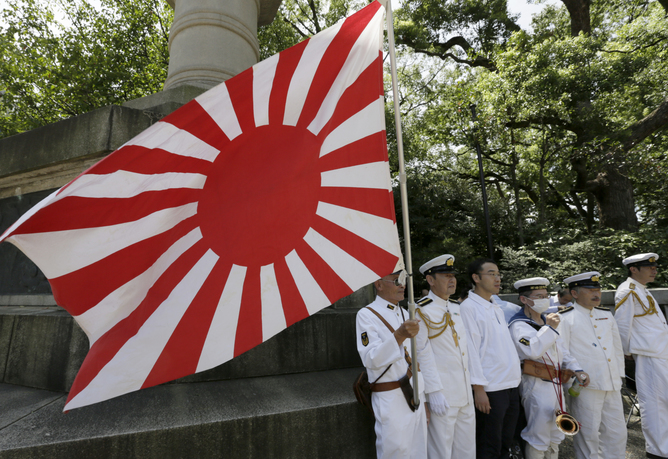
epa04354254 Japanese people wearing imperial navy costumes raise a rising sun flag as they visit the controversial Yasukuni Shrine to mourn for victims of World War Two in front of a torii gate at the shrine, Japan, 15 August 2014, marking the 69th anniversary of the end of World War Two. More than 2.5 million Japanese soldiers who died in the service are enshrined at Yasukuni, including convicted war criminals from World War II. EPA/KIMIMASA MAYAMA

” Japanese people wearing imperial navy costumes raise a rising sun flag as they visit the controversial Yasukuni Shrine to mourn for victims of World War Two in front of a torii gate at the shrine, Japan, 15 August 2014, marking the 69th anniversary of the end of World War Two. More than 2.5 million Japanese soldiers who died in the service are enshrined at Yasukuni, including convicted war criminals from World War II.” EPA/KIMIMASA MAYAMA