“Did Jefferson Really Mean It When He Said Liberty Now and Then Requires the Shedding of Blood?” | History News Network

M. Andrew Holowchak challenges some popular interpretations of Jefferson’s contention that “[t]he tree of liberty must be refreshed from time to time with the blood of patriots and tyrants.”
After reviewing Jefferson’s thinking on the relationship between the people and the government, he concludes: “The people ‘preserve the spirit of resistance,’ and that spirit of resistance in turn preserves their rights and liberties. Governors cannot be trusted.  Yet Jefferson did not always appeal to hyperbole or rebellion to make his point apropos of acting on behalf of preserving liberty. He recognized that once a constitution was in place, there would be a limited role for rebellion. He says to C.W.F. Dumas (10 Sept. 1787), ‘Happy for us, that when we find our constitutions defective and insufficient to secure the happiness of our people, we can assemble with all the coolness of philosophers and set it to rights, while every other nation on earth must have recourse to arms to amend or to restore their constitutions.’”

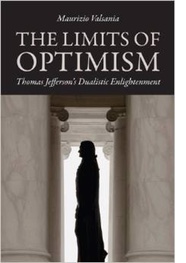
Was Jefferson a Pessimist?

This is the contention of Maurizio Valsania in his new book The Limits of Optimism. Anyone familiar with Jefferson would probably find this a dubious claim, including myself. It is an interesting thesis, but after careful examination of Valsania’s argument M. Andrew Holowchak, an expert on Jefferson, concludes: “Valsania’s Jefferson is a figure unrecognizable to one amply acquainted with Jefferson’s writings.”

Valsania’s thesis may be a dud, but Holowchak’s considered review of the book is worthwhile if you’re at all interested in Jefferson: History News Network | Review of Maurizio Valsania’s “The Limits of Optimism: Thomas Jefferson’s Dualistic Enlightenment (Jeffersonian America)”

Here is an excerpt from the review: “Valsania’s imprecise usage of language throughout the book lends itself to vagueness, or at least, ambiguity. Many times he seems to sanction a strong thesis—namely, every Jeffersonian utterance of optimism betrays plainly an equal (or nearly so) amount of pessimism. At other times, he seems to countenance a weak thesis—namely, utterances of optimism often (or sometimes) betrays plainly an equal (or nearly so) amount of pessimism. Valsania never unequivocally settles on one thesis or the other throughout the book—everything rides on him doing so—therefore, at day’s end, chary readers are confounded.”

The limits of optimism