“Lawmakers fear Islamic ‘indoctrination’ in TN classes”

“A recent uproar over a Tennessee middle school history course that touches on Islam has federal and state lawmakers calling for changes.”

This is really sad! These politicians either don’t understand the difference between teaching the history of a particular religion and indoctrination,  or they’re exploiting this issue for political gain. Either way this type of bigotry and divisive politics is unacceptable!

They’re even railing against the “bias” in favor of Islam!! Seriously!

Source: Lawmakers fear Islamic ‘indoctrination’ in TN classes

“Donald Trump is our creepy new face of demagoguery” – Salon.com

The historians Andrew Burstein and Nancy Isenberg weigh in on the present state of politics (spoiler alert: it’s not pretty). They note the long history of demagoguery in the U.S., but they also point out what is different today: “a pliant media and a reality TV culture.” These two additional factors make today’s demagogues significantly more dangerous.

This excerpt sums up the problem: “We have no indication that Trump thinks very hard about consequences. Half-baked generalizations roll off the tongue of the superlative-seeking demagogue. Will his followers ever demand facts from him? Probably not. When you are a demagogue, you only have to promise stuff, identify and threaten the bad guys, make bold declarations like, “I’ll be the best president for the military,” and keep the fans excited. Nothing is real. That how politics operates when it’s all reality TV. And don’t forget to wear your flag pin in the next scene.”

Read the article here: Donald Trump is our creepy new face of demagoguery – Salon.com

“The Second Amendment Con Job” | History News Network

The historian Gregory J. W. Urwin debunks some of the self-serving Second Amendment narrative perpetuated by the NRA.  Urwin’s essay is insufficient, but I applaud his effort. We need more historians pushing back against the seriously flawed and deadly NRA interpretation of the Second Amendment. The stakes are too high for them to remain on the sidelines.
Read Urwin’s brief overview of the history of the Second Amendment here: History News Network | The Second Amendment Con Job.

second amendment

“The Long History of Political Idiocy” – The New York Times

Hyperbole in political discourse may seem to be a recent phenomenon, but as the historian Joanne B. Freeman reminds us “none of this is new. Politicians have always resorted to dumb claims, blatant insults, bold exaggerations and baldfaced lies to gain press coverage and win votes.” And we can’t just blame politicians or the media for this sad state of affairs. The truth is, we the people love it. Just as now, in the nineteenth century “Legislators who went to extremes were virtually guaranteed press coverage.”

Read Freeman’s entertaining history of “political idiocy” here: The Long History of Political Idiocy – The New York Times.

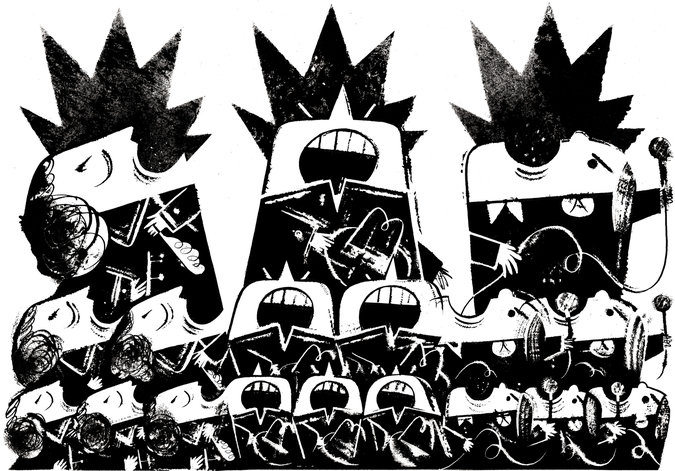
Roman Muradov

Roman Muradov

Jonas Persson Explores the History of School Choice: What He Finds Isn’t Pretty

After reviewing the history of vouchers, Jonas Persson at PR Watch concludes “‘choice’ was always predicated on parents choosing private—sometimes even segregated—schools. Vouchers were not proposed with equity in mind; they were cooked up out of an ideological disdain for public schools and teachers’ unions.”

Persson article is enlightening, if not sad. We all need to understand the real motives and purposes of the school choice movement if we want to save our public education system. Here’s an excerpt from Persson informative piece:

“As if hit by a collective wake-up call, voucher advocates suddenly realized that the pipe dream of a free market “utopia,” where public schools and democratic school boards were consigned to the dustheap of history, could actually be realized. All it took was some posturing and a great deal of cynicism.

‘In today’s world,’ the rightwing quarterly The Public Interest suggested in a 1988 article, ‘those who would expand choice programs face many legal and political obstacles. Linking choice programs and integration may be their best bet.’ The New Right had, as The Black Commentator eloquently explained in a 2004 article, found its missing link:

Former Reagan Education Secretary William Bennett understood what was missing from the voucher political chemistry: minorities. If visible elements of the Black and Latino community could be ensnared in what was then a lily-white scheme, then the Right’s dream of a universal vouchers system to subsidize general privatization of education, might become a practical political project. More urgently, Bennett and other rightwing strategists saw that vouchers had the potential to drive a wedge between Blacks and teachers unions, cracking the Democratic Party coalition. In 1988, Bennett urged the Catholic Church to “seek out the poor, the disadvantaged…and take them in, educate them, and then ask society for fair recompense for your efforts”–vouchers. The game was on.

In the late ’80s, conservative think tanks and advocacy groups across the nation launched massive whitewashing campaigns; they started churning out policy reports and books purporting to show how school vouchers would actually benefit minority students. Examples include: We Can Rescue Our Children: The Cure for Chicago’s Public School Crisis (Heartland Institute, 1988) and Liberating Schools: Education in the Inner City (Cato Institute, 1990).

By proposing schemes with vouchers weighted to boost racial diversity, or restricted to children from low-income families, the organizations pushing vouchers were able to kill two birds with one stone. They made them acceptable by obscuring the segregationist history, and, crucially, they could now cast themselves as the ‘new’ civil rights movement.”
"Participants hold up signs during an Americans For Prosperity "Tallahassee Days Rally" March 3, 2014 at the Capitol in Tallahassee, Fla. Participants hope to meet with their elected officials this week to discuss issues including tax cuts, pension reform, school choice and accountability for education spending. The 2014 Florida legislative session starts Tuesday. (AP Photo/Phil Sears)"

(AP Photo/Phil Sears)

“This Research Suggests Why Historians Have to Begin Acknowledging that Biology Is a Key Factor in a Person’s Politics” | History News Network

Two political scientists, John R. Hibbing and Kevin B. Smith, propose that historians acknowledge “that biology is a key factor in a person’s politics.” There has been a lot of recent research that confirms this. But the real issue is not whether historians should acknowledge these findings (they should if the evidence supports them), it is whether or not this knowledge is useful to them in understanding the past. I’m not convinced that it is. While history may be useful in confirming (or dis-confirming) the pattern of conflicts “between innovation and tradition, between stability and progress” that is an expression of these biological predispositions, it offers little help to the historian in understanding particular historical events. And it may even lead us to misleading and false conclusions without any tools, beyond a person’s behavior, to determine someone’s biological predispositions. Given the type of evidence that we have, a person’s social, cultural, and political environment is more useful  when it comes to understanding human motivations and behaviors.

This is not to dismiss the grow body of evidence that supports a biological component in human politics as useless. But it seems to be more relevant for human behavior today. This knowledge may be useful to changing human behavior, if it leads us to recognize that “[p]eople are different; they experience the world differently; they do not see, feel, and sense identical stimuli in the same way.” An appreciation of this could possibly “soften the edges of political disputes that are so detrimental.” One can only hope!

History News Network | This Research Suggests Why Historians Have to Begin Acknowledging that Biology Is a Key Factor in a Person’s Politics.

republican and democratic brain

“India and Israel Start to See Enemies Within” – Bloomberg View

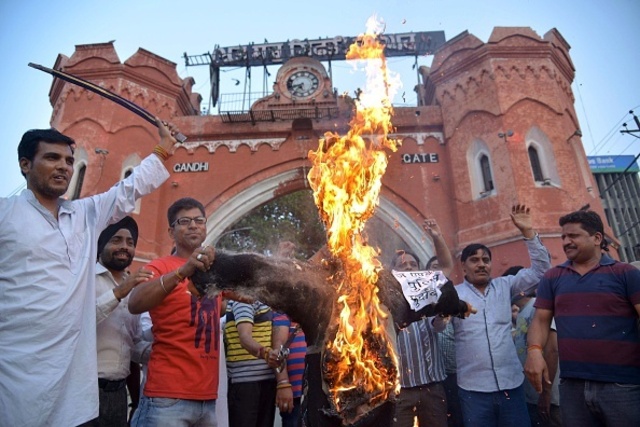
Nationalism has been on the rise lately. I’ve written previously about the new nationalism in Russia and Japan, but the rise of nationalism in India and Israel may even be more concerning. Pankaj Mishra describes the current situation in these two countries: “There are eerie similarities between the Hindu thugs who assault Muslim males marrying Hindu women and followers of the far-right Israeli group Lehava (Flame), who try to break up weddings between Muslims and Jews…The new ruling classes seem obsessed with moral and patriotic education, reverence for national symbols and icons (mostly right-wing), and the uniqueness of national culture and history.” These leaders were brought to power by tapping into the resentment and discontent of their respective populations. This “politics of resentment,” as Mishra calls it, is powerful, and astute politicians know how to exploit it. As human beings we seem to have an affinity for nationalism. It gives us an identity, a purpose, a community, a compelling narrative, and a scapegoat for our woes. Unfortunately, it more often than not devolves into violence and oppression. How many times do we have to go down this road? Will we ever learn?

“It would be nice to hope that India and Israel’s emboldened hotheads are different, and will lead their countries to stability, prosperity and peace through their special mix of right-wing economics and the politics of ressentiment. It is already clear, however, that they find more thrilling the prospect of perpetual warfare with their perceived enemies, especially the ones within.” I’m afraid that Mishra is right.

Read Mishra’s important reporting on the situation in India and Israel: India and Israel Start to See Enemies Within – Bloomberg View.

"Playing with fire? Photographer: NARINDER NANU/AFP/Getty Images"

“Playing with fire? Photographer: NARINDER NANU/AFP/Getty Images”

“Russia must not be allowed to rewrite Srebrenica’s history” | Natalie Nougayrede | The Guardian

We all want to belong. We all want to think that we are good. We all want to be proud of our heritage, community, and history. We all want to have purpose and meaning in our lives. These are all genuine human desires that are by themselves positive sentiments, but they ultimately leave us vulnerable to manipulation by ambitious political leaders. Because nationalism fulfills all of these desires it has been the ideal political weapon for leaders like Slobodan Milosević, who unleashed the forces of Serbian nationalism as a way to rise to power. But more than fulfilling Milosević’s political ambitions it also released the forces of hatred that tore apart the former Yugoslavia of which the massacre of Srebrenica was a part of. Nationalism rests on an “us versus them” narrative that is more myth than actual history. All past nationals sins must be swept under the rug as a way to make the nation worthy of glory. If it just engendered pride in one’s past, nationalism would not be such a destructive force. Unfortunately, the end result is usually arrogance and hatred.

Natalie Nougayrede’s article at The Guardian reminds us that Putin is playing with the same fire for his own political purposes. This is not to say that Putin is planning to commit genocide or ethnic cleansing, but that his use of nationalism will, and already has, bring great suffering to many. Putin’s veto of the UN resolution is only a small part of his overall power play, but as Nougrayrede reminds us, it is still significant if we value peace and justice. “Some will argue that Russia’s latest veto should be seen as just another snub to the west. But the rewriting of the history of the Bosnian war and the unravelling of the mechanisms that the west tried to put in place to prevent more violence are something that Europeans would do well not to minimise. If only because of those unarmed 8,000 men and boys who were killed just because of who they were: Bosnian and Muslim.”

Russia must not be allowed to rewrite Srebrenica’s history | Natalie Nougayrede | Comment is free | The Guardian.

Srebrenica mourning

“Why Aren’t Pro-Life Evangelical Christians Appalled by America’s Record of Gun Violence?”|History News Network

Lawrence Wittner’s answer: “The embrace of guns by many white Protestants is bolstered by a number of arguments linked to their religious assumptions. One contention is that the United States was established by God and, therefore, the Second Amendment to the Constitution (which they allege guarantees individual gun ownership) is sacred. Another is that depriving people of ‘self-defense’ deprives them of a God-given right. In addition, they tend to believe that corrupt, un-Christian values, rather than the easy availability of guns, lie behind the frequency of gun massacres.” This sounds about right to me. But now what? There is no amount of reasoning or evidence that would convince them to change their mind on gun control.
Wittner also speculates on the reason why the U.S. has such a high gun death rate.
Read the entire article here:

History News Network | Why Aren’t Pro-Life Evangelical Christians Appalled by America’s Record of Gun Violence?

guns_god_country_flag


The Current “Crises” in Higher Education

In this post Dr. Kich exposes the flaws in the assumptions about higher ed as presented by James Baar. It also serves as a critique of some of these same assumptions that are often passed off as fact in the media.

martinkich's avatarACADEME BLOG

In an op-ed published by the Providence Journal in Rhode Island, James Baar identifies “Four Crises That Dog Higher Education”:

1. Inflation of product cost.

2. Deflation of product value.

3. Enablement of social and moral dissolution.

4. Lower-priced, knockoff and fraudulent competition.

Given the space constraints on most op-ed pieces, Baar addresses each of these topics fairly succinctly. So, I suspect that if he had more space, he might have been able to address somewhat articulately at least some of the concerns that I am about to express.

First, I don’t believe that anything can be dogged by a crisis. A crisis is the climax of an escalating situation; it is not a condition. And the word “dogged” suggests an extended condition. But perhaps some editorial assistant, rather than Baar himself, is responsible for the headline.

Second, I don’t think that it is either accurate or helpful to assert…

View original post 1,150 more words