“The Long Campaign by White Supremacists to ‘Take Our Country Back’” |History News Network

Roy E. Finkenbine gives a brief, but worthwhile, overview of the white supremacists’ efforts to “take our country back” (i.e. restore white supremacy). He writes, “The Civil War decided the questions of slavery and Confederate independence, but it didn’t quash hopes for a continuation of white nationalism.”
Read his summary of this history here:

History News Network | The Long Campaign by White Supremacists to “Take Our Country Back”.

KKK 1950s

“Essay on being accused of being an anti-Israel professor” | Inside Higher Ed

Jonathan Judaken is just the latest victim in a concerted effort by a well-organized group united in defense of Israel. I have written on this topic several times (Pro-Israeli Groups Continue their Assault on Academic Freedom and Conservatives go after UCLA’s historian James Gelvin). It is a troubling trend that threatens academic freedom and the progress that flows from it.

Judaken opens with an explanation of his situation: “Let me tell you how I ended up on Jihad Watch. This is a tale of the new red scare wending its way across college campuses. More than an account of my own travails, this is an anatomy of how critical thought about Islam and Judaism, the Arab-Israeli conflict, anti-Semitism and anti-Muslim racism is today monitored in the academy with the goal of chilling reflection.”

I noticed a common theme in the comments section. (Of course, going to the comments section of any online forum is a bit like going to the Twilight Zone. You enter at your own risk.) Many of the commenters accused Judaken of being the McCarthyites, not the minions of Campus Watch. The strategy of flipping an argument on its head as a way of taking down your opponent is not new. It has proven to be an effective strategy on the right. Someone calls you a racist, you respond by claiming that they are the real racist. Someone calls you intolerant, you respond by calling them intolerant, and so on.

The problem with their argument is that they fail to make the appropriate distinction between McCarthyism and criticism. What McCarthy did was attempt to silence people that he disagreed with through intimidation and bullying tactics, not debate. Judaken was not trying to silence those associated with the Middle East Forum and Campus Watch, but expose what they were doing. And the analogy is appropriate because they use the tactics of intimidation to bully those in academia whose account of Middle East history does not agree with theirs (the Israeli government is always innocent and anyone who says otherwise is an anti-Semite).

What Caschetta did was not criticism for the purpose of advancing the debate, but an intentional distortion of Judaken’s lecture and intentions. The Middle East Forum was founded to promote a particular ideology. And the way they have chosen to further that ideology is through intimidation, not academic debate. The academic world is built on the principle of debate and criticism. This is what fuels progress in all academic fields of knowledge. If the real goal of Campus Watch was the advancement of knowledge, there are multiple avenues available to critique Judaken’s position in a constructive and professional manner. Every academic has to face criticism as they engage in their own field. This is not the kind of criticism that Caschetta engaged in. He intentionally distorted Judaken’s lecture as a way to intimidate him. This was the way of McCarthy, and therefore the label is apt in the case of Campus Watch, but not the other way around.

Essay on being accused of being an anti-Israel professor | InsideHigherEd.

 academic freedom

“The Hoax of Climate Denial” | History News Network

Naomi Oreskes, historian of science, discusses her experience testifying before the Committee on Natural Resources last month. She explains, “In preparing my testimony, however, I realized that something far larger was at stake: the issue of politically driven science itself.  It’s often claimed that environmental science done in federal agencies is “politically driven” and therefore suspect.  It was, I realized, time to challenge the presumption that such science is bad science. While widely held, the idea is demonstrably false. Moreover, the suggestion that “government science” is intrinsically problematic for Republicans who eschew big government ignores the simple fact that most of the major contributions of the twentieth century, at least in the physical sciences, came from just such government science.”
Besides defending “government science,” Oreskes reviews the history of the current climate denialism, as well as the political and economic forces that are driving it. Read her important exposé here:

History News Network | The Hoax of Climate Denial.

Merchants of Doubt

“This Is What Happens When You Slash Funding for Public Universities” | The Nation

In Arizona the state legislature cut $99 million dollars from the higher education budget, and it is even worse in places like Wisconsin and Louisiana. This trend has been going on for some time, but the economic crisis prompted even more severe cuts to higher education. As Michelle Goldberg notes, many states have begun restoring funding, but “[e]ight Republican-dominated states, however, have kept cutting. Among them are North Carolina, Wisconsin, Arizona, Louisiana, and South Carolina.”

What is driving this trend? It is partly political (animus towards the “liberal” academia), partly ideological (absolute devotion to privatization and taxing cutting), and partly financial (the opportunity to make money off of education).

What are the consequences? 1) Higher tuition that will increasingly make college accessible only to the wealthy. 2) University’s are turning to solutions that will harm the long-term quality of education, such as larger class sizes and corporate partnerships that put the focus on making money rather than educating students. 3) There will be less time and money for faculty to do the research that is vital to the health and wealth of our nation. 4) Higher education will start to become more of a job-training program, rather than an educational institution that creates well-rounded and thoughtful citizens in addition to preparing them for their careers. 5) Inequality will increase.

Please read the entire article here:

This Is What Happens When You Slash Funding for Public Universities | The Nation.

Arizona-State-University


“Could a Movie Help Lead to the Departure of Scotland from the UK?” | History News Network

More proof that movies have more influence than historians, even when the movie is mostly myth!

History News Network | Could a Movie Help Lead to the Departure of Scotland from the UK?

Braveheart

Ideological Thinking: The Scourge of Humanity

Reflecting on the years he spent in conflict zones all over the globe, John F. Burns declared, “What those years bred in me, more than anything else, was an abiding revulsion for ideology, in all its guises. From Soviet Russia to Mao’s China, from the Afghanistan ruled by the Taliban to the repression of apartheid-era South Africa, I learned that there is no limit to the lunacy, malice and suffering that can plague any society with a ruling ideology, and no perfidy that cannot be justified by manipulating the precepts of a Mao or a Marx, a Prophet Muhammad or a Kim Il-sung.” Many of us who have studied ethnic/religious conflict have come to the same conclusion.

But the lesson goes beyond the violent and oppressive regimes encountered by Burns. As Walter G. Moss notes in his article on this topic (“Why Learning from History Means Saying No to Rigid Ideologies” HNN), “the growth of a rigid U.S. political conservativism” has been harmful as well, even if less deadly.

If ideologies are so destructive, can we eradicate them? Moss believes that we don’t need to completely reject “all isms or embracing an unprincipled opportunism. We can, for example, prefer conservatism or liberalism in our approach to politics, as long as we let our individual values and judgments and not some party platform (see, e.g., here for that of the tea party) determine our political decisions.” I agree, but this still leaves the problem of persuading individuals to let go of their cherished world views.

Ideologies are so pervasive because they are comforting and often intoxicating. They give us meaning, certainties, identities, and a sense of self-worth. The best weapon against ideological thinking is education with a healthy dose of the humanities. The study of history in particular could potentially inculcate students against the temptations of ideologies. If students learn how to critically evaluate evidence, make analytic comparisons, and learn to appreciate complexities and ambiguities they will be less likely to fall for the distorted views of ideologies. And any exposure to the long train of human misery caused by ideological rigidity might make them think twice before they fall under the spell of any ideology. I don’t believe that we’ll ever completely eradicate ideological thinking, but we must try to at least limit its appeal.

For now, we as individuals must take responsibility for our own beliefs, and the behaviors that flow from those beliefs. And here Moss’s advice is apt: “Political wisdom requires a proper mix of idealism and realism and other virtues or values such as the love, kindness, and humility mentioned by Pope Francis, as well as compassion, empathy, tolerance, a sense of humor, creativity, temperance, self-discipline, passion, courage, and prudence. The trick is finding the proper combination of such values to apply to any concrete, unique political situation in order to further the common good.”

The Things I Carried Back – NYTimes.com.

Rituals For the Perpetuation of False Ideologies

“Rituals For the Perpetuation of False Ideologies” by Jeremy Eskin at http://eskinfineart.blogspot.com/

“Same-sex marriage: Supreme Court Justices don’t know much about history” – LA Times

Michael Hiltzik, in the LA Times, rightly scolds some of the Supreme Court Justices for their ignorance of history. During the arguments about same-sex marriage at the Supreme Court last week, Chief Justice John Roberts declared, “Every definition that I looked up, prior to about a dozen years ago defined marriage as unity between a man and a woman as husband and wife.” As Hiltzik points out, “He must not have looked very far.” The historical record is very clear that marriage “[i]n definition and practice…has evolved and devolved to meet economic and political demands, shifting cultural norms and biological imperatives. The mandate of procreation to preserve the human race has always been part of the definition of marriage, certainly, but rarely the only goal or, in some cases, even the principal one.” Read the entire article here:

Same-sex marriage: Supreme Court Justices don’t know much about history – LA Times.

supreme-court-samesex-marriage 2015

The Consequences of Ignoring the Lessons of History: “Stand Your Ground Makes No Sense” – NYTimes.com

What has been the impact of the “Stand your Ground” laws since their enactment? This is the subject of an article in The New York Times today. After examining several new studies on the subject, Robert J. Spitzer concludes that “[n]ot only have these laws failed to increase public safety, they have also turned the clock back to the mythologized mayhem of the Wild West.” And he points out, “We’ve learned this lesson before, in our own violent past, when strict regulation of concealed gun carrying was the near-universal and successful response to gun violence. As early as 1686, New Jersey enacted a law against wearing weapons because they induced ‘great Fear and Quarrels.’ Massachusetts followed in 1750. In the late 1700s, North Carolina and Virginia passed similar laws. In the 1800s, as interpersonal violence and gun carrying spread, 37 states joined the list. Tennessee’s 1821 law fined ‘each and every person so degrading himself’ by carrying weapons in public. Alabama’s 1839 law was titled ‘An Act to Suppress the Evil Practice of Carrying Weapons Secretly.’ Why must we relearn a lesson we codified centuries ago? How dumb are we?” It’s unlikely that these laws will be repealed any time soon. Evidence means little to the NRA and its zealous followers.

Stand Your Ground Makes No Sense – NYTimes.com.

John-Patrick Thomas, The New York Times (May 4, 2015)

John-Patrick Thomas, The New York Times (May 4, 2015)

“Two Things You Don’t Know About Roe v. Wade that Will Surprise You” | History News Network

James Robenalt, in his new book January 1973, argues “that this controversial change in how the case was decided had a dramatic impact on American politics. The Roe decision activated the so-called Religious Right. But more importantly, because abortion is an issue about which many will not compromise—it is a life and death decision to some—the whole concept of “no compromise” as a political strategy entered our political bloodstream. Along with the other great events of January 1973—Truman’s death, end of the Vietnam War for the US, Watergate burglars’ trial, Nixon’s Second Inaugural, Roe and the death of Lyndon Johnson (on the same day as Roe)—the conditions set up for a government of deadlock.” To find out the two things about Roe that will surprise you, read his article:

History News Network | Two Things You Don’t Know About Roe v. Wade that Will Surprise You.

January 1973

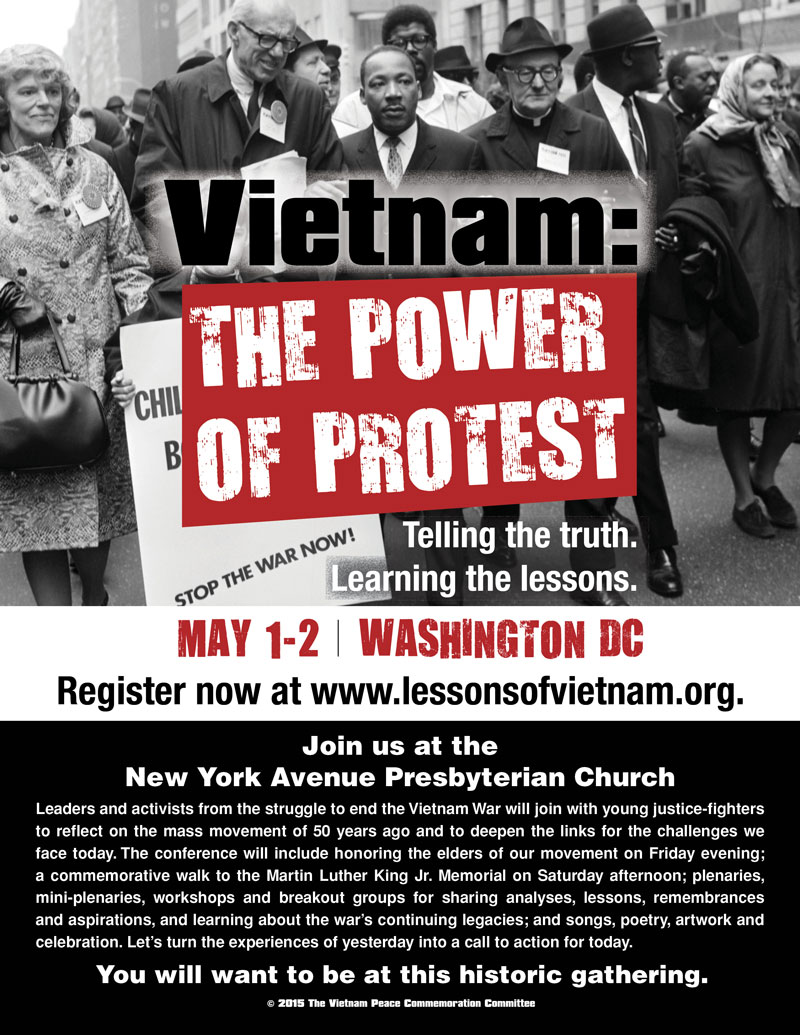
“Activists are combating the U.S. Army’s multimillion dollar commemoration of the War in Vietnam”| History News Network

Some of you may be interested in this:

History News Network | Activists are combating the U.S. Army’s multimillion dollar commemoration of the War in Vietnam.

Vietnam the power of protest