What Is Deism? | Patheos.com

In a recent blog post at Patheos, Thomas Kidd argues that during the eighteenth century “[m]ost deists really did consider themselves serious theists, and…devotees of Jesus and his teachings” and therefore “[t]heir deism was not just a convenient cloak for atheism.” From that assumption he concludes, “The deists’ closest descendants today are not the ‘new atheists’ who have stirred up so much media chatter in recent years.”  Instead, “Their closest descendants are probably liberal mainline Christians who see Jesus as their model but who eschew (or even deny) the particular, exclusive doctrines that have been associated with Christian orthodoxy for millennia.”

In defending this position Kidd overstates the Deists’ connection to Christianity in order to claim that they were theists. They believed in God, otherwise they would not have been Deists, but their god was not the theistic god of Christianity, even if they had an affinity for the moral precepts of the man Jesus as Jefferson did. (For a more in-depth discussion of Jefferson’s religious beliefs and whether or not he was a Deist see my previous post on the subject: Was Jefferson a Christian?). But once Kidd establishes their theistic credentials he believes that therefore they could not possibly have been the forerunners of the “new atheists.”
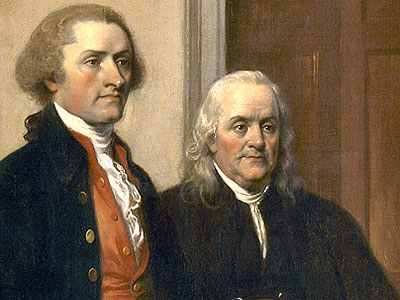
Thomas Jefferson & Benjamin Franklin

Thomas Jefferson & Benjamin Franklin


Continue reading

Book Review (Part I): Thomas Jefferson: Roots of Religious Freedom by John Harding Peach Was Jefferson a Christian?

In Thomas Jefferson: Roots of Religious Freedom, John Harding Peach claims that Thomas Jefferson was a Protestant Christian whose vision of religious liberty was grounded in his passionate desire to protect religion. Peach can perhaps defend this misleading portrayal of Jefferson under the guise that it is “a biographical novel,” but given that he also insists that “all historical events and places were provided as they factually occurred” (xii) this excuse is not credible. He may wish Jefferson was the person that he presents in his “novel” but he cannot honestly claim that Jefferson was that person. Unfortunately, his followers, who, no doubt, also want to believe that Jefferson was the Christian in Peach’s narrative, will uncritically accept his version of events. These distortions of history are not innocent ventures; they are part of a larger movement intent on re-writing history to support their claim that the United States is a Christian nation.

9781462720521_cover.indd

The wannabe historian David Barton has been at the forefront of this movement. His book (The Jefferson Lies) is the latest in a series of books dedicated to the goal of making this a Christian nation. But Jefferson’s well-known “infidelism” doesn’t fit this narrative, so rather than ignore the writer of the Declaration of Independence Barton and others have decided to remake Jefferson into a devout Christian. This is not an easy task and the only way to achieve it is through deception, dishonesty, and willful ignorance. In fact, Barton’s book is so egregiously dishonest that it was discontinued by his publisher after a group of conservative historians exposed it as misleading and “unsupportable.”1 Unlike Barton, Peach may not have gone as far as Barton, but it is still a dishonest and misleading portrayal of Jefferson. In his desire to see Jefferson as an upstanding Christian, Peach has cherry-picked, distorted, and misinterpreted the evidence.

Peach’s “novel” begins with Jefferson’s education with his childhood teacher the Rev. James Maury, who Peach claims “lit his fire,” (1) and ends with Jefferson’s death in 1826. The book highlights events in Jefferson’s life, large and small, which serve to present Jefferson as “practice[ing] his core conviction of basic Protestantism.” (xiii) This book review will challenge Peach’s portrayal of Jefferson. This post will be dedicated to Jefferson’s religious beliefs in general before turning to the Declaration of Independence and Jefferson’s views on religious liberty in future posts.

Continue reading

A Historian Complains About a Cross on a Float Alongside Jefferson and Franklin

The History News Network (HNN) posted a letter sent to Newsday from a retired historian after he attended a local Parade Celebrating Independence Day. The parade included a float with a large cross with the words “In God We Trust” displayed alongside Thomas Jefferson and Benjamin Franklin. The historian, Bill Bernstein, complained that “[t]he float implied that there is a state religion.” You can imagine the responses!

I love the way one of the responders (Leslie Dimmling) explains that the Declaration of Independence included the “word ‘God’ in the first sentence, and ‘Creator’ in the second” [these words are not actually found in the first and second sentence but the first and second paragraph] but she forgot to mention the word “Nature’s” that appears before “God.” As she probably knows (or on second thought she may not know) “Nature’s God” is not the god of Christianity. For more read the post at the HNN.

In a New Pew Report Americans View Jews, Catholics, and Evangelicals Most Favorably and Atheists and Muslims Least Favorably

This is probably not too surprising, but in light of our history of anti-Catholicism and anti-Semitism this is amazing. It was not that long ago (1960) that

JFK had to explain that he believed in the complete separation of church and state because of fears that, as a Catholic, he would be under the control of the Pope if was elected as president. Too bad that some current Catholics don’t believe in the separation of church and state!

Unsurprisingly, Evangelicals and atheists mutually despise each other. On a scale from 0 to 100 with 0 the most unfavorable and 100 the most favorable, the Evangelicals rated atheists with a mean score of 25 and atheists rated Evangelicals with a mean score of 28. (Pew study)

How did the Individual Right to the Free Exercise of Religion become a Right to Impose One’s Own Religion on Others?

In the wake of the Supreme Court’s ruling in the Hobby Lobby case that exempts closely held corporations (not publicly owned) from the Affordable Health Care Act’s mandate to pay for contraceptives, the supporters of Hobby Lobby are declaring it a victory for religious liberty. On the other hand, the Left has framed the issue in terms of women’s rights. Even the respected legal scholar, Douglas Laycock, has framed the issue as a choice between religious liberty on one side and women’s rights on the other (“A Flood of Suits”). While the Court framed it as a balancing act between religious liberty on one side and government interest on the other, per the Religious Freedom Restoration Act (RFRA). This framing falsely sets up the debate as one between religious liberty on the one hand (represented by Hobby Lobby and its supporters) and either women’s rights or government interest on the other. No one is questioning whether or not Hobby Lobby’s request really is about religious liberty. How can a decision that allows a particular individual’s (or a corporation’s) right to the free exercise of religion trump the right of other individuals to act according to the dictates of their own consciences be a victory for religious liberty?
Continue reading

A Lesson From England: “Education Should Be Beyond Belief”

In today’s The New York Times, Kenan Malik wrote a great piece about the alleged “Muslim Plot” in Birmingham: “Education Should Be Beyond Belief: A ‘Muslim Plot’ in Birmingham Shows the Folly of Faith Schools.”