“Oldest known stone tools found in Kenya; makers not known” – Yahoo News

Check this out! Scientists have found stone tools far older than any known stone tool. ” At 3.3 million years old, they push back the record of stone tools by about 700,000 years. More significantly, they are half-a-million years older than any known trace of our own branch of the evolutionary tree.” Read the entire article here:

Oldest known stone tools found in Kenya; makers not known – Yahoo News.

"In this undated photo made available in May 2015 by the Mission Prehistorique au Kenya - West Turkana Archaeological Project, Sonia Harmand and Jason Lewis hold stone tools found in the West Turkana area of Kenya. The artifacts, dated at 3.3 million years old, are much older than the earliest known trace of our own branch of the evolutionary family tree. So it’s a new challenge to the traditional idea that only members of our branch made stone tools. The discovery was reported in the journal Nature on Wednesday, May 20, 2015. (MPK-WTAP via AP)"

“In this undated photo made available in May 2015 by the Mission Prehistorique au Kenya – West Turkana Archaeological Project, Sonia Harmand and Jason Lewis hold stone tools found in the West Turkana area of Kenya. The artifacts, dated at 3.3 million years old, are much older than the earliest known trace of our own branch of the evolutionary family tree. So it’s a new challenge to the traditional idea that only members of our branch made stone tools. The discovery was reported in the journal Nature on Wednesday, May 20, 2015. (MPK-WTAP via AP)”

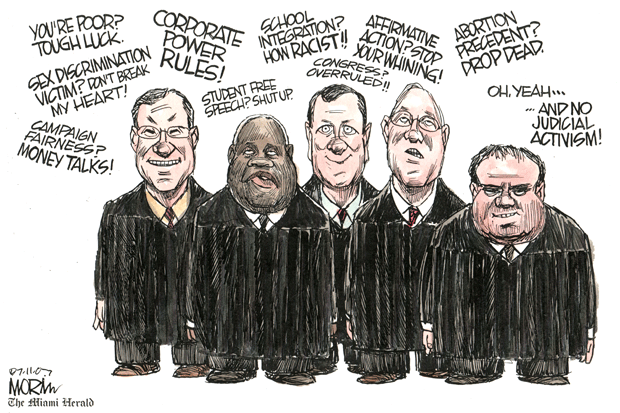
Are the Supreme Court Justices Roberts, Scalia, Alito, and Thomas Qualified to be Justices?

Alan J. Singer says “no.” In an interview at Education News, Singer told Michael F. Shaughnessy that these four should never have been elected Supreme Court Justices  “because Justices swear an oath to defend the United States Constitution as the first law of the land…In decision after decision they placed ideology and personal values above the Constitution and the law. They decided corporations have the same rights as people and then defended the rights of the world’s wealthiest companies over the rights of ordinary people, are still considering undermining a national health insurance plan, and denounce crime and violence while ensuring the maximum distribution of deadly weapons. However they eventually decide on the same-sex marriage issue, I do not trust them.” Neither do I! Read the entire interview here:

Alan J. Singer: Comments about the Supreme Court Justices Comments | Education News.

Alito, Thomas, Roberts, Kennedy, and Scalia

Alito, Thomas, Roberts, Kennedy, and Scalia

“A New Image of William Shakespeare Has Been Discovered, Historian Says” | TIME

This is interesting:

A New Image of William Shakespeare Has Been Discovered, Historian Says | TIME.

MAY 20 COVER IPAD.indd

“ISIS is threatening Palmyra, the Venice of Syria” | History News Network

Another ancient treasure is under threat from ISIS. Once these treasures are gone, they are gone forever! This is sickening!!

History News Network | ISIS is threatening Palmyra, the Venice of Syria.

Palmyra

Palmyra

History Wars: “Fight over AP U.S. History framework lands in N.J.” | The Auditor | NJ.com

Republican state Sen. Joe Kyrillos proposed a resolution (SR128) that would encourage the College Board to alter the AP U.S. history framework, because “the framework the College Board adopted in 2012 ‘reflects a seemingly biased view of American history, overemphasizing the negative aspects of our nation’s history while omitting and minimizing many of the positive aspects,'” and that “the new test’s framework ‘does not adequately discuss America’s Founding Fathers, the principles of the Declaration of independents the religious influences on our nation’s history.'” Even though this non-binding resolution is unlikely to pass, the efforts to teach our students a distorted patriotic version of history is troubling. We should be educating and challenging our students, not indoctrinating them. Progress requires an educated and thoughtful citizenry. And it is only by confronting the past honestly that we can actually live up to our ideals.

Fight over AP U.S. History framework lands in N.J. | The Auditor | NJ.com.

apush

Book Review: Ron Briley’s Review of John Merriman’s “Massacre: The Life and Death of the Paris Commune” HNN

The history of the Paris Commune is little known in the United States, but this history is not only riveting it has important lessons to offer. In 1871 the working class of Paris seized control of the government in Paris. However, the short-lived rule of the Communards ended with the massacre of approximately 15,000 to 20,000 by the French army. John Merriman recounts this tragedy in Massacre: The Life and Death of the Paris Commune. In his review of this book, Ron Briley sees this book as “provid[ing] an opportunity for contemporary readers to revisit the Commune and consider its legacy—for global capitalism has failed to provide the ending of history and dawning of a new age of prosperity following the collapse of the Soviet Union.” Read the entire review here:

History News Network | Review of John Merriman’s “Massacre: The Life and Death of the Paris Commune”

Massacre Paris Commune

Book Review: Ron Briley Reviews Christian G. Appy’s “American Reckoning: The Vietnam War and Our National Identity” HNN

In his review of Appy’s book, Ron Briley concludes that it “is a provocative read and presents a convincing argument regarding the Vietnam War as exposing the myth of American innocence. Yet, the concept of American exceptionalism continues to exercise a strong hold upon the nation’s belief system, and the fiftieth anniversary of the Vietnam War may not provide the national reckoning so passionately called for by Appy.” Read the entire review here:

History News Network | Review of Christian G. Appy’s “American Reckoning: The Vietnam War and Our National Identity”

American Reckoning

The Revenge of History: Dealing with Historical Memory

In today’s The New York Times Roger Cohen wrote a thoughtful piece on memory and forgetting (“The Presence of the Past”). Given the role that the manipulation of historical memory has played in past and present violence this article brings up a topic that deserves more attention, especially as nationalism is on the rise. Despite the importance of this topic, it is rarely publicly discussed. Part of the problem is the complexity of the subject, not to mention that it calls into question the cherished identities of many. But if we’re going to stave off the violence that is the product of certain kinds of historical memory we must discuss it.

History is a double-edged sword, as Cohen points out: “History illuminates. It can also blind.” History is illuminating when it is confronted honestly and in all its complexity. It is blinding when it is used to serve ideological or political ends.  This is where historical memory comes in. “History” is often abused in the service of ideology or political power.

Continue reading

“Jewish Soldiers Battled Nazi Germany” | History News Network

Alan Singer  reminds us that we need to remember the times when the Jews rose up to defend themselves. The most well-known case is the Warsaw Ghetto Uprising. But Singer thinks we need to also remember the 500,000 Russian Jewish soldiers who fought in WWII against the Nazis. Read the entire article here:

History News Network | Jewish Soldiers Battled Nazi Germany.

Warsaw Ghetto Uprising

Warsaw Ghetto Uprising

“The American Military Uncontained” | History News Network

The retired lieutenant colonel (USAF) William J. Astore examines the current role of the U.S. military from the perspective of the 1990s, after we emerged victorious from the Cold War. Rather than gearing down for peacetime Astore shows that the military retained it Cold War size and attitude. But crucially, according to Astore, it also became uncontained as the sole superpower. He argues that after the fall of the Soviet Union the attitude that emerged was one of “go[ing] for broke.” After laying out the consequences of this situation, he warns, “No military should ever be trusted and no military should ever be left uncontained.  Our nation’s founders knew this lesson.  Five-star general Dwight D. Eisenhower took pains in his farewell address in 1961 to remind us of it again.  How did we as a people come to forget it?  WTF, America?”
I agree with much of what Astore says, but I see the transition to the present situation a little differently. He makes no differentiation between the humanitarian efforts (or non-efforts to be more accurate) in places like Bosnia, Somalia, and Rwanda in the 1990s, and the so-called “national security” interests in places like Iraq, Afghanistan, Iraq, Pakistan, and Yemen in the twenty-first century.
“Yet even as civilian leaders hankered to flex America’s military muscle in unpromising places like Bosnia and Somalia in the 1990s, and Afghanistan, Iraq, Libya, Pakistan, and Yemen in this century, the military itself has remained remarkably mired in Cold War thinking.”
I think it is a mistake to see this trend beginning in the 1990s. We did NOT “go all in” for the 1990s humanitarian situations. In fact, trying to persuade the Bush (papa) administration and then the Clinton administration to do anything in these situations was like pulling teeth. We only intervened belatedly in the Bosnian War with very little cost or effort after thousands of Bosnian Muslims (Bosniaks) were slaughtered. We did successfully intervene in Kosovo, but mostly out of guilt for what we didn’t do in Bosnia. We shamefully did nothing in Rwanda. And we pulled out of Somalia, where we were engaged in humanitarian aid, after the first sign of trouble (Black Hawk Down), which played right into the hands of the Somalian warlords. So, I think it is misleading to include Madeleine Albright’s plea to send in troops to the former Yugoslavia as evidence of the “all in” attitude in regards to the military. In all these cases, those in power did everything they could to make sure we didn’t use the military. Why? Because these were humanitarian causes and the “Vietnam Syndrome” was still alive and well. These were the cases we should have intervened, but didn’t. So much for “never again”!
The hawks that Astore refers to care little for humanitarian interventions and were happy to intervene in what they saw as “national security” situations (e.g. The Gulf War). But I think it was something else that turned the tide toward the intervention everywhere attitude: 9/11. Presently the fear of terrorism ensures that this attitude will continue to prevail.
However, I agree with his conclusion “Take an uncontained, mutating military, sprinkle it with unconditional love and plenty of dough, and you have a recipe for disaster.” Read the entire article here:

History News Network | The American Military Uncontained.

rice.cheney.bush.rumsfeld