Srebrenica: Twenty Years after the Genocide, Have we Learned Anything?

I doubt it. Many Americans don’t know anything about the Bosnian War (1991-1995) much less Srebrenica. And if they did they would likely be baffled by the confusing mix of ethnic and religious groups, and conclude, like we did during the conflict, that there is nothing we can do! In addition, our focus, in terms of foreign policy, has been taken over by the troubles in the Middle East. At the time of I don’t think we ever learned them, but it’s never too late to learn something. Therefore, it is worth remembering what happened in Srebrinica.

On this day twenty years ago the Bosnian Serb Gen. Ratko Mladić entered the U.N. declared “Safe Area” at Srebrenica, where thousands of Bosnian Muslim refugees had sought safety. No one thought that the Serbs would dare attack a U.N. “safe area” while the world was watching, but Mladić knew that the Dutch U.N. soldiers could do nothing. They were there to protect the Bosnian Muslims, yet their mandate only allowed them to use their weapons in their own defense. This situation was the result of the reluctance of Western nations to risk their own soldiers’ lives in defense of others.

After negotiations, Mladić was able to manipulate the U.N. into paying for the gas for buses that would, unbeknownst to the U.N., be used to take only the women out of Srebrinica. They had something else in mind for the men. Even before the Dutch soldiers had gone the Serbs separated the men from the women. However, they made sure that the Dutch would not see the killing, and therefore sent them on their way before the real killing began. In the end, they massacred approximately 8,000 Muslim men.

bosnia-srebrenica-warcrimes-genocide-commemoration-1

The point of the massacre, and those at other “safe areas,” was to ethnically cleanse (a term the Serbs coined themselves) the remaining Muslim enclaves in pursuit of their dream of a Greater Serbia that was free of all non-Serbs. Ironically, this massacre and the “cleansing” of the other safe areas opened the way for a peace agreement that was signed on December 14, 1995 in Dayton, Ohio. Continue reading

Why are the Sephardic Jews Who Fled Intolerant Spain in the 15th Century Now Considering Returning?

In 1492 the Jews of Spain were given the choice of converting to Christianity or leaving. Many fled to the Ottoman Empire, where they were welcomed by the Sultan Bayezid II. At the time it was the Muslim world that was tolerant in contrast to Catholic Europe. Now the tables have turned. While the Sephardic Jews in Turkey are not under the same threat they faced in 15th century Spain, they are concerned in the face of a rising antisemitism.  According to The New York Times, “[m]any Turks put the blame for the rise in anti-Jewish feelings on the actions of the Israeli government, particularly the killing of civilians during the Gaza war.” This is unfortunate. If anyone should be against generalizing from particular members of a group to the whole, it should be Muslims. It is a mistake to blame the Sephardic Jews in Turkey for what the Israeli government has done. The Israeli government does not represent all Jews or even all Israelis. Many Israelis disagree with the rhetoric and actions of the Israeli government. Similarly, it is a mistake to blame all Muslims for the actions of a few. This type of generalizing has been responsible for so much human suffering throughout human history. Will we ever learn?!

Sephardic Jews Feel Bigotry’s Sting in Turkey and a Pull Back to Spain – NYTimes.com.

Sultan Bayazid II welcomes Jews expelled from Spain

Sultan Bayazid II welcomes Jews expelled from Spain

              Sephardic migration

Ideological Thinking: The Scourge of Humanity

Reflecting on the years he spent in conflict zones all over the globe, John F. Burns declared, “What those years bred in me, more than anything else, was an abiding revulsion for ideology, in all its guises. From Soviet Russia to Mao’s China, from the Afghanistan ruled by the Taliban to the repression of apartheid-era South Africa, I learned that there is no limit to the lunacy, malice and suffering that can plague any society with a ruling ideology, and no perfidy that cannot be justified by manipulating the precepts of a Mao or a Marx, a Prophet Muhammad or a Kim Il-sung.” Many of us who have studied ethnic/religious conflict have come to the same conclusion.

But the lesson goes beyond the violent and oppressive regimes encountered by Burns. As Walter G. Moss notes in his article on this topic (“Why Learning from History Means Saying No to Rigid Ideologies” HNN), “the growth of a rigid U.S. political conservativism” has been harmful as well, even if less deadly.

If ideologies are so destructive, can we eradicate them? Moss believes that we don’t need to completely reject “all isms or embracing an unprincipled opportunism. We can, for example, prefer conservatism or liberalism in our approach to politics, as long as we let our individual values and judgments and not some party platform (see, e.g., here for that of the tea party) determine our political decisions.” I agree, but this still leaves the problem of persuading individuals to let go of their cherished world views.

Ideologies are so pervasive because they are comforting and often intoxicating. They give us meaning, certainties, identities, and a sense of self-worth. The best weapon against ideological thinking is education with a healthy dose of the humanities. The study of history in particular could potentially inculcate students against the temptations of ideologies. If students learn how to critically evaluate evidence, make analytic comparisons, and learn to appreciate complexities and ambiguities they will be less likely to fall for the distorted views of ideologies. And any exposure to the long train of human misery caused by ideological rigidity might make them think twice before they fall under the spell of any ideology. I don’t believe that we’ll ever completely eradicate ideological thinking, but we must try to at least limit its appeal.

For now, we as individuals must take responsibility for our own beliefs, and the behaviors that flow from those beliefs. And here Moss’s advice is apt: “Political wisdom requires a proper mix of idealism and realism and other virtues or values such as the love, kindness, and humility mentioned by Pope Francis, as well as compassion, empathy, tolerance, a sense of humor, creativity, temperance, self-discipline, passion, courage, and prudence. The trick is finding the proper combination of such values to apply to any concrete, unique political situation in order to further the common good.”

The Things I Carried Back – NYTimes.com.

Rituals For the Perpetuation of False Ideologies

“Rituals For the Perpetuation of False Ideologies” by Jeremy Eskin at http://eskinfineart.blogspot.com/

“Israel needs to acknowledge the reasons for the rise of anti-Semitism in Europe”| History News Network

In his astute assessment of the current state of anti-Semitism, Alon Ben-Meir quotes H. L. Mencken: “Moral certainty is always a sign of cultural inferiority… All human progress, even in morals, has been the work of men who have doubted the current moral values, not of men who have whooped them up and tried to enforce them.” I think this gets to the heart of the problem. All sides (all who are involved in fanning the flames of hatred, whether toward the Jews or Palestinians) have been guilty of adamantly adhering to their own moral superiority without ever considering that they may be wrong or partly wrong.
With this in mind, Ben-Meir wisely advises Israelis not to “dismiss anti-Semitism simply as an incurable disease when in reality it is practicing ‘anti-Semitism’ against a large segment of its own population. The responsibility of diminishing anti-Semitism falls squarely on the shoulders of the Israeli political leaders and the public. Israel must embrace the moral values on which it was founded; its future, if not its very survival, may well depend on it.”
Please read the entire article at:

History News Network | Israel needs to acknowledge the reasons for the rise of anti-Semitism in Europe.

anti-semitism europe

History News Network | Why History Matters


Charles Spencer writes about a very intriguing period of English history in Killers of the King. It was a time of religious conflict between the Calvinistic Puritans in Parliament and the Catholic-sympathizing Stuart monarchy at a time when the Protestant Church of England was the nominally established church. It was also partly a power struggle between Parliament and the Stuart monarchs (first James I and then his son Charles I), who seemed too fond of absolute monarchies. It was in this context that some powerful members of Parliament decided to try and behead Charles I as a traitor. Spencer insists that while “[t]his dramatic tale sounds far removed from today…it is not.” He explains: “Many of the killers of the king that I write about did what they did because they knew an obscure verse in the Old Testament Book of Numbers that justified their actions: it told them that, if a country is to end its bloodshed, “that Man of Blood” who started it all must be put to death. Organized religion still provides many with guidance that they believe to the end. Texts written many centuries earlier can be twisted to justify a course of action. History is about the past, but it resonates today. We never change. History is the story of man – past, present and future.” This is one reason, although not the only reason, why history matters.

History News Network | Why History Matters
.

Killers of the King Spencer

History News Network | Sharpening Contradictions: Why al-Qaeda attacked Satirists in Paris

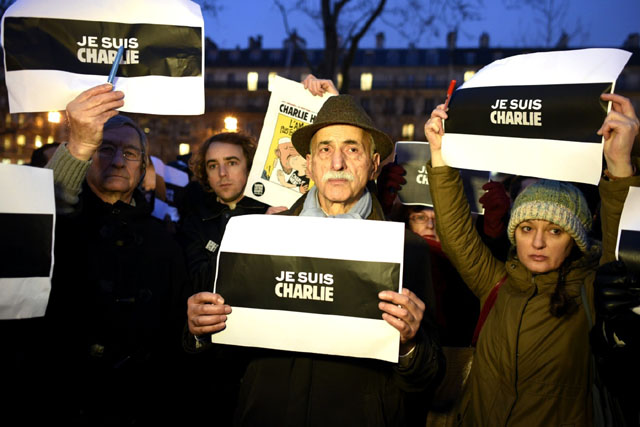
Juan Cole has an interesting take on the Charlie Hebdo terrorist attack: “This horrific murder was not a pious protest against the defamation of a religious icon. It was an attempt to provoke European society into pogroms against French Muslims, at which point al-Qaeda recruitment would suddenly exhibit some successes instead of faltering in the face of lively Beur youth culture (French Arabs playfully call themselves by this anagram).” It is certainly a possibility, but I’m not convinced at this point. It has happened before (as Cole points out) so it is not out of the question. However, this would assume that these men were carrying out an Al-Qaeda strategy rather than being lone wolves. At this point we don’t know enough. Either way, Cole is correct that this event will polarize the French population unless they have the fortitude to follow Cole’s advice: “The only effective response to this manipulative strategy (as Grand Ayatollah Ali Sistani tried to tell the Iraqi Shiites a decade ago) is to resist the impulse to blame an entire group for the actions of a few and to refuse to carry out identity-politics reprisals.” Read his entire essay at:

History News Network | Sharpening Contradictions: Why al-Qaeda attacked Satirists in Paris.

 charlie-hebdo-shooting-4

Pro-Israeli Groups Continue their Assault on Academic Freedom

Chip Gibbons reports that “some pro-Israel groups have now set their sights on a familiar target—Middle Eastern studies departments. A coalition of groups led by the Louis D. Brandeis Center for Human Rights Under Law and the AMCHA Initiative are leading a campaign to end federal funding for college Middle Eastern studies programs unless they adopt means to oversee and police the alleged ideological content of those programs.” If these groups get their way it would set a precedent for imposing ideological agendas by force in higher education. Knowledge does not advance through censorship, but through unfettered debate. If these groups disagree with certain claims about Israel they should engage in scholarly debate. Their agenda also threatens to undermine any hope for peace in the region. If we are to tackle the problem we need to face the situation honestly and JUSTLY. A one-sided perspective in which one group is completely innocent (Israelis) and the other is completely guilty (Palestinians) is not only not true, it will perpetuate the status quo of revenge/counter-revenge in the region.

Congress Under Pressure to Defund University Middle East Programs | Defending Dissent Foundation.

academic freedom

History News Network | Why Now Is the Time to Remember the Thousands of Frenchmen Who Volunteered to Fight for Hitler

The historian Robert Zaretsky makes an interesting comparison between the Frenchmen who volunteered to fight for Hitler during WWII and the Frenchmen who are volunteering to fight for ISIS today. I think it’s a useful reminder that this kind of thing is not new.

Zaretsky writes: “Drawing these parallels between France’s past and present is more than a simple parlor game. Instead, they offer lessons that are both sobering and comforting. From one generation to the next, there will always be those susceptible to the siren call of millenarian movements that offer a heightened sense of purpose, along with the weapons and language to pursue it. Moreover, just as historians rightly underscore the extremely small percentage of Frenchmen who joined the Charlemagne ranks, future historians will no doubt do the same in regard to the French contingent in ISIS. Finally, that the parallels should recall to France, whose large Muslim community already and unfairly serves as a lighting rod for many discontents and disappointments, that Islam is no more responsible for the bloody-minded recruits to ISIS than liberalism was for those who flocked to the colors of the Charlemagne Division seventy years ago.” Read his entire article at:

History News Network | Why Now Is the Time to Remember the Thousands of Frenchmen Who Volunteered to Fight for Hitler.

ISIS flag II

History News Network | Every 30 or 40 Years We See Flagrant Attacks on Free Speech. Here We Go Again.

While the present attack on academics who speak out against Israel is not as egregious as those that happened during the McCarthy Era, they are just as damaging to free speech. The critics are usually denounced as anti-Semitic and under that guise they are discredited as racist. On those grounds those defending Israel feel justified in their efforts to destroy the careers of those academics (the Salaita case is just the most prominent). The problem is that this is to confuse antisemitism with actions of the state of Israel (some may have done so intentionally as a way to shut down opinions that they do not like). One doesn’t have to be an anti-Semite to object to the actions of the state of Israel.  I find antisemitism abhorrent (and I have said so often), but I also find some of the actions of the Israeli government abhorrent as well. And there have been many Jews who have spoken out against the Israeli government on this topic as well. One of the most powerful statements comes from Theodore Bikel, who wrote in the Jewish Journal against “the death of Arab children.” “People see suffering and unless it is Jewish suffering they are silent. How dare they?” We should follow Theodore’s example and take a stand against injustice no matter who is committing it.
The Israeli government does not and should not get a free pass just because of the long history of antisemitism.
The historian Lawrence Davidson points out that attempts to shut down speech is a historical pattern that is unlikely to end. But he believes that we can “minimize the consequences of these repeated assaults” if we “continuously defy them. In other words, only by maintaining a counter-pattern of vigorously defending and using the right of free speech and academic freedom can space be sustained for critical voices. If at any time we fail to sustain this space we risk the possibility of being overwhelmed by a combination of closed-minded ideologues and the mass indifference of the majority.” Please read his article at the HNN:

History News Network | Every 30 or 40 Years We See Flagrant Attacks on Free Speech. Here We Go Again..

See also: “Did Salaita Cross the Line of Civility?” The New York Times

first-amendment

The Reign of ‘Terror’ – NYTimes.com

In today’s The New York Times, Tomis Kapitan very persuasively argues that:

“[b]y effectively placing designated individuals or groups outside the norms of acceptable social and political behavior, the rhetoric of “terror” has had these effects:
1) It erases any incentive the public might have to understand the nature and origins of their grievances so that the possible legitimacy of their demands will not be raised.
2) It deflects attention away from one’s own policies that might have contributed to their grievances.
3) It repudiates any calls for negotiation.
4) It obliterates the distinction between national liberation movements and fringe fanatics (for example, during the 1990s, the “terrorist” label was applied to Nelson Mandela and Timothy McVeigh alike);
5) It paves the way for the use of force by making it easier for a government to exploit the fears of its citizens and ignore objections to the manner in which it responds to terrorist violence.”

I hope that you will all read Kapitan’s article and consider his argument. For too long we have been captive to the rhetoric of terrorism. While it has been an incredibly effective tool for politicians and ideologues, it has hurt our ability to deal effectively with terrorism. Fear mongering dismantles our ability to think rationally. We too easily accept emotionally gratifying solutions that feel right but in reality may not be. Any real solution will not be easy, and it will require that we give up the quick-fix, emotionally gratifying responses that we keep turning to. It will also require humility and a willingness to confront our own role in creating and exacerbating the situation.

The Reign of ‘Terror’ – NYTimes.com.

terrorism