I hope everyone will take the time to watch this TED Talk. Because Zak Ebrahim’s father was a terrorist he has a unique perspective on the subject. But Zak is not just any son of a terrorist, he is a thoughtful and compassionate human being that we could all learn from. His message is one of choosing love and compassion over hatred and revenge. The message is for all of us! Please watch the video!
Ethnic/Religious Conflict
A Beautiful Story from an Unexpected Place: Srebrenica
“Srebrenica is famous for the massacre. But it’s time to move on and make a beautiful, inspiring story.” Ismar Poric, the choirmaster of Suprar
With all the violence in the Middle East and Africa a story from Srebrenica is hopeful. Talk about irony!
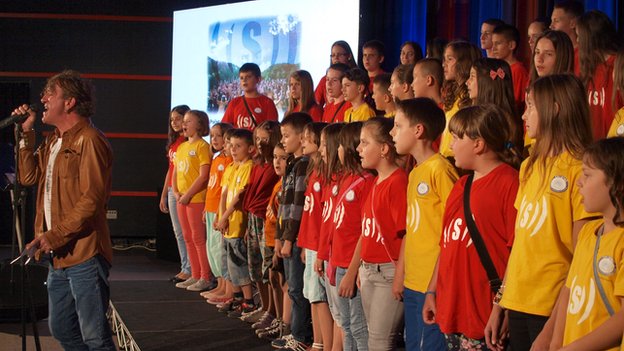
A group of children from Srebrenica (both Bosnian Serbs and Bosniaks) created a song (Love People) to raise money for the recent flood victims. The choirmaster, Ismar Poric, sees this as more than an opportunity to help the flood victims but also as an opportunity to heal the past. “In one way, the country is poisoned by nationalism – but the children are not. Their parents were in the war and told them stories. But we try to bring them together – put different ethnic groups together so they can learn about each other.”
Read the entire story at the BBC (“Srebrenica children seek harmony in music” By Guy De Launey)
Henry Siegman, a Jewish leader speaks honestly about the history of Israel.
They are doing exactly they opposite of what they should be doing if they actually want to protect their citizens. Don’t they remember their own history?
I’m so glad to see a Jewish leader who survived the Holocaust speak out on this issue. Thank you Henry Siegman for speaking out!!
Advice that Israel Should Take But Won’t
Today in The New York Times Mustafa Akyol wrote a great piece of advice for Israel if the Israelis actually wanted to end the terrorism. It’s advice I would have given the Israelis if they had asked (ha ha!).
Israel vs. Palestinians: Will We ever Learn that Revenge Doesn’t Work!
Gavilro Princip: Hero or Terrorist? The Origins of the First World War and the Blame Game
June 28 is Vidovdan (Saint Vitus’ Day), a sacred day for all Serbs. It marks the anniversary of the Battle of Kosovo (1389), when the Serbs were defeated by the Ottoman Turks. This is also the anniversary of the assassination of the Archduke Franz Ferdinand, which kicked off WWI. That these two events share the same anniversary is not accident. The young Gavilro Princip, who shot the Archduke of Austria and his wife Sophie, was a Bosnian Serb and a member of the Serbian nationalist terrorist organization Ujedinjenje ili Smrt (Union or Death also known as the Black Hand). The Austro-Hungarian Empire had recently acquired the Bosnian territories, previously part of the Ottoman Empire, to administer per the Congress of Berlin (1878). But this was an inopportune time to acquire these territories. Nationalism was on the rise and the peoples of these regions desired independence. They didn’t fight to throw off the yoke of the Turks to then gain a new master. The Serbs in the newly independent Serbia were not content with their independence they also wanted their Serbian brothers in Bosnia to have the same freedom that they had. Here’s where the connection between the Battle of Kosovo and the Archduke’s assassination comes in. Ferdinand, knowing full well that June 28 was a sacred day for Serbs, decided to visit Sarajevo on that day anyway. He was already hated as a figure of the Austro-Hungarian Empire but this decision sealed his fate as a target.
It may seem strange that the Battle of Kosovo plays such an important role in Serbian history. But the defeat that marked the beginning of 500 years of oppression (at least in myth) created and cultivated the distinctive Serbian character. As Thomas Emmert explains “the Kosovo ethic…expressed a basic attitude toward life itself: democratic, anti-feudal, with love for justice and social equality.” The myth that grew in the aftermath of the battle, skillfully turned a defeat into a victory. In the most popular version of the myth Czar Lazar, the Serbian prince, choose defeat because he would be rewarded with a heavenly kingdom if he did so, thus making the Serbs a “heavenly” people rather than an “earthly” people.

Slobodan Milosevic in Kosovo
The Massacre at Srebrenica: What Does the Situation Look Like Almost Twenty Years Later?
It had been a long time since I had thought about Srebrenica or the war in Bosnia, so when I saw Scott Anderson’s article in The New York Times Magazine (“Life in the Valley of Death”) this past weekend I was hoping for an optimistic update. I should have known better. It is difficult to heal from such traumatic events. The war in Bosnia had been raging since 1992 and the Bosniak refugees in the so-called UN protected “safe area” of Srebrenica were war weary, homeless, and hungry long before Ratko Mladic and his Bosnian Serb army showed up in July 1995. The massacre of 8,000 men at Srebrenica that followed was the beginning of the end of the Serbian campaign of ethnic cleansing. The elimination of the Muslim island in the Serbian sea opened the way for the peace talks at Dayton, Ohio that November. Continue reading
 History Chick in AZ