 “A memorial wall and a new Holocaust museum reflect a push in the Netherlands to give a more complete understanding of what happened under Nazi occupation.”
Source: Beyond Anne Frank: The Dutch Tell Their Full Holocaust Story – The New York Times
“A memorial wall and a new Holocaust museum reflect a push in the Netherlands to give a more complete understanding of what happened under Nazi occupation.”
Source: Beyond Anne Frank: The Dutch Tell Their Full Holocaust Story – The New York Times

This is an exciting find!
“New discoveries at the archaeological site of Kalkriese in Germany point to where many Roman legionaries were massacred. Sarah Bond and ancient historian Adrian Murdoch explore the discovery.”
Source: Give Me Back My Legions! Discovery of Gold Coins Confirm Battle of Teutoburg Forest Site – Forbes

This gruesome practice has been all too common in human history.


 “The rhetoric of the rapidly growing Alternative for Germany party and its supporters indicates a potentially profound shift in German political culture: it is now possible to be an outspoken nationalist without being associated with—or, for that matter, without having to say anything about—the Nazi past.”
Jan-Werner Muller explains that “the AfD has fed off and in turn encouraged a radical street movement, the “Patriotic Europeans Against the Islamization of the West,” or Pegida, that has no equivalent elsewhere in Europe. And perhaps most important, the AfD’s warnings about the “slow cultural extinction” of Germany that supposedly will result from Chancellor Angela Merkel’s welcoming of more than a million refugees have been echoed by a number of prominent intellectuals. In fact, the conceptual underpinnings for what one AfD ideologue has called “avant-garde conservatism” can be found in the recent work of several mainstream German writers and philosophers. Never since the end of the Nazi era has a right-wing party enjoyed such broad cultural support. ”
This does not bode well for the future of Germany, or Europe as a whole, if things continue in this direction. But I think it is only if another major event (terrorist attack(s), severe economic downturn, another major wave of immigrants, etc.) befalls the German people will these groups be in a position to take power. Still, this is not good! Don’t they remember their own history?
Source: Behind the New German Right by Jan-Werner Müller | NYR Daily | The New York Review of Books
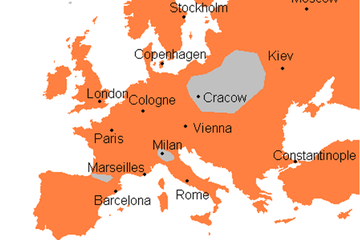
“It spread across Europe in just six years — and wiped out 60 percent of the European population.”
Read the entire article here: The Black Death’s utter destruction of 14th-century Europe, in one scary GIF – Vox

Martha Howell’s review of The Richest Man Who Ever Lived: The Life and Times of Jacob Fugger provides an excellent overview of early capitalism in Europe. If you are interested in the history of capitalism you’ll find this review enjoyable.
Bringing the past to bear on the present, Howell points out a notable fact about capitalism:
“If Fugger was not the “first capitalist,” the story of his life perfectly exemplifies sixteenth-century capitalism and suggests a fundamental truth about many more forms of capitalism, one that was so monstrously embodied by the Dutch East India Company: wealth is won and preserved with the support of a state that is, in turn, dependent on the riches accumulated by the few who excel in commerce. In some periods, at some moments of technological history, the riches are typically extracted from ever more efficient production, invariably aided by ruthless exploitation of human labor and natural resources. In others the wealth comes principally from control of supplies, manipulation of demand, and management of distribution networks. But always the merchants grow rich because state power protects them or looks away when the time is right—and does so because in a world where commerce reigns, neither the state nor a powerful merchant class can exist without the other. We have Steinmetz’s book to thank not just for telling Fugger’s story so well but also for showing us how the partnership between state and commerce worked in the earliest days of European capitalism.”
Read the review here: The Amazing Career of a Pioneer Capitalist by Martha Howell | The New York Review of Books
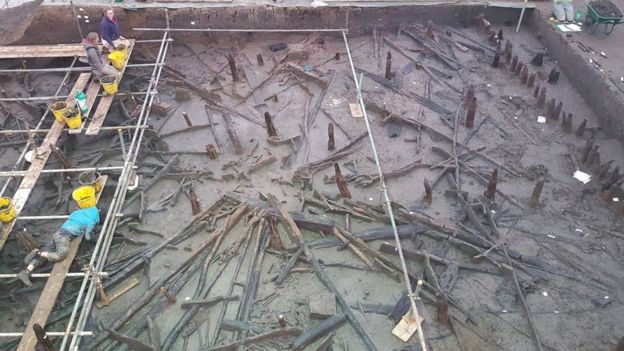
 “Archaeologists in Cambridgeshire uncover Britain’s ‘Pompeii’ with what they describe as the “best-preserved Bronze Age dwellings ever found.'”
Source: Bronze Age houses uncovered in Cambridgeshire are Britain’s ‘Pompeii’ – BBC News

I was tempted to say “duh,” but a closer look at their research shows a much more nuanced finding that would not be obvious from a simple review of the history. What is particularly concerning to me is the fact that our instincts in the face of these crises (not just financial but security threats as well) are wrong. Our response usually makes things worse without solving the real underlying problems. When will we learn, a knee-jerk, fear based response is not the solution!
Source: The political aftermath of financial crises: Going to extremes | VOX, CEPR’s Policy Portal

 “Marine Le Pen’s party capitalises on Paris attacks to win 27-30% of national vote, the highest the party has ever scored in a local election.”
I hate being right sometimes! This was totally predictable. Why do we never learn from history? Do we really need to repeat the twentieth century? Haven’t we learned that radical political leaders peddling hate will only lead us down the path of death and destruction? These supposed “strong” leaders are nothing but bullies!
At this point, I don’t think they (and I include Donald Trump in this) can win. However, if the economy takes a turn for the worse or some other tragic event occurs before the election it is possible.
Source: Front National wins opening round in France’s regional elections | World news | The Guardian
 History Chick in AZ