“Demagogues are only a joke until they win.”
Another interesting take on what Trump’s campaign tells us about ourselves: What Ronald Reagan Teaches Us About Donald Trump | VICE | United States

“Demagogues are only a joke until they win.”
Another interesting take on what Trump’s campaign tells us about ourselves: What Ronald Reagan Teaches Us About Donald Trump | VICE | United States
The historian Timothy Snyder, with his usual insight, challenges us to re-think our assumptions about the Holocaust: “Seeing the Holocaust as an encounter of general anti-Semitism and local statelessness helps us to make sense of the two great geopolitical disasters of our century: the American invasion of Iraq in 2003 and the Russian invasion of Ukraine in 2014. In part because Americans misunderstood the Holocaust as the oppression of a minority by an authoritarian state within its own boundaries, they could believe in 2003 that regime change by force of arms in Iraq would automatically bring positive consequences. By the early 21st century, we had convinced ourselves that the Holocaust was caused by an authoritarian regime acting against a minority within its own borders, which in the main it wasn’t, and that we acted to stop it, which with a few minor exceptions we didn’t. The Holocaust was the mass murder of Jews beyond the borders of prewar Germany, in a zone from which conventional political institutions had been removed, and the Holocaust was largely over by the time Americans soldiers landed on Normandy. American troops liberated none of the major killing sites of the Holocaust, and saw none of the thousands of death pits in the East. The American trials at concentration camps reattributed prewar citizenship to the Jewish victims, helping us overlook that the eliminations of citizenship—usually by the destruction of states of which Jews had been citizens—were what permitted mass murder. A large body of scholarship on ethnic cleansing and genocide concludes that mass killing generally takes place during civil wars or regime changes. Nazi Germany deliberately destroyed states and then steered the consequences toward Jews. Destroying states without such malign intentions creates the space for the kind of disaster that continues to unfold in the Middle East: in its civil wars, religious totalitarianism, and refugee crisis.”
Read his entire essay here: Holocaust history misunderstood: It has provided moral cover for the wars in Iraq and Ukraine.
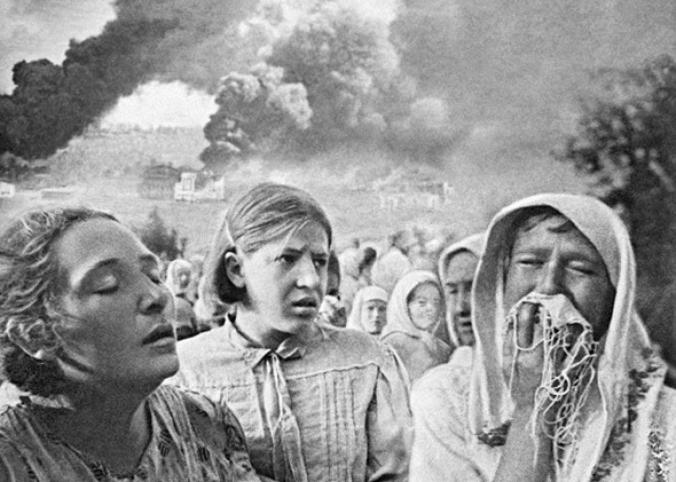
“Russia and Iran are deeply embedded in Syria; they cannot be dislodged and will always remain a player in shaping Syria’s future. The US has little choice but to accept this simple reality.” As much as I hate the idea, I think that Alon Ben-Meir is right. Given the situation, our only option if we want to stop the conflict in Syria and defeat ISIS is to work with Russia and Iran (both of which have substantial interests in the region). What’s the alternative?
Read an overview of Ben-Meir’s solution here: History News Network | These Are the Hard Steps that Must Be Taken to Resolve the Syrian Mess

History News Network | Get Used to It Europe: Homogenous States Are a Thing of the Past

This is an interesting comparison between the Iran nuclear agreement and the North Korean one: History News Network | Here Are One Dozen Reasons Why The Nuclear Agreement with Iran Is Better than the One with North Korea

It’s easy to forget our anti-Catholic past with six Catholic Supreme Court Justices (Alito, Thomas, Scalia, Roberts, Kennedy, and Sotomayor) and a significant Catholic presence (30.7%) in Congress. “But it was not that long ago that word of the impending arrival of a pope on the shores of the United States would have triggered bloody riots and a call to arms. Indeed, for most of this nation’s history Americans saw the Pope as a sinister and dangerous leader who was determined to destroy America’s experiment in republican government,” as Edward T. O’Donnell reminds us.
It’s hard to over state the significance of this change in attitude. But rather than attribute this change to “the strength of religious tolerance in modern American society” in general, as O’Donnell claims. I think it has more to do with demographic changes (thanks to large numbers of Catholic immigrants) and the realization on the part of conservative Protestants that they have a lot in common with Catholics, who have become allies on many issues dear to Protestants. But for whatever reason, the new-found tolerance of Catholics is encouraging for the future of religious liberty.
The history of anti-Catholicism sentiment should remind us that the fears that drive intolerance are usually grounded in falsehoods and prejudices, not reality. Therefore, we should always be skeptical of malicious claims hurled at any group. They are often false. And besides, we should treat individuals as individuals, not as representatives of a particular group.
And as O’Donnell reminds us, “we must not delude ourselves into thinking our work is done on this front [toleration]. For the history of United States makes clear that this tradition of religious tolerance is one that has evolved and expanded over time to include many faiths initially deemed beyond the pale, including not just Catholics but also Jews, Mormons, and Jehovah’s Witnesses. We would do well to keep this in mind as recent immigration continues to expand the nation’s religious diversity. This is especially true in the case is Islam, a religious tradition that polling data reveals many Americans view with fear and hostility not very different from that reserved for Catholics a few generations ago.”
Read the entire article here: The Pope Is Coming to Get Us — At Least That’s What We Used to Think | Edward T. O’Donnell

Some words of wisdom from the preeminent historian Joseph J. Ellis: “once we get past seeing the founders as cartoon-like characters, all kinds of lights go on along the line between then and now. Is the paralysis of the current federal government a function of the political architecture the founders designed, which is now anachronistic, or more a product of our own making? Does our own failure to arrest the catastrophic consequences of climate change help us understand why the most gifted political leaders in American history could not put slavery on the road to extinction? Does our enhanced awareness of the depth and resilience of racism in our own time modify our posture toward its virulence within the founding era? At a historical moment when the term ‘political leadership’ has become an oxymoron, how do you explain its flowering at the founding? Such questions constitute a serious conversation across all ages that is blissfully bereft of nostalgia, condescension and utopian delusions. If the founders were not flawed, they would have nothing to teach us. And they do.”
Read the entire article here: The Founding Fathers: Demigods or scoundrels? – LA Times

“Trump is simply the most visible embodiment of a society that is not merely suspicious of critical thought but disdains it. Trump is the quintessential symbol of the merging of a war-like arrogance, a militant certainty, and as self-absorbed unworldliness in which he is removed from problems of the real world.”
He goes on, “What is clear in this case is that a widespread avoidance of the past has become not only a sign of the appalling lack of historical consciousness in contemporary American culture, but a deliberate political weapon used by the powerful to keep people passive and blind to the truth, if not reduced to a discourse drawn from the empty realm of celebrity culture. This is a discourse in which totalitarian images of the hero, fearless leader, and bold politicians get lost in the affective and ideological registers of what Hannah Arendt once called “the ruin of our categories of thought and standards of judgment.”[5] Of course, there are many factors currently contributing to this production of ignorance and the lobotomizing of individual and collective agency. The forces promoting a deep seated culture of authoritarianism run deep in American society.”
Read Giroux’s thought-provoking essay here: Donald Trump and the Ghosts of Totalitarianism

Too few people are aware of this growing problem, and the problem is not just the fact that adjuncts are an exploited work force. This injustice also has broader implications for the quality of higher education.
Caroline Fredrickson at The Atlantic explains the problem, and uses an interesting analogy with companies like Uber: “With courses that need to be taught every semester led by an interchangeable set of adjuncts, the schools seem to be doing just what trucking companies, housecleaning services, and now app-driven businesses such as Uber and Lyft have been accused of doing: misclassifying workers as contractors. Especially when a teacher is asked to carry out similar responsibilities as full-time permanent staff but for less than half the salary, there may be grounds to believe that universities and colleges are evading their legal obligations as employers. And with the overrepresentation of women in these jobs, it seems possible that many of these universities could be violating not only labor laws but civil-rights laws as well.”
Read the entire article here: There Is No Excuse for How Universities Treat Adjuncts – The Atlantic

 History Chick in AZ