History News Network | Why It’s Time to Remember Waterloo for a Different Reason.
History
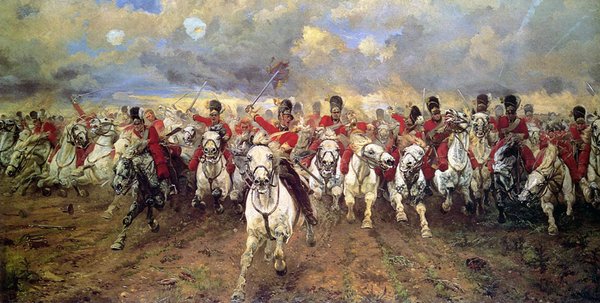
“Just What Exactly Are People Commemorating on the 200th Anniversary of Waterloo?” | History News Network
“Showing Pictures of Muhammad Is Ok” |History News Network
The Forgotten Hero of the American Revolution: The Marquis de Lafayette
Today Americans think of the French as effeminate snobs who are lazy and weak. This caricature was in part inherited from the British, but it has been allowed to flourish in the absence of a historically informed citizenry. This distorted view of the French is unfortunate given the significant role the French played in the American Revolution. And one Frenchman in particular stands out as a forgotten American hero: the Marquis de Lafayette. During his lifetime he was treated like a rock star by grateful Americans, who were very much aware of the key role he played in the American victory. But since then he has faded from historical memory as the complexities of the revolution gave way to a simplified heroic narrative.
At the HNN, Thomas Fleming recalls Lafayette’s valiant heroism at Yorktown: “The Marquis de Lafayette played a crucial role in the final attack. His Americans captured one key redoubt, while French troops captured another one. The allies soon had cannon in the two redoubts, enabling them to fire directly into the rest of the British defense line. Cornwalliis [sic] decided it was time to surrender.” This victory was also made possible by Lafayette’s servant, and former slave, known as James. He infiltrated the British camp pretending to be a runaway, and came away with crucial information that led to the victory at Yorktown.
Read Fleming’s account of Lafayette’s heroism here:
History News Network | How Lafayette’s Arrival on the Hermione Made Yorktown Possible.
“The Renaissance of the Sultans by William Dalrymple” | The New York Review of Books
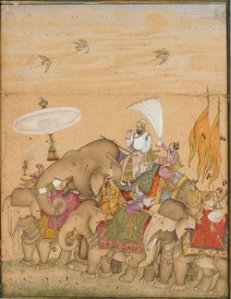
William Dalrymple examines the seventeenth-century Indian ruler, Sultan Ibrahim, and his obsession with art. In many ways his reign ushered in a renaissance,”[b]ringing together Hindu and Muslim traditions in an atmosphere of heterodox learning, and uniting Persians, Africans, and Europeans in a cosmopolitan artistic meritocracy, Ibrahim presided over a freethinking court in which art was a defining passion. For Ibrahim was literally obsessed with the power of art. In his poems he dwells on its ability to bring people together, and on the way that art, and particularly music, acted on the body and was capable of moving an individual to tears, or ecstasy, or a deep melancholic sadness.”
Read Dalrymple’s interesting review of Deborah Hutton and Rebecca Tucker’s The Visual World of Muslim India, and the “Sultans of Deccan India, 1500-1700: Opulence and Fantasy” (exhibition at the Metropolitan Museum of Art, New York City, April 20–July 26, 2015) here:
The Renaissance of the Sultans by William Dalrymple | The New York Review of Books.
“Ten fascinating facts on the 71st anniversary of D-Day” – Yahoo News
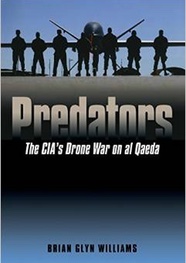
History News Network | Did the Bush Invasion of Iraq “Create” ISIS?
Here’s an excerpt from the essay: “The Iraqi military, which consisted of 385,000 men in the army and 285,000 in the Ministry of Defense, was a much respected institution in Iraq and its disbandment shocked Iraqi society. The tens of thousands of Iraqi soldiers who had taken their weapons home instead of fighting the American invasion felt betrayed when they were fired. This created a recruitment pool of armed, organized and disaffected soldiers. In one fell swoop these Iraqi soldiers lost their careers, their paychecks, their pensions and their source of pride. General Daniel Bolger would claim that de-Baathification ‘guaranteed Sunni outrage.’[6]”
Read Williams’ entire argument here:
History News Network | Did the Bush Invasion of Iraq “Create” ISIS?
The Textbook Wars: An Historical Perspective
History News Network | The Texas Textbook Controversy. It’s Part of a Long, Awful, Tradition.
“Kissinger Memo from 1972: Make the North Vietnamese think Nixon and I are crazy” | History News Network
This is interesting!
“Was Robert Kennedy Really the Dove He and Arthur Schlesinger Jr. Made Him Out to Be During the Cuban Missile Crisis?” | History News Network
This might be of interest to some of you: