“The First Global Terrorists Were Anarchists in the 1890s” – The New York Times

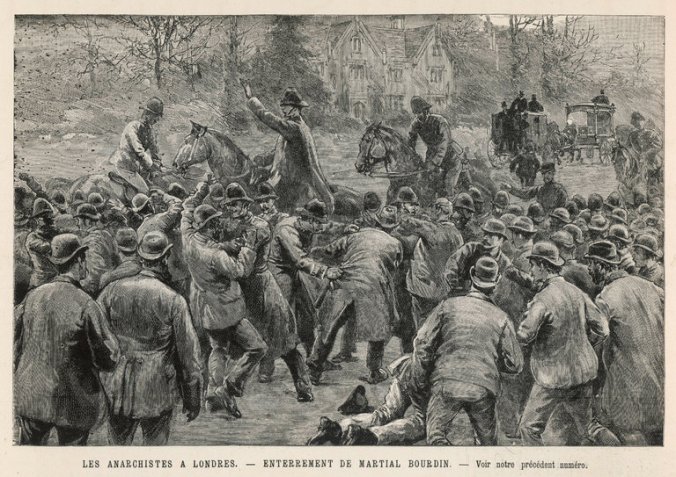
Maya Jasanoff reminds us of the time when anarchists terrorized Europe. The reaction to these acts of terrorism fit a familiar pattern: in response to fear we turn against the Other (immigrants, foreigners, minorities, etc.). The period examined by Jasanoff fits into this pattern, as she notes, “then as now, migrants and civil liberties paid the price.”

While history never repeats itself exactly, there are discernible patterns of human behavior that are instructive and this is one of them. To Jasanoff’s example we could add many others. Unfortunately, the knowledge gleaned from the past is by itself not enough to bring about change. The barrier to making this knowledge useful, as I see it, is also rooted in human behavior. To overcome this barrier we need to turn to psychology.

Here is just a few of the psychological barriers that prevent us from acting rationally:

  • the irrational knee-jerk reaction in the face or fear that prevents us from acting or thinking rationally.
  • the mismatch between the perception of threat and the actual threat. For example, the actual fear of terrorism does not match the slim probability of being killed by an act of terrorism.
  • the tendency to scapegoat those who are different from us even when the evidence clearly doesn’t warrant it.
  • the tendency to reject claims that are contrary to one’s intuition, ideology, or preferred positions, rather than on the basis of reason and evidence.
  • the tendency to seek out evidence that confirms our beliefs and ignoring evidence to the contrary (confirmation bias).
  • our irrational response to cognitive dissonance (the discomfort we feel when we are confronted with two inconsistent beliefs). For example, when an anti-vaxer is confronted with the evidence that are putting kids at risk pits the belief that they are a smart and responsible parent against the claim that they are not.  To reduce the dissonance we could change our behavior or our beliefs, but more often than not we find a way to either ignore the claim or rationalize it away.

And of course, we need an educated population with the skills and desire to do the hard work to have informed opinions.

Read the informative article on anarchists here: The First Global Terrorists Were Anarchists in the 1890s – The New York Times

” Polish leaders threaten fate of nearly finished WWII museum” – Daily Reflector

The Museum of the Second World War may be a casualty of Poland’s rightward turn. Only a Polish-centered museum will do for this nationalist government. This would be unfortunate. As the historian Timothy Snyder points out, “the government’s concept of a museum focusing solely on Westerplatte and Poland’s military struggle in 1939 would result in a narrowly focused exhibit that would not appeal to a wider international audience.”

Read the entire story here: – Daily Reflector

“Top 7 ways Harriet Tubman is the most Badass Spy & Warrior ever to be on US Currency?” By Juan Cole | (Informed Comment)

Juan Cole lists some of Harriet Tubman’s amazing heroic acts. She truly was a “badass”!

Read the entire article here: Top 7 ways Harriet Tubman is the most Badass Spy & Warrior ever to be on US Currency?

Behind the New German Right by Jan-Werner Müller | NYR Daily | The New York Review of Books

“The rhetoric of the rapidly growing Alternative for Germany party and its supporters indicates a potentially profound shift in German political culture: it is now possible to be an outspoken nationalist without being associated with—or, for that matter, without having to say anything about—the Nazi past.”

Jan-Werner Muller explains that “the AfD has fed off and in turn encouraged a radical street movement, the “Patriotic Europeans Against the Islamization of the West,” or Pegida, that has no equivalent elsewhere in Europe. And perhaps most important, the AfD’s warnings about the “slow cultural extinction” of Germany that supposedly will result from Chancellor Angela Merkel’s welcoming of more than a million refugees have been echoed by a number of prominent intellectuals. In fact, the conceptual underpinnings for what one AfD ideologue has called “avant-garde conservatism” can be found in the recent work of several mainstream German writers and philosophers. Never since the end of the Nazi era has a right-wing party enjoyed such broad cultural support. ”

This does not bode well for the future of Germany, or Europe as a whole, if things continue in this direction. But  I think it is only if another major event (terrorist attack(s), severe economic downturn, another major wave of immigrants, etc.) befalls the German people will these groups be in a position to take power. Still, this is not good! Don’t they remember their own history?

Source: Behind the New German Right by Jan-Werner Müller | NYR Daily | The New York Review of Books

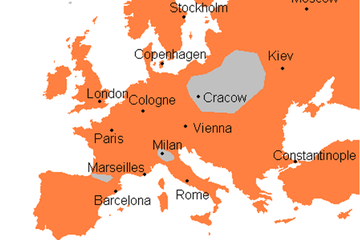
“The Black Death’s utter destruction of 14th-century Europe, in one scary GIF” – Vox

“It spread across Europe in just six years — and wiped out 60 percent of the European population.”

Read the entire article here: The Black Death’s utter destruction of 14th-century Europe, in one scary GIF – Vox

“Balkan Poison, Revisited” by Tim Judah | NYR Daily | The New York Review of Books

The horrific wars that tore Yugoslavia apart offer a window into the dark side of human nature. At a time when ethnic and religious violence has become widespread across the globe, revisiting these wars could prove useful. Just as the UN tribunals for war crimes committed during these Balkan wars wind down Tim Judah, a seasoned war correspondent who frequently reported on these wars, has chosen to reassess their legacy.

Last month (March 24) Radovan Karadzic, one of the Bosnian Serb leaders, was sentenced to forty years in prison for various war crimes and genocide. The UN tribunal has yet to declare a verdict in the case of Ratko Mladic, the leader of the Bosnian Serb army  who led the killing of 7,000 men in Srebrenica.  The biggest fish, Slobodan Milosevic, the former president of the Republic of Serbia who did much to stir up nationalist sentiments and hatred, died while his trial was still underway in March 2006.

Assessing the situation today Judah notes that “so much more could be done by Balkan leaders to address the legacies of these brutal conflicts, which have not yet really become history. Sometimes it looks like they are not capable of or interested in doing so and verdicts like the Karadžić one gave Serbian and Bosniak leaders an opportunity to beat nationalist drums again and remind their voters that they had better vote for them or the enemy would one day be back.” This is exactly the dilemma that perpetuates the violence in never-ending cycles of revenge. And it is not just demagogues who are to blame for this situation. They are only rewarded with power because ordinary people give it to them, because they are enamored with their nationalist rhetoric. They are made to feel special through national myths of past greatness and current innocence. They are not responsible for their present woes, it is “the other” who is responsible. It’s a powerful message. Many are unable, or unwilling, to resist the siren song of nationalism.

Source: Balkan Poison, Revisited by Tim Judah | NYR Daily | The New York Review of Books

“Don’t study history, Lt. Gov. Jenean Hampton tells students”

The Lt. Governor’s comments are short-sighted and ignorant. Students, of course, should choose their careers carefully, but telling students to make that choice based solely on the likelihood of getting a job is irresponsible. The future job market is not always predictable.  The prospects for engineering students may look good at the moment, but by the time the students graduate things may look very different.

Students also need to consider their commitment to a career that they may not like or may not be suited to their talents. I have had many students who have returned to college because they hated their jobs (many of them engineers). They had returned to college to do what they actually loved, even though it meant they would have to live with a significantly smaller pay check. Money isn’t everything.

And just because it is difficult to get an academic job in history at this moment it doesn’t mean that there are no jobs or that the market won’t change. We still need historians. There are also many non-academic jobs for those with history degrees. History majors are often desirable employees because of their analytic skills and their informed perspective on the world.

More importantly, she should be encouraging all students, not just history majors, to study history. We desperately need an educated population!

Source: Don’t study history, Lt. Gov. Jenean Hampton tells students

Who’s Responsible for the Demise of America’s Public Research Universities? – The Atlantic

Jonathan R. Cole accurately calls out the main driver of this “demise”: “The withdrawal of state funds is often one of the direct causes of increased college tuition—not necessarily an increase in faculty size, spending on construction, or administrative costs.”

It is an unfortunate situation that affects all of us. As Cole points out, “A type of delusional thinking seems to convince American policymakers that excellent public colleges and universities can continue to be great without serious investment. As the former Secretary of State and Stanford University provost Condoleezza Rice and Joel Klein, the former New York City schools chancellor, wrote in a Council of Foreign Relations report, higher-education investments are a form of national security at least as important as direct investments in bombers, military drones, missiles, or warships. In other words, these education investments have a very high payoff for states, the nation, and the larger world.”

Read the entire article here: Who’s Responsible for the Demise of America’s Public Research Universities? – The Atlantic

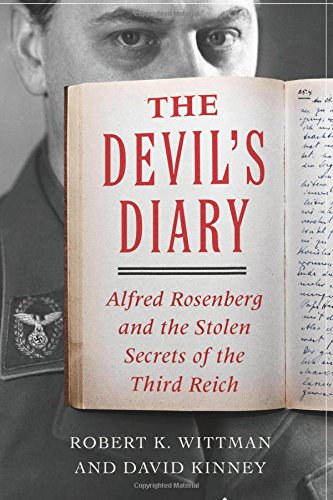
“Tracking an Elusive Diary From Hitler’s Inner Circle” – The New York Times

“A new book, The Devil’s Diary: Alfred Rosenberg and the Stolen Secrets of the Third Reich, reveals how two men uncovered a Nazi artifact.”

I haven’t read the book yet, but it sounds like a great read and all of the Amazon reviews except one gave it 5 stars. It’s on my reading list along with Rosenberg’s actual diary.

Read the brief article on the book here: Tracking an Elusive Diary From Hitler’s Inner Circle – The New York Times

The Devil's Diary Wittman and Kinney

History News Network | The Zionists Censor a Textbook – An Analysis

Lawrence Davidson takes McGraw-Hill to task (and rightly so) for taking “the extreme step of withdrawing from the market a published text, Global Politics: Engaging a Complex World, and then proceeded to destroy all the remaining books held in inventory.” This radical solution was the result of pressure from pro-Israel groups who didn’t like the story that the above map told. If it had been incorrect, McGraw-Hill’s actions might have been warranted, but as Davidson explains the maps are not “historically inaccurate.”

Did the group pressuring the publisher have any legitimate claims? No. In fact, as Davidson points out, their claims were “historically perverse – the sort of grasping at straws that reflects a biased and strained rewriting of history.”

“The sad truth is that the suborning of textbooks addressing culturally sensitive subjects has become a standard practice. Thus, the process of education is indeed threatened by incessant propaganda. This includes the culture war that swirls around American biology textbooks. It also includes the powerful Zionist drive to literally wipe the Palestinians off the map.”

Read Davidson’s detailed explanation of the whole sorry affair: History News Network | The Zionists Censor a Textbook – An Analysis