Read O’Farrell’s entire proposal here: History News Network | Alas, Eleanor Roosevelt Remains All-Too Relevant to Our Politics
The Master of Political Spin: Arthur C. Brooks and “Academia’s Rejection of Diversity” – The New York Times
Arthur C. Brooks, president of the American Enterprise Institute (a conservative think tank), claims that “[m]any academics and intellectuals are biased against conservative viewpoints.” But Brooks’ claim is built on rhetorical trickery.
And it’s important to note that Brooks works for a political think tank that has no interest in diversity in personnel or ideas. The goal of the AEI is not the pursuit of knowledge or truth, but the promotion of their ideology.
Brooks uses the language of liberalism (“diversity” and “open-mindedness”) to portray conservatives as victims of liberal bias. To pull this off, he takes advantage of the progressive affinity for “diversity.” However, it soon becomes clear that Brooks is not talking about diversity of gender, race, sexual orientation, etc., he is referring to the diversity of ideas (something that is very important to academia). This sounds like a good thing, but what Brooks is asking for is the acceptance of certain ideas (his) in the academic world based on something other than merit.
The acquisition of knowledge in the academic world is the result of a brutal competition of ideas. Only those ideas that survive this process are generally accepted as knowledge, and then only provisionally. If new evidence comes in, we must revise what we know. Academia is committed to the pursuit of knowledge (something that AEI is not because they believe they already have the truth). The process has its flaws, but over time it brings us closer to the truth. So if Brooks wants his ideas accepted they have to the same rigorous process that all ideas are subjected to.
So, for example, in my own field of history the conservative claim that the Civil War was over states’ rights because the evidence does not support it. In science, biologists don’t reject creationism (or its newer form ID) because they are biased, but because the evidence doesn’t support it! Climate scientists claim that the climate is changing not because they have a liberal bias, but because the evidence supports this conclusion!
Not all ideas are equally valid! The ideas that become accepted as knowledge win through merit not through appeals to fairness. Open mindedness requires only that the idea be given a fair hearing. If an idea is to be accepted, it must stand up to the rigorous standards of logic and evidence. Truth is not about fairness, although there should be fairness (based on relevant qualifications rather than irrelevant factors such as race, gender, etc.) in who participates.
Source: Academia’s Rejection of Diversity – The New York Times
“Like Prohibition, the fight over guns is about something else” – LA Times
Jonathan Zimmerman puts forward an interesting claim about the fight over guns. He argues that it’s not about guns or “safety,” it’s about “victory.” Just as the prohibition movement wasn’t about drinking, Zimmerman asserts, the same holds true in the current fight over guns. “Even if alcohol prohibition could never make America ‘dry,’ it made its adherents feel as if the country was still theirs.”
While this surely plays a role in the battle over guns, I’m not convinced that it is not really about “safety,” at least for gun control advocates. There have been way too many gun-related deaths.
Read the entire article here: Like Prohibition, the fight over guns is about something else – LA Times
“Grave of ‘Griffin Warrior’ at Pylos Could Be a Gateway to Civilizations” – The New York Times
“A warrior’s tomb full of precious metals and jewels is expected to give insight into the rise of the Mycenaeans, from whom Greek culture developed.” This is very exciting. I can’t wait to find out what they learn from this grave!
Source: Grave of ‘Griffin Warrior’ at Pylos Could Be a Gateway to Civilizations – The New York Times
“Why Tuition-Free College Makes Sense” | History News Network
Read the entire article here: History News Network | Why Tuition-Free College Makes Sense
Professors in Poverty
I’ve lived the life of an adjunct and it’s not fun. The use of adjuncts and full-time temporary faculty (which is what I am) continues to grow as universities and colleges try to save money in the face of ever diminishing public funds. You spent a lot of time and money to get a PhD believing that you’ll make a decent living, but that reality seems to be a thing of the past for most of us! Please watch this brief overview of the reality facing adjunct faculty. This situation isn’t good for anyone!
As part of Campus Equity Week, Brave New Films has released this terrific short film about the very real poverty of many faculty in contingent positions:
Contains some illuminating stats comparing presidential salaries to adjunct wages, and personal stories from adjuncts–mostly women, which reflects the reality that contingent labor issues are also women’s issues. It’s definitely worth watching and sharing this week as we focus on the working conditions of what’s now the majority of faculty.
“The Dangerous Nonsense Ben Carson Is Spreading About Muslims” | History News Network
More nonsense coming from Ben Carson with no apparent concern for the truth or the consequences of his claims. Brian Catlos explains why Carson is wrong at the History News Network.
“In the last few weeks, the radical right of the GOP and its various organs have come upon a new concept to cloak their Islamophobia: taqiyya. As they would tell it, taqiyya permits Muslims to lie and, therefore, it effectively makes every Muslim a potential mole, traitor, or fifth-columnist. As Ben Carson, himself a presidential hopeful, would have it, it is because of taqiyya (and not because of simple bigotry) that he believes – the constitutional ban on religious tests for public office notwithstanding – a Muslim should not be permitted to serve as President of the United States. This is a dangerous and insidious argument: not only does it vilify a whole class of people, it does so in a way that makes them permanently suspect. Any Muslim who denies he is practising taqiyya, it may be presumed, may be practicing taqiyya when he or she does so. Therefore, no Muslim can be trusted, ever.”
It’s unfortunate that this kind of nonsense is what has helped him overtake The Donald (who also has a problematic relationship with the truth) in the polls.
“Before the bubonic plague wrecked Europe, it was way less contagious”
New Research: “They found the DNA of Yersinia pestis bacteria in seven individuals, the oldest of which walked the earth around 2794 B.C. Until now, the earliest known DNA sample of this bacteria dated to the sixth century Plague of Justinian.” Very cool!
Read the entire article here: Before the bubonic plague wrecked Europe, it was way less contagious
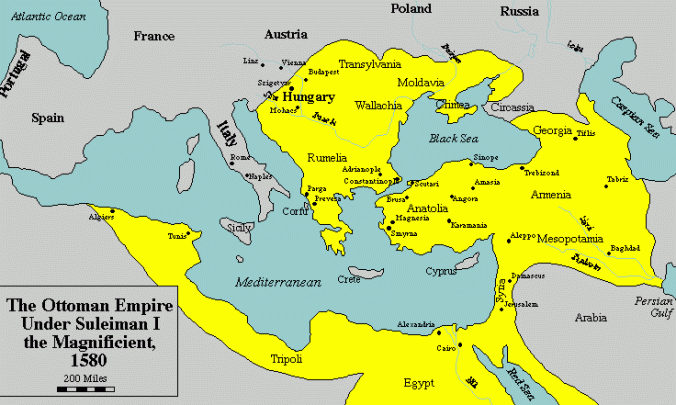
“Ottomans saved Hungarian PM Orban’s Ancestors; now he says Islam never part of Europe” | History News Network
“Hungarian Prime Minister Viktor Orban not only continued to defend his anti-immigrant bigotry but went on to say that Islam has never been part of Europe. Mr. Orban not only is increasing the misery of largely Muslim refugees, but now he has erased 1300 years of European culture and politics, committing a sort of cliocide or mass killing of history.” Juan Cole explains why Orban is wrong: History News Network | Ottomans saved Hungarian PM Orban’s Ancestors; now he says Islam never part of Europe
What’s So Radical about Defending Public Education?
Martin Kich gives a great overview of some of the problems caused by the corporatization of public higher education.
Being antagonistic to corporatization should not necessarily be conflated with being broadly antagonistic to corporations. Universities and corporations have long had mutually beneficial relationships that have caused relatively infrequent controversies. And, just to be clear, although some faculty with more progressive political values have been very skeptical of those relationships between their universities and corporate interests, very, very few faculty have been categorically opposed to the development of such relationships because, for the most part, they have clearly been mutually beneficial.
Corporatization, on the other hand, is the recent manifestation of a historically recurring attempt to redefine public higher education as a business enterprise. In the 1980s, it started with the premise that universities had become such complex institutions, with very large budgets and multifaceted operations, that they would benefit from the adoption of more formal, and perhaps some cutting-edge, business-management practices. American corporations were beginning to respond to post-industrial…
View original post 967 more words