This is interesting!

Kissinger memo 1972
This is interesting!
Kissinger memo 1972
This might be of interest to some of you:

At the HNN, Barry Hankins argues that Baptists are coming to the recognition that they may soon be in the same position as Muslim leaders who “acknowledge that their religious practices are at odds with some facets of American law.” The change that would make Baptists at odds with American law: gay marriage. He fears that if the Supreme Court strikes down the gay marriage bans that exist in some states, then the Baptist belief that marriage is between a man and a women would be under threat. First, he is concerned that the Baptists won’t remember their roots when they were outsiders who were willing to be “fined, horsewhipped, and jailed” for their beliefs. But more importantly he fears that their conception of marriage may be in danger through government intervention.
In an effort to protect marriage as they see it, Hankins explains that the Texas Baptist Christian Life Commission (CLC) has “urged churches to insert in their bylaws a clause specifically defining biblical marriage.” They fear that they may be forced to allow gay weddings to be held in their churches under anti-discrimination laws. To show that this is not wild paranoia, he points to the loss of tax exempt status at Bob Jones University because they refused to accept students who were inter-racially married.
It is doubtful that Hankins’s nightmare scenario will materialize, but it is within the realm of possibility. However, they would only be forced to comply if they were unwilling to give up their tax exempt status. And the loss of this privilege is not unjust, as Chief Justice Warren Burger explained in the Bob Jones case, “to warrant exemption under § 501(c)(3), an institution must fall within a category specified in that section and must demonstrably serve and be in harmony with the public interest. The institution’s purpose must not be so at odds with the common community conscience as to undermine any public benefit that might otherwise be conferred.”
Maybe Hankins, and Baptists in general, should follow the advice of their Baptist colleague, Bruce T. Gourley, who suggested that they reconsider the separationist principles of the Baptist preacher John Leland. While Gourley acknowledges that “the elimination of preferential tax treatment would likely result in weeping and gnashing of teeth among religious groups,” it would allow them “to address politics from the pulpit.” It would also free them from the burdens of tax exempt status. And it would free taxpayers from supporting religious societies that they are not members of. It’s a win, win!
History News Network | The Surprising Thing Baptists and Muslims Have in Common.

Hardly the ideal of chastity, pray, and hard work. But not too surprising.
Sex, Mischief And Witches: Dark Side Of Life Discovered In A Medieval Oxford Nunnery.

Jill Lepore examines the complex history of women’s rights as it played out in the courts from Griswold v. Connecticut (1965), which ruled Connecticut’s law banning contraception was unconstitutional, to the present. Griswold was decided on the basis of a couple’s right to privacy, rather than a woman’s right to determine her own path in life. Lepore argues that this precedent carried forward in later judicial decisions to the detriment of women’s struggle for full equality as citizens. “There is a lesson in the past fifty years of litigation. When the fight for equal rights for women narrowed to a fight for reproductive rights, defended on the ground of privacy, it weakened. But when the fight for gay rights became a fight for same-sex marriage, asserted on the ground of equality, it got stronger and stronger.” Read her entire argument here:
From Griswold v. Connecticut to Gay Marriage – The New Yorker.
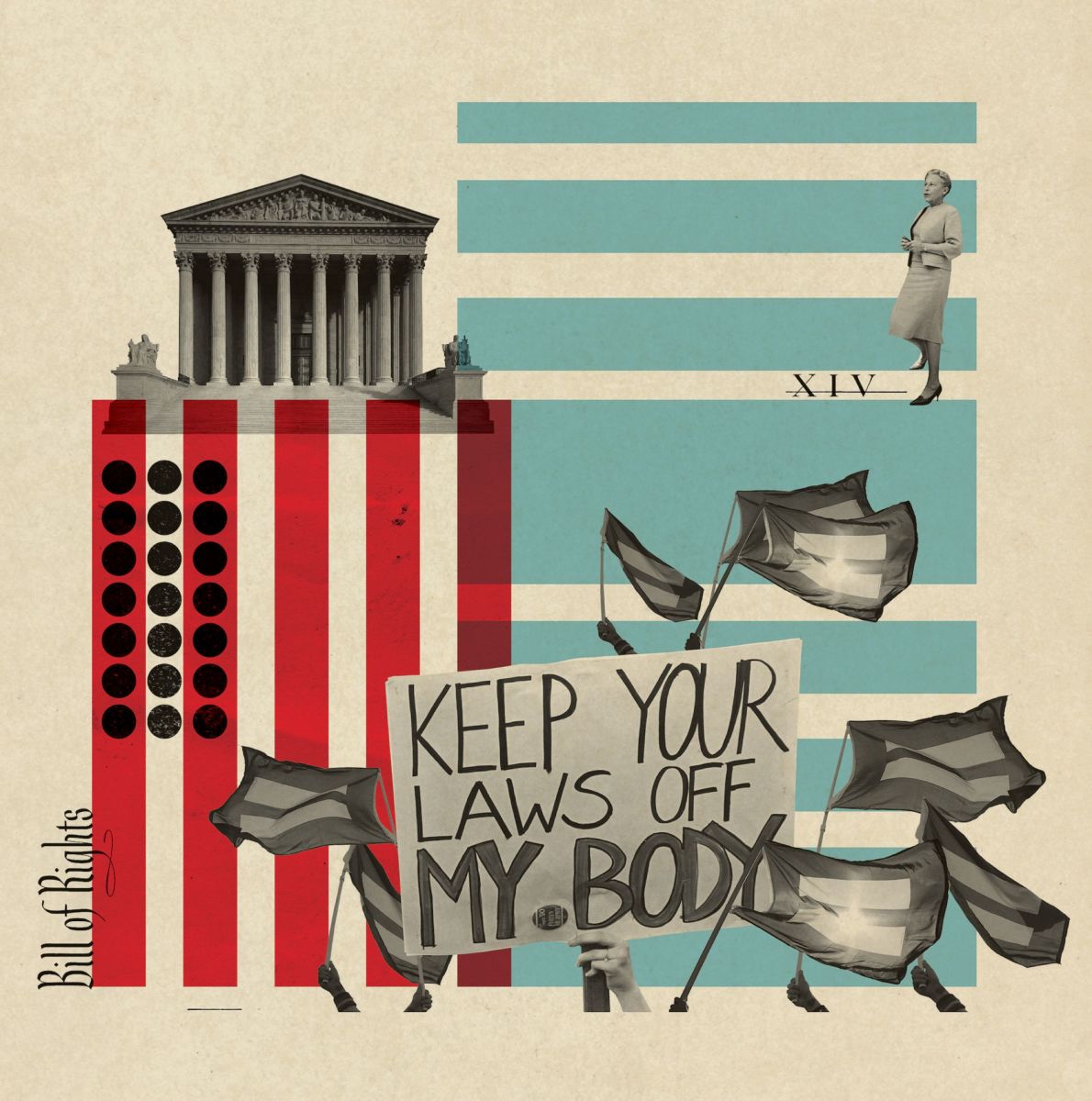
“Illustration by Cristiana Couceiro; Clockwise from Top Right: Lee Lockwood / The LIFE Images Collection / Getty (Griswold); Paul Morigi / Getty Images for HRC and Bill Clark / CQ Roll Call / Getty (Flags); Barbara Alper / Getty (Sign); Purestock / Getty (Supreme Court)”
David Shulman comments on a report released by Breaking the Silence, an organization of Israeli ex-soldiers. The report is the culmination of an investigation of the Israeli campaign in Gaza last summer. Shulman explains that “the findings of the report—including the results of the fighting and the orders that brought them about—are nothing very new. What is more striking is how they suggest the impressive persistence and, indeed, continual intensification of practices that have occurred over the last three or four decades. Significant change lies only in the fact that the acts in question now reflect deliberate and explicit policy of a systemic nature coming down from the top. The Israel army once claimed to hold, nominally at least, to moral considerations of an entirely different order than those officially adopted last summer. Now, even that pretense seems to be gone.” Read more on this report and Shulman’s insightful commentary:
Gaza: Killing Gets Easier by David Shulman | NYRblog | The New York Review of Books.

Many Americans would be shocked to learn about the long history of anti-Catholicism in the United States. The standard narrative of U.S. history is one of religious liberty and toleration. Unfortunately, this is far from the truth. From the beginning, the majority of the U.S. population has been composed of various Protestant sects. Protestantism’s roots were anti-Catholic in origin and the Protestant Reformation kicked off years of violent conflict between the two Christian rivals. This legacy of hatred was inherited by the Protestants that settled in America. Following independence many states banned Catholics from holding public offices out of fear that “Popery and the Inquisition may be established in America.”(1) Anti-Catholic sentiment only grew as Catholic Irish and Italian immigrants flocked to the U.S. during the nineteenth century. One of the more violent outbursts against Catholics came during the Kensington and Southwark Bible Riots in Philadelphia (1844).
Maura Jane Farrelly, in an interesting piece at Aeon, reminds us of that past. Noting the recent change in attitudes towards Catholics, she argues that “Americans no longer consider Catholicism to be a threat because the very idea of ‘freedom’ in the US has changed into something more compatible with the corporate approach to freedom that the Catholic Church has always insisted upon. The Catholic understanding of religious liberty and church-state relations has also changed, becoming more compatible with the US vision and the reality of religious pluralism.”
She also examines the shifting attitudes about the separation of church and state among evangelicals, Catholics, and Muslims. Based on polling, she concludes, “Only 28 per cent of US‑born Muslims think that mosque leaders should refrain from politics, but 60 per cent of Muslim immigrants recently told researchers at Pew that mosque leaders should ‘keep out of political matters’. It’s a directive that suggests Muslim immigrants in the US might be more ‘American’ than some of the Catholics and Protestants voting and campaigning in the US today.”
Given the importance of this topic in light of the increasing anti-Islamic attitudes, I think Farrelly’s review of our anti-Catholic past is apropos. Read her entire essay here.

Kensington Bible Riots 1844
(1) Major Thomas Lusk at the Massachusetts Ratification Convention (February 4, 1788) in The Documentary History of the Ratification of the Constitution, vol. 6, p. 1421.
In 1492 the Jews of Spain were given the choice of converting to Christianity or leaving. Many fled to the Ottoman Empire, where they were welcomed by the Sultan Bayezid II. At the time it was the Muslim world that was tolerant in contrast to Catholic Europe. Now the tables have turned. While the Sephardic Jews in Turkey are not under the same threat they faced in 15th century Spain, they are concerned in the face of a rising antisemitism. According to The New York Times, “[m]any Turks put the blame for the rise in anti-Jewish feelings on the actions of the Israeli government, particularly the killing of civilians during the Gaza war.” This is unfortunate. If anyone should be against generalizing from particular members of a group to the whole, it should be Muslims. It is a mistake to blame the Sephardic Jews in Turkey for what the Israeli government has done. The Israeli government does not represent all Jews or even all Israelis. Many Israelis disagree with the rhetoric and actions of the Israeli government. Similarly, it is a mistake to blame all Muslims for the actions of a few. This type of generalizing has been responsible for so much human suffering throughout human history. Will we ever learn?!
Sephardic Jews Feel Bigotry’s Sting in Turkey and a Pull Back to Spain – NYTimes.com.
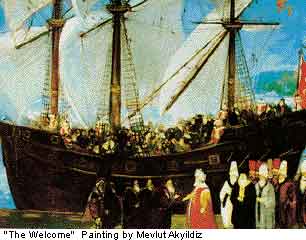
Sultan Bayazid II welcomes Jews expelled from Spain
I think Tony Evers description says it best: Wisconsin is in a “race to the bottom.”
Scott Walker has a plan. It is called “reform,” but in reality it is destruction. He (acting through the legislature) is holding funding for public schools flat (he wanted to cut it); he is increasing funding for charter schools and vouchers; he is imposing draconian budget cuts on the University of Wisconsin system; and he is lowering standards for entry into teaching. One analysis says the voucher expansion proposal would drain $800 million from public schools over a 10-year period.
Tony Evers, the veteran educator who was elected twice as state superintendent of education, says Wisconsin is in a “race to the bottom.”
Wisconsin has decided to reform its teacher licensing standards—by eliminating them! Anyone with any bachlor’s degree can teach any subject, a change inserted into the state budget without hearings.
Even those without a bachelor’s degree are eligible to teach, as Valerie Strauss notes: “That’s not all. The…
View original post 891 more words
This is an interesting interview with the Chinese artist and filmmaker Hu Jie. He has spent his life trying to preserve the memory of what happened in Maoist China through his art. Here’s an excerpt from the interview that is in reference to the picture below:
“You also did a series called “We.” Some of these pictures are more hopeful. This one shows a child looking up.
It shows a street that Party leaders’ cars would drive down. Everyone has a bowed head but one child is looking up. In fact, I think all my work has hope in it. There is always someone who is not accepting the official story.”

Hu Jie: We #3, 2015


 History Chick in AZ