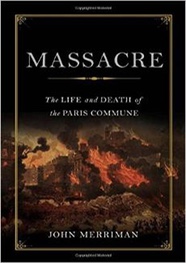
Book Review: Ron Briley’s Review of John Merriman’s “Massacre: The Life and Death of the Paris Commune” HNN

The history of the Paris Commune is little known in the United States, but this history is not only riveting it has important lessons to offer. In 1871 the working class of Paris seized control of the government in Paris. However, the short-lived rule of the Communards ended with the massacre of approximately 15,000 to 20,000 by the French army. John Merriman recounts this tragedy in Massacre: The Life and Death of the Paris Commune. In his review of this book, Ron Briley sees this book as “provid[ing] an opportunity for contemporary readers to revisit the Commune and consider its legacy—for global capitalism has failed to provide the ending of history and dawning of a new age of prosperity following the collapse of the Soviet Union.” Read the entire review here:

History News Network | Review of John Merriman’s “Massacre: The Life and Death of the Paris Commune”

Massacre Paris Commune

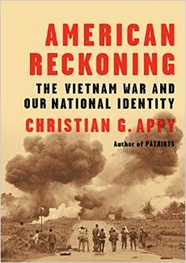
Book Review: Ron Briley Reviews Christian G. Appy’s “American Reckoning: The Vietnam War and Our National Identity” HNN

In his review of Appy’s book, Ron Briley concludes that it “is a provocative read and presents a convincing argument regarding the Vietnam War as exposing the myth of American innocence. Yet, the concept of American exceptionalism continues to exercise a strong hold upon the nation’s belief system, and the fiftieth anniversary of the Vietnam War may not provide the national reckoning so passionately called for by Appy.” Read the entire review here:

History News Network | Review of Christian G. Appy’s “American Reckoning: The Vietnam War and Our National Identity”

American Reckoning

The Revenge of History: Dealing with Historical Memory

In today’s The New York Times Roger Cohen wrote a thoughtful piece on memory and forgetting (“The Presence of the Past”). Given the role that the manipulation of historical memory has played in past and present violence this article brings up a topic that deserves more attention, especially as nationalism is on the rise. Despite the importance of this topic, it is rarely publicly discussed. Part of the problem is the complexity of the subject, not to mention that it calls into question the cherished identities of many. But if we’re going to stave off the violence that is the product of certain kinds of historical memory we must discuss it.

History is a double-edged sword, as Cohen points out: “History illuminates. It can also blind.” History is illuminating when it is confronted honestly and in all its complexity. It is blinding when it is used to serve ideological or political ends.  This is where historical memory comes in. “History” is often abused in the service of ideology or political power.

Continue reading

“Jewish Soldiers Battled Nazi Germany” | History News Network

Alan Singer  reminds us that we need to remember the times when the Jews rose up to defend themselves. The most well-known case is the Warsaw Ghetto Uprising. But Singer thinks we need to also remember the 500,000 Russian Jewish soldiers who fought in WWII against the Nazis. Read the entire article here:

History News Network | Jewish Soldiers Battled Nazi Germany.

Warsaw Ghetto Uprising

Warsaw Ghetto Uprising

“The American Military Uncontained” | History News Network

The retired lieutenant colonel (USAF) William J. Astore examines the current role of the U.S. military from the perspective of the 1990s, after we emerged victorious from the Cold War. Rather than gearing down for peacetime Astore shows that the military retained it Cold War size and attitude. But crucially, according to Astore, it also became uncontained as the sole superpower. He argues that after the fall of the Soviet Union the attitude that emerged was one of “go[ing] for broke.” After laying out the consequences of this situation, he warns, “No military should ever be trusted and no military should ever be left uncontained.  Our nation’s founders knew this lesson.  Five-star general Dwight D. Eisenhower took pains in his farewell address in 1961 to remind us of it again.  How did we as a people come to forget it?  WTF, America?”
I agree with much of what Astore says, but I see the transition to the present situation a little differently. He makes no differentiation between the humanitarian efforts (or non-efforts to be more accurate) in places like Bosnia, Somalia, and Rwanda in the 1990s, and the so-called “national security” interests in places like Iraq, Afghanistan, Iraq, Pakistan, and Yemen in the twenty-first century.
“Yet even as civilian leaders hankered to flex America’s military muscle in unpromising places like Bosnia and Somalia in the 1990s, and Afghanistan, Iraq, Libya, Pakistan, and Yemen in this century, the military itself has remained remarkably mired in Cold War thinking.”
I think it is a mistake to see this trend beginning in the 1990s. We did NOT “go all in” for the 1990s humanitarian situations. In fact, trying to persuade the Bush (papa) administration and then the Clinton administration to do anything in these situations was like pulling teeth. We only intervened belatedly in the Bosnian War with very little cost or effort after thousands of Bosnian Muslims (Bosniaks) were slaughtered. We did successfully intervene in Kosovo, but mostly out of guilt for what we didn’t do in Bosnia. We shamefully did nothing in Rwanda. And we pulled out of Somalia, where we were engaged in humanitarian aid, after the first sign of trouble (Black Hawk Down), which played right into the hands of the Somalian warlords. So, I think it is misleading to include Madeleine Albright’s plea to send in troops to the former Yugoslavia as evidence of the “all in” attitude in regards to the military. In all these cases, those in power did everything they could to make sure we didn’t use the military. Why? Because these were humanitarian causes and the “Vietnam Syndrome” was still alive and well. These were the cases we should have intervened, but didn’t. So much for “never again”!
The hawks that Astore refers to care little for humanitarian interventions and were happy to intervene in what they saw as “national security” situations (e.g. The Gulf War). But I think it was something else that turned the tide toward the intervention everywhere attitude: 9/11. Presently the fear of terrorism ensures that this attitude will continue to prevail.
However, I agree with his conclusion “Take an uncontained, mutating military, sprinkle it with unconditional love and plenty of dough, and you have a recipe for disaster.” Read the entire article here:

History News Network | The American Military Uncontained.

rice.cheney.bush.rumsfeld

“Open Letter in Support of Historians in Japan Signed by Hundreds Including John Dower and Herbert Bix” | History News Network

I’m happy to see this open letter from historians in support of the historians in Japan who are committed to confronting the past honestly. Because, as they conclude: “The process of acknowledging past wrongs strengthens a democratic society and fosters cooperation among nations. Since the equal rights and dignity of women lie at the core of the “comfort women” issue, its resolution would be a historic step toward the equality of women and men in Japan, East Asia and the world. In our classrooms, students from Japan, Korea, China and elsewhere discuss these difficult issues with mutual respect and probity. Their generation will live with the record of the past that we bequeath them. To help them build a world free of sexual violence and human trafficking, and to promote peace and friendship in Asia, we must leave as full and unbiased an accounting of past wrongs as possible.”

Please read the entire letter here:

History News Network | Open Letter in Support of Historians in Japan Signed by Hundreds Including John Dower and Herbert Bix.

Robert G. Fresson, The New York Times

Robert G. Fresson, The New York Times

“New Documentary on Nazi Propaganda Films to Debut” |History News Network

Many of the propaganda films produced by the Nazis have never been shown in the U.S. or Europe over fears that they may incite hatred, particularly against Jews. But a new documentary (Forbidden Fruit: The Hidden Legacy of Nazi Film), which opens today in N.Y., takes excerpts from the forty films that had been considered too offensive to show publicly and compiles them into one film. The director, Felix Moeller, is unsure about the consequences of the film. He wonders, “Are they nothing but historical documents at this point or still effective ideological messages?”

I think this documentary will be of interest to many, but rather than hatred, I hope this documentary prompts us to reflect on our own susceptibility as human beings to hate other who are different from us. It’s easy to criticize the Germans for being duped by Nazi propaganda, but must remember that we have the same vulnerabilities and that we could just as easily be duped. The same human dynamics that played out in Nazi Germany continue to fuel hatred and violence all across the globe. If we are to learn anything from this period of history, we should be skeptical of claims that inspire us to hate others. We should be wary of negative stereotypes and dubious claims that vilify others. If some one or some group asks us to hate, we should say “no”!

Read Bruce Chadwick’s review of the film here:

History News Network | New Documentary on Nazi Propaganda Films to Debut.

nazi-germany

“The History Wars in Ukraine Are Heating Up” |History News Network

What happened to the Ukraine that wanted to look West? The Ukrainian parliament just passed legislation regulating historical truth.  The first law (“On Condemning the Communist and National Socialist (Nazi) Totalitarian Regimes and Prohibiting the Propagation of their Symbols) outlaws “the public denial, particularly in the mass media, of the criminal nature of the Communist totalitarian regime of 1917-1991 in Ukraine and the National-Socialist regime”as well as Soviet and Nazi symbols.

The second law (“On the Legal Status and Honoring of the Memory of the Fighters for the Independence of Ukraine in the 20th Century”) bans publicly insulting those who fought for Ukrainian independence as well as questioning the legitimacy of the struggle for independence. The law justifies these restrictions by claiming that they “insult[] the dignity of the Ukrainian people.” As Christopher Gilley and Per Anders Rudling point out that there is no punishment included in the legislation.
Gilley and Rudling explain the contradictions and possible consequences of this legislation here:

History News Network | The History Wars in Ukraine Are Heating Up.

Ukrainian Independence Day Parade

Ukrainian Independence Day Parade

“Talking Honestly About Islamic Hate Speech” | History News Network

The debate between the “religion is the culprit” camp and the “circumstances” camp continues. As I’ve said before I don’t think it’s an either/or problem. Particular circumstances drive people toward certain kinds of beliefs. Or, to put it another way, certain circumstances, such as lack of opportunity, perceived or real oppression, etc., make certain ideas appealing. This does not mean that those who take up those beliefs do not hold them wholeheartedly. For example, the post-war conditions in Germany made Nazi ideology appealing. Without the Great Depression, the Nazis may have remained a fringe group.

But unfortunately the current debate over Islamic terrorism is driven by the it’s either religion or its circumstances narrative. Those putting forward the circumstances are rightly concerned that some will blame all Muslims if we attribute the violence to religion. But the solution to this problem is not to ignore the evidence that those associated with terrorist organizations like ISIS are not motivated by a particular interpretation of Islam (one that most Muslims reject!). Instead we must make it clear that it is wrong to indict an entire group of people based on the actions of a few of them.

At the History News Network, Timothy R. Furnish describes the polemics between these two camps at a recent conference (“Apocalyptic Hopes, Millennial Dreams and Global Jihad”). In doing so, he gave some great advice on how to deal with the problem of the eschatological thinking characteristic of the current Islamic terrorist groups. He argues that “modern attempts to de-fang apocalyptic groups (overt ones like ISIS; quasi-eschatological ones like Syria’s Jabhat al-Nusrah) need to emulate the Ottoman example: that is, actually employ Islamic religious texts (Qur’an, hadiths, scholarly works) to undermine eschatological jihadists (as I first called for in August 2014). Simply labeling them “non-Muslim” will not do the trick.” Read the entire article here:

History News Network | Talking Honestly About Islamic Hate Speech.

mohammed and jesus

Ideological Thinking: The Scourge of Humanity

Reflecting on the years he spent in conflict zones all over the globe, John F. Burns declared, “What those years bred in me, more than anything else, was an abiding revulsion for ideology, in all its guises. From Soviet Russia to Mao’s China, from the Afghanistan ruled by the Taliban to the repression of apartheid-era South Africa, I learned that there is no limit to the lunacy, malice and suffering that can plague any society with a ruling ideology, and no perfidy that cannot be justified by manipulating the precepts of a Mao or a Marx, a Prophet Muhammad or a Kim Il-sung.” Many of us who have studied ethnic/religious conflict have come to the same conclusion.

But the lesson goes beyond the violent and oppressive regimes encountered by Burns. As Walter G. Moss notes in his article on this topic (“Why Learning from History Means Saying No to Rigid Ideologies” HNN), “the growth of a rigid U.S. political conservativism” has been harmful as well, even if less deadly.

If ideologies are so destructive, can we eradicate them? Moss believes that we don’t need to completely reject “all isms or embracing an unprincipled opportunism. We can, for example, prefer conservatism or liberalism in our approach to politics, as long as we let our individual values and judgments and not some party platform (see, e.g., here for that of the tea party) determine our political decisions.” I agree, but this still leaves the problem of persuading individuals to let go of their cherished world views.

Ideologies are so pervasive because they are comforting and often intoxicating. They give us meaning, certainties, identities, and a sense of self-worth. The best weapon against ideological thinking is education with a healthy dose of the humanities. The study of history in particular could potentially inculcate students against the temptations of ideologies. If students learn how to critically evaluate evidence, make analytic comparisons, and learn to appreciate complexities and ambiguities they will be less likely to fall for the distorted views of ideologies. And any exposure to the long train of human misery caused by ideological rigidity might make them think twice before they fall under the spell of any ideology. I don’t believe that we’ll ever completely eradicate ideological thinking, but we must try to at least limit its appeal.

For now, we as individuals must take responsibility for our own beliefs, and the behaviors that flow from those beliefs. And here Moss’s advice is apt: “Political wisdom requires a proper mix of idealism and realism and other virtues or values such as the love, kindness, and humility mentioned by Pope Francis, as well as compassion, empathy, tolerance, a sense of humor, creativity, temperance, self-discipline, passion, courage, and prudence. The trick is finding the proper combination of such values to apply to any concrete, unique political situation in order to further the common good.”

The Things I Carried Back – NYTimes.com.
Rituals For the Perpetuation of False Ideologies

“Rituals For the Perpetuation of False Ideologies” by Jeremy Eskin at http://eskinfineart.blogspot.com/