The Goals of the Islamic State: Hijrah, al-Haramayn and Hegemony |History News Network

A historian of Islamic history, Timothy R. Furnish, explains the goals of ISIS:

“Long-term, ISIS—as many breathlessly have reported—aspires to not just ruling all the Islamic portions of the Middle East, Europe and South/Central Asia, but Rome and points further west, including the United States.  This may be a hookah-dream, but considering that the ideology—if not quite all the brutal activity—of ISIS has solid grounding in Salafism, both its Wahhabi and Deobandi (South Asian) versions, it’s something that should be taken seriously by non-Muslims.

It is the medium-term goals of ISIS that should most concern us.  I submit that these primarily are two-fold:  1) to goad us—that is, the United States—into inserting ground troops into, particularly, Syria, as a means of fulfilling the hadith about the great apocalyptic battle  near Dabiq; and 2) to take over Saudi Arabia, or at least to cause such regional instability that Riyadh’s regime fractures, and ISIS Toyotas ride triumphantly into al-Haramayn, the “two holy places” of Mecca and Medina.” Read his entire article at:

History News Network | The Goals of the Islamic State: Hijrah, al-Haramayn and Hegemony.
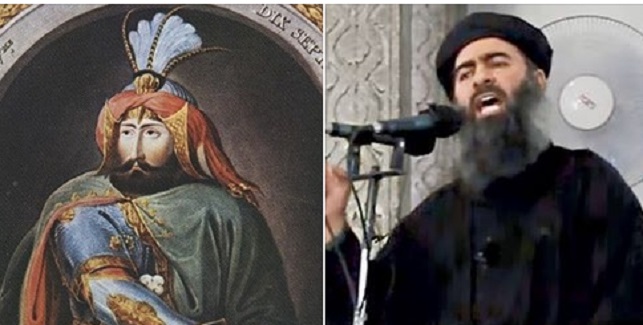
Sultan Murad IV (seventeenth century) and al Baghadadi

Sultan Murad IV (seventeenth century) and al Baghadadi

History News Network | Bombing Iran: What Would Happen If the Hawks Got Their Way?

Hopefully, even the hawks would not be so stupid as to pursue the policy of bombing Iran! Besides the fact that bombing doesn’t work, Juan Cole points out, “Leaving behind a relatively stable Afghanistan, forestalling a second march of Taliban into Kabul, and ousting ISIL from Sunni Iraq and trying to put the country back together are stated US military and foreign policy goals. They are profoundly imperiled by an Iran strike.” Read the full article at:

History News Network | Bombing Iran: What Would Happen If the Hawks Got Their Way?

US-war-syria bombing campaign

One Standard, Not Two, for Christianity and Islam – The American Interest

Obama’s refusal to call ISIS (or ISIL) a radical Islamic organization has sparked a debate over the relationship between religion and violence. The controversy escalated after he reminded Americans of Christianity’s violent past at the recent national prayer breakfast. Much of the outrage over his comments was motivated by the belief that Obama had fabricated the claims and insulted Christianity. At the same time many in this camp also believe that Islam is responsible for the violent behavior of ISIS. To them Christianity is the good religion and Islam is the bad one. This opinion is grounded in bias rather than evidence and we can safely dismiss it. That leaves us with the two contradictory views presented by Obama: 1) religion has no relationship to ISIS, or 2) religion, at least in part, is responsible for the violent behavior of Christians in medieval and early modern Europe as well as ISIS in the Middle East today. In the above cited essay, the historian Jeffrey Herf argues that both are culpable in the same way. Different traditions and selective use of sacred texts result in different behaviors and versions of the same religion. As Herf points out,

“Western governments have tied themselves in knots to the point of foolishness because they refuse to state what is obvious to many millions of people about the importance not of the religion of Islam per se but of interpretations of Islam in this era of terror. Just as it makes no historical sense to discuss slavery or the Holocaust without examining Christianity’s contributions, so it is ridiculous to assert that the Islamic State, the Hamas Covenant, the fanaticism of the Iranian mullahs, al-Qaeda, Hezbollah, and the Muslim Brotherhood have nothing to do with Islam. It amounts to saying that its adherents either do not mean what they say or that they don’t know what they are doing. Both assumptions are condescending. To be sure, these varieties of Islamism differ from one another, but they all engage in the labors of selective tradition. They did not invent the texts that they quote but they have selected and emphasized some rather than other components of the tradition. They can all point to passages in the Koran and in the commentaries about it that in their view justify attacks on the Jews, on Muslims of whom they disapprove, on Christians and on other assorted ‘infidels.’”(“One Standard, Not Two, for Christianity and Islam”)

the crusades

Continue reading

History News Network | Letter to My Friends: Why We Can’t Expect to Win a Religious War in the Middle East

William R. Polk’s great advice at the HNN that we unfortunately won’t follow:

“Adding up these points, I argue that the more they are attacked, the stronger the salafis become.  Even if we kill their leadership, cut off their supplies of arms and food and overwhelm their followers, we cannot destroy their movement.  I believe that the history of religious movements proves two things:

The first it that, religious wars are never “won.” That is the “bad news.”

Second, the “good news” is that even violent, radical, ugly religious movements “mature.”  That is, they are forced by their followers and even by some of their leaders to become “civilized.”  This is a process, slow to be sure, we can see in all radical movements.

Thus, what we need to do, in my opinion, is to ease our pressure to enable internal changes — those that are beneficial to them and to us — to take place.

Admittedly that is a long-time strategy.  It is far less popular than attacking:  most people love war, soldiers like to win glory and promotion and arms dealers want to sell their goods.  So our leaders may not have the strength or the courage to try a long-term strategy, but I think it is far and away the most likely to accomplish our objectives.”

Please read his entire post at:

History News Network | Letter to My Friends: Why We Can’t Expect to Win a Religious War in the Middle East.

isis flag

History News Network | Foreign Policy: Can’t Anybody Play this Game Better?

William R. Polk argues for a different kind of foreign policy: “The bottom line is avoiding aggression.  Of course, we must defend ourselves.  But, as recent history makes clear, defense and aggression often are hard to distinguish.  What is defense to one is often aggression to the other.  Mutual respect and mutual forbearance should be our objective.  This is not, as Mrs. Thatcher would have said, to “go wobbly,” to appease,  to pussyfoot or to be just weak-willed liberals.  It may be a matter of life or death and certainly can help us avoid catastrophes.   But, we should realize that adopting a strategy of avoiding conflict will often be difficult.  Public angers are far easier to whip up than to dispel.  Demagogues multiply like rabbits and sometimes we follow them like lemmings.  All the polls tell us how ignorant we are as a people.  And, looking around us,  we must ask ourselves where we can find today the wise leaders we need to guide our actions.  I confess that I cannot identify them.” I agree with Polk’s conclusion even though I come to it from a different historical perspective. Polk’s article is long but worth reading. We need to abandon our short-sighted, knee-jerk, punitive approach to foreign policy.

History News Network | Foreign Policy: Can’t Anybody Play this Game Better?.

terrorism