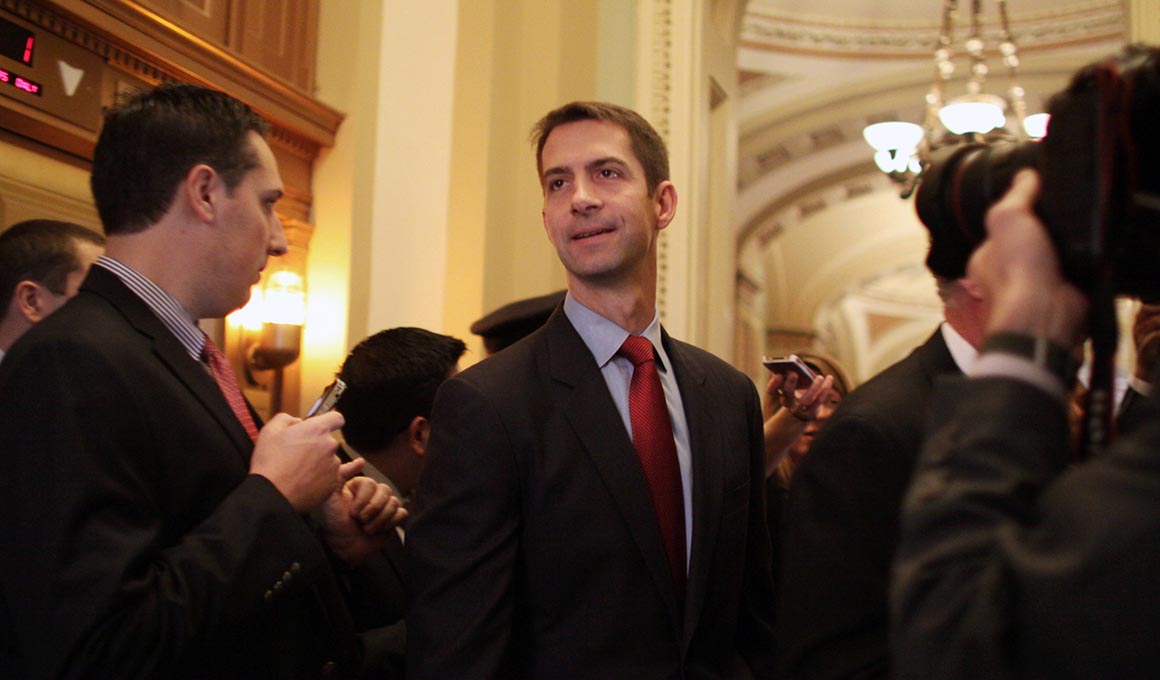
The historian Mark Byrnes warns against the “unconditional surrender” mentality that has taken hold on the right: “Like the uncompromising Tea Party Congressional caucus does with domestic issues, Cotton seems to think that in diplomacy, any kind of compromise with an adversary, anything less than total victory, is abject failure. As I’ve written before, this attitude is dangerous enough when it shuts down the U.S. government or blocks meaningful action in Congress. When it is brought to bear on the world stage, it can be catastrophic.” Read his entire article:
Uncategorized
A Deadly Assault on Academic Freedom | Geoffrey R. Stone
This is becoming all too common! The Board of Governors’ recent decision to close the University of North Carolina Law School’s Center on Poverty, Work and Opportunity is only the most recent attempt to undermine the academic freedom that is so vital to our progress as a nation. This is something that we should all be concerned about. As the law professor Geoffrey R. Stone writes: “What we are seeing now in North Carolina is an ugly resurgence of an attempt by political elements outside the university to censor, discipline, and punish those inside the university who take positions that annoy, offend, or disturb them. This is unconscionable.” Read the full article here:
One Standard, Not Two, for Christianity and Islam – The American Interest
Obama’s refusal to call ISIS (or ISIL) a radical Islamic organization has sparked a debate over the relationship between religion and violence. The controversy escalated after he reminded Americans of Christianity’s violent past at the recent national prayer breakfast. Much of the outrage over his comments was motivated by the belief that Obama had fabricated the claims and insulted Christianity. At the same time many in this camp also believe that Islam is responsible for the violent behavior of ISIS. To them Christianity is the good religion and Islam is the bad one. This opinion is grounded in bias rather than evidence and we can safely dismiss it. That leaves us with the two contradictory views presented by Obama: 1) religion has no relationship to ISIS, or 2) religion, at least in part, is responsible for the violent behavior of Christians in medieval and early modern Europe as well as ISIS in the Middle East today. In the above cited essay, the historian Jeffrey Herf argues that both are culpable in the same way. Different traditions and selective use of sacred texts result in different behaviors and versions of the same religion. As Herf points out,
“Western governments have tied themselves in knots to the point of foolishness because they refuse to state what is obvious to many millions of people about the importance not of the religion of Islam per se but of interpretations of Islam in this era of terror. Just as it makes no historical sense to discuss slavery or the Holocaust without examining Christianity’s contributions, so it is ridiculous to assert that the Islamic State, the Hamas Covenant, the fanaticism of the Iranian mullahs, al-Qaeda, Hezbollah, and the Muslim Brotherhood have nothing to do with Islam. It amounts to saying that its adherents either do not mean what they say or that they don’t know what they are doing. Both assumptions are condescending. To be sure, these varieties of Islamism differ from one another, but they all engage in the labors of selective tradition. They did not invent the texts that they quote but they have selected and emphasized some rather than other components of the tradition. They can all point to passages in the Koran and in the commentaries about it that in their view justify attacks on the Jews, on Muslims of whom they disapprove, on Christians and on other assorted ‘infidels.’”(“One Standard, Not Two, for Christianity and Islam”)
What’s the purpose of education in the 21st century? – The Washington Post
Governor Scott Walker’s attempt to change the mission statement of the University of Wisconsin by replacing “search for truth” and “improve the human condition” with “meet the state’s workforce needs” has provoked a backlash. Many Republicans like Walker see higher education solely in terms of job training. This narrow and myopic view of education has gained traction recently and has made colleges and universities the target of increased criticism. There has already been some pressure on institutions of higher education to conform to this model, but for the most part the traditional model has prevailed, as it should. If the narrow, worker model of education triumphs we will all lose. To advocate for a broader intellectual education does not mean that we cannot also prepare students for the workforce. As Arthur H. Camins notes “it doesn’t have to be either-or.” Instead, he argues, “[e]ducation should prepare young people for life, work and citizenship.” Read Camins’ defense of higher education at:
What’s the purpose of education in the 21st century? – The Washington Post.
2014 in review
The WordPress.com stats helper monkeys prepared a 2014 annual report for this blog.
Here’s an excerpt:
A San Francisco cable car holds 60 people. This blog was viewed about 2,100 times in 2014. If it were a cable car, it would take about 35 trips to carry that many people.
Freedom of Religion Shouldn’t Be Unconditional
We are likely to see another bill like this brought up in the AZ legislature next year. This time it may pass because our new governor Doug Ducey is likely to sign the bill rather than veto it as Jan Brewer did.
While I agree with Rabbi Miller I disagree with his characterization of these laws as laws for religious freedom. The right to the free exercise of religion does not include the right to violate the rights of others. I will be writing more about this in a future post on the disestablishment of religion in the early republic.
The varieties of denialism
Massimo Pigliucci writes about what he learned at an interdisciplinary conference on denialism. I highly recommend reading this blog post because, as Massimo points out, “denialism in its various forms is a pernicious social phenomenon, with potentially catastrophic consequences for our society.”
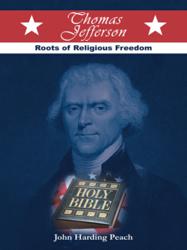
Book Review (Part I): Thomas Jefferson: Roots of Religious Freedom by John Harding Peach Was Jefferson a Christian?
In Thomas Jefferson: Roots of Religious Freedom, John Harding Peach claims that Thomas Jefferson was a Protestant Christian whose vision of religious liberty was grounded in his passionate desire to protect religion. Peach can perhaps defend this misleading portrayal of Jefferson under the guise that it is “a biographical novel,” but given that he also insists that “all historical events and places were provided as they factually occurred” (xii) this excuse is not credible. He may wish Jefferson was the person that he presents in his “novel” but he cannot honestly claim that Jefferson was that person. Unfortunately, his followers, who, no doubt, also want to believe that Jefferson was the Christian in Peach’s narrative, will uncritically accept his version of events. These distortions of history are not innocent ventures; they are part of a larger movement intent on re-writing history to support their claim that the United States is a Christian nation.
The wannabe historian David Barton has been at the forefront of this movement. His book (The Jefferson Lies) is the latest in a series of books dedicated to the goal of making this a Christian nation. But Jefferson’s well-known “infidelism” doesn’t fit this narrative, so rather than ignore the writer of the Declaration of Independence Barton and others have decided to remake Jefferson into a devout Christian. This is not an easy task and the only way to achieve it is through deception, dishonesty, and willful ignorance. In fact, Barton’s book is so egregiously dishonest that it was discontinued by his publisher after a group of conservative historians exposed it as misleading and “unsupportable.”1 Unlike Barton, Peach may not have gone as far as Barton, but it is still a dishonest and misleading portrayal of Jefferson. In his desire to see Jefferson as an upstanding Christian, Peach has cherry-picked, distorted, and misinterpreted the evidence.
Peach’s “novel” begins with Jefferson’s education with his childhood teacher the Rev. James Maury, who Peach claims “lit his fire,” (1) and ends with Jefferson’s death in 1826. The book highlights events in Jefferson’s life, large and small, which serve to present Jefferson as “practice[ing] his core conviction of basic Protestantism.” (xiii) This book review will challenge Peach’s portrayal of Jefferson. This post will be dedicated to Jefferson’s religious beliefs in general before turning to the Declaration of Independence and Jefferson’s views on religious liberty in future posts.
History News Network | Historians Should Honor Protesting Colorado Students
Students in Colorado protested against the conservative school board’s attempt to impose an ideologically driven U.S. history on students. One of the conservative school board members, Julie Williams, complained that the current Advanced Placement curriculum emphasized “race, gender, class, ethnicity, grievance and American-bashing.” In a History New Network article, Peter Dreier, the chair of the Urban & Environmental Policy Department, at Occidental College, is calling on “The American Historical Association (AHA) and the Organization of American Historians (OAH) should honor these students for standing up to their school board’s effort to distort U.S. history around a blatantly political agenda.”
History News Network | Historians Should Honor Protesting Colorado Students.
see also this Associated Press article on the Colorado student protest.
Facts & Figures: Don’t Know Much About Government – NYTimes.com
Unfortunate but not surprising!
Facts & Figures: Don’t Know Much About Government – NYTimes.com.