“Harvard Business School’s Case-Study Method Is Inspiring History Education Reform” – The Atlantic

“One professor is borrowing a method from Harvard Business School to teach students about America’s past and inspire better judgment for the future.”

Using the case method to teach history, as David Moss is doing at Harvard, is a creative way to engage students. But it’s not as revolutionary as this article makes it out to be. History teachers have used similar methods to engage students for a long time.

Good history teachers are always engaged in the delicate balancing act between content and skills. Unfortunately, the current testing craze has forced many k-12 educators to focus almost exclusively on content, which means teaching by rote memorization. This is unfortunate because what we really need are students who can think critically and who are passionate about learning.

Source: Harvard Business School’s Case-Study Method Is Inspiring History Education Reform – The Atlantic

David Barton: “Still Misleading America About Thomas Jefferson” | History News Network

The historian John Fea argues that “[b]y defending Thomas Jefferson, David Barton has dishonored their [the founders of the American Bible Society’s] memory.”

“Ironically, the same Thomas Jefferson that admired the Enlightenment views of Voltaire, Hume, Gibbon, and Paine, and served as the primary target for the men who built the American Bible Society, is now celebrated by David Barton, the nation’s most influential Christian nationalist. Barton is a GOP political activist who uses the past to advance his conservative agenda in the present.”

Source: History News Network | Still Misleading America About Thomas Jefferson

“This Is When Your Politicians Have Lied About History” | History News Network

This chart created by Allen Mikaelian (posted on his blog, Flat Hill) is really cool (and useful)! Have fun!

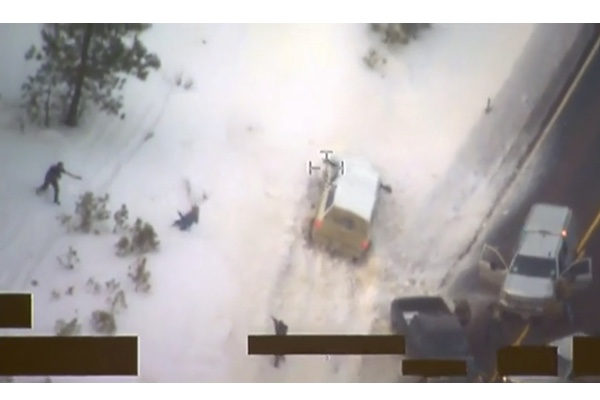
“Ammon Bundy’s Wrongheaded History of Militias Is Getting People Killed” | History News Network

Thomas A. Reinstein reviews the history of militias starting with their roots in Medieval England through the American tradition to the present. In conclusion, he explains:”Ammon Bundy and his men wish to claim their place as heirs to the militia tradition. They see themselves as defending a free society against an oppressive federal government. What they fail to understand is that in American legal tradition, militias are placed under government control. Even the most ardent Anti-Federalist would have had little problem with the notion of state authorities placing strict regulations on their respective militias. Their principal objection was against the idea of the federal government creating a standing army more powerful than state militias. Viewed through this lens, Bundy’s “Citizens for Constitutional Freedom,” along with their 1990s forebears, are merely paramilitary bands. Referring to them as anything else is a gross misinterpretation of history.”

Source: History News Network | Ammon Bundy’s Wrongheaded History of Militias Is Getting People Killed

“Revolution from Another Angle by Jamey Gambrell” | NYR Daily | The New York Review of Books

“The serendipitous confluence of technology, art, and politics in the fields of photography and film is the subject of the Jewish Museum in New York’s current exhibition, “The Power of Pictures: Early Soviet Photography, Early Soviet Film.” In his catalogue essay, the Russian art historian Alexander Lavrentiev, grandson of the artists Varvara Stepanova and Alexander Rodchenko, gives a nuanced view of the complex situation in which Soviet photography developed: photography was dominated by three groups or tendencies, whose aesthetics mirrored, to some extent, the spectrum of political factions on the post-Soviet cultural stage. None of these groups opposed the Revolution, however; initially, in fact, most artists and the intelligentsia supported the regime.”

“The Power of Pictures: Early Soviet Photography, Early Soviet Film,” is on view at the Jewish Museum in New York through February 7.

Source: Revolution from Another Angle by Jamey Gambrell | NYR Daily | The New York Review of Books

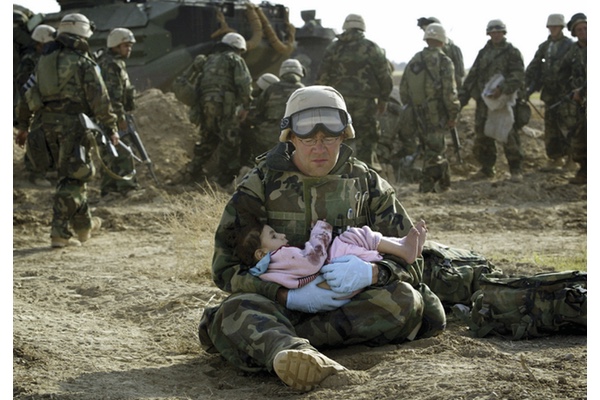
“Does Even the New York Times Glamorize Modern Armed Conflict?” | History News Network

Rarely does a book come around that so profoundly confronts us with what should be obvious and as a result challenges us to rethink the status quo. But this is what David Shield’s new book (War is Beautiful: The New York Times Pictorial Guide to the Glamour of Armed Conflict) has done. He has examined front page photos of war in The New York Times from 1991 to 2013. What he found were romanticized versions of war that were strikingly beautiful. In the photos, he notes,  “[t]here’s no war there. There’s no attempt to document reality. It’s basically the war as screen saver, as wallpaper—a very distant aesthetic experience. Certainly, part of that is not to show the American dead except in a posture of composed relief. It seems the grief is kept out of frame in any true sense of agony or viscera or blood.”

While Shield is correct to call The New York Times out for its responsibility for glamorizing war, I think we all bear some responsibility. We don’t want to see the horror. We don’t want to think about the consequences of war. It is much easier to ignore it and carry on as usual. Shield is doing a great service by shocking all of us out of our comfort zones.

I highly recommend reading Robin Lindley’s interview with Shield: History News Network | Does Even the New York Times Glamorize Modern Armed Conflict?

“The history of the world, as you’ve never seen it before” – The Washington Post

Some of you may find this interesting. This is a really unique way to look at history. The charts make it easy see the overlapping life spans of some historical figures.

Source: The history of the world, as you’ve never seen it before – The Washington Post

Blackburn archaeological survey: Bodies of 800 young children found – BBC News

“The bodies of 800 children aged under six are among the remains of nearly 2,000 people unearthed ahead of the construction of a road in Lancashire.”

“Dave Henderson, an expert in the study of bones with Headland Archaeology, said full analysis of the skeletons had ‘barely started’ but the team believed most of the children had died from infections in the lungs and guts.”

Source: Blackburn archaeological survey: Bodies of 800 young children found – BBC News

“Why Most Everyone Gets Munich Wrong” | History News Network

The “Munich lesson” that we should never appease evil has to be one of the most pervasive and incorrect lessons of history. In this HNN post, John Kelly explains why the lesson is wrong. And as John Kelly points out, “millions of Americans who know nothing about the Munich Conference or the Sudetenland know that evil appeased is evil emboldened because American presidents have evoked the Munich lesson to justify almost every U. S. military action since 1945.”

The lesson is flawed in both its understanding of the events in Munich and in its application to events that bear no resemblance to the unique circumstances of 1938 Nazi Germany. As Kelly explains: “It is a fantasy to imagine that, had Churchill rather than Chamberlain been sitting across the table at Munich, Hitler would have been deterred. Unafraid of war and boundlessly ambitious, Hitler was that most dangerous of leaders, a man who could neither be appeased nor deterred by threats of force.”

It will take more than one article to debunk the “appeasement” foreign policy reasoning, but its a start. We historians need to call out this kind of abuse of history, especially when a misguided history lesson is driving us to make bad foreign policy choices.

Read Kelly’s entire article here: History News Network | Why Most Everyone Gets Munich Wrong